
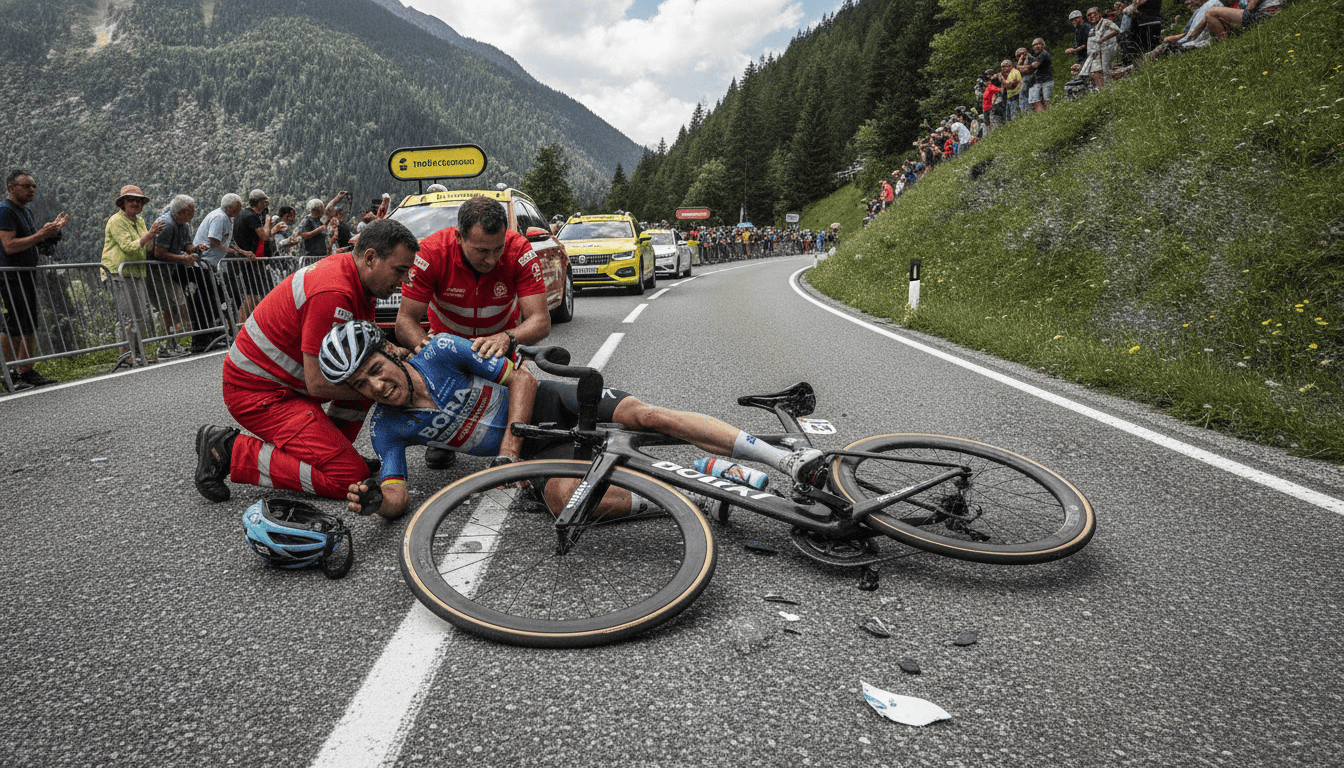
Florian Lipowitz crashes in Tour time trial, breaks collarbone and sees title hopes end
Florian Lipowitz crashes in Tour de France time trial, breaks collarbone and sees his campaign end; team duel with Remco Evenepoel and future options reviewed.
Florian Lipowitz was forced out of contention after a high-speed crash in the stage 16 individual time trial, suffering a broken collarbone that ended his bid at the Tour de France. The 25-year-old German hit a right-hand bend too fast, lost control and tumbled off his bike, bringing a dramatic end to weeks of intense preparation. The injury compounds the disappointment of a campaign in which Lipowitz arrived with promise but left without the victory he and his team had hoped for.
Crash details from the stage 16 time trial
Race footage and team reports indicate Lipowitz clipped the apex of a right-hand corner while riding at racing speed and subsequently lost balance. The impact fractured his clavicle, a common but serious injury that typically requires weeks of recovery and can force immediate withdrawal. Team staff and medical personnel tended to him at the scene before he was taken from the course, ending his participation in the three-week race.
Medical assessment and sporting consequences
A broken collarbone effectively removes a rider from the general classification battle and many of the remaining stage objectives in a Grand Tour. Beyond the physical break, Lipowitz faces the immediate loss of race rhythm and the psychological toll that follows a high-profile crash. The lengthy build-up and sacrifices required to contest the Tour make such an abrupt exit particularly painful for a rider whose form had been carefully managed.
Red Bull-Bora-hansgrohe’s internal hierarchy after the time trial
The time trial also crystallized a wider story inside Red Bull-Bora-hansgrohe: a team duel between co-captains that ultimately tilted in favor of Remco Evenepoel. Evenepoel’s strength on the time-trialling sections and his climbing form left Lipowitz operating increasingly in a support role late in stages. With Evenepoel asserting himself, the team’s leadership balance became clearer, and Lipowitz’s crash removed any remaining uncertainty about who would carry the squad’s ambitions forward in this edition.
Lipowitz’s results and where the Tour fits in his résumé
On paper, Lipowitz has assembled solid results but remains in search of a breakthrough at the sport’s highest level. His record includes podium finishes and a notable overall victory at the Slovenia Tour, but wins on WorldTour stages or Grand Tours have so far eluded him. The Tour de France has been both his stage and his measuring stick; this year’s outcome leaves him without the headline victory that could have reshaped his trajectory.
Contract status and strategic options after withdrawal
Lipowitz signed a contract extension with his team before this season, but the path forward will depend on how he recovers and what role the squad envisions next year. With Evenepoel continuing to display leader qualities, Lipowitz faces choices about whether to pursue co-leadership roles in races like the Giro d’Italia or Vuelta a España or to refocus on stage hunting and one-week events. Team management must weigh commercial ambitions, global exposure and rider development when setting priorities after such an abrupt end to a Tour campaign.
Recovery timeline and potential next steps for his career
A fractured clavicle usually requires a period of immobilization followed by physiotherapy and a carefully staged return to training, but timelines vary with severity and treatment approach. Lipowitz and his medical team will map out a rehabilitation plan that balances a safe recovery with a realistic return to competition in the months ahead. How he responds over the winter and spring will determine whether he aims again at the Tour or redirects his season toward other Grand Tours where leadership opportunities may be more attainable.
Florian Lipowitz leaves the race with a fracture and a host of questions about his immediate role within Red Bull-Bora-hansgrohe and his broader career plan. The experience is likely to be both a physical setback and a moment of reflection for the 25-year-old. If he can convert the lessons from this campaign into targeted preparation and recovery, the crash may become a turning point rather than an endpoint.
