
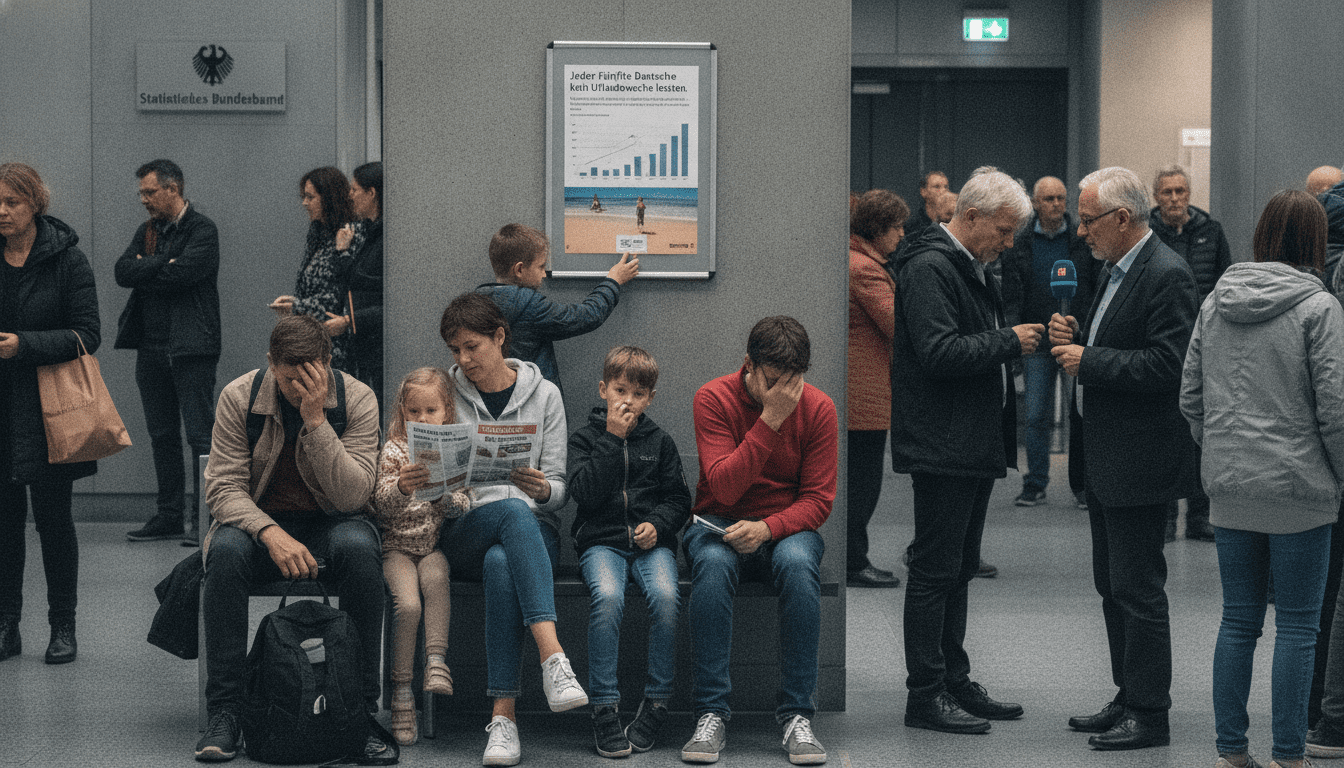
One in five Germans cannot afford a one-week holiday, federal data show
About 21% of Germans said they cannot afford a one-week holiday in 2025, with singles and single parents most affected, Eurostat-based data reveal nationwide.
Germany’s Federal Statistical Office reports that roughly one in five people in the country lived in households that said they did not have enough money for a one-week holiday in 2025, highlighting persistent gaps in leisure affordability. The survey results, based on European income and living conditions data, show pronounced differences by household type and by income group. Officials and analysts say the figures underline how disposable income and family composition shape access to basic leisure activities.
Breakdown by household type shows singles and single parents most exposed
The Federal Statistical Office found that 29% of people living alone reported they could not afford a week’s holiday, while the share was even higher at 39% for those in single-parent households. These groups, the agency noted, face particular budgetary constraints that limit discretionary spending on travel and short breaks. The results point to structural cost pressures for households without pooled incomes or economies of scale.
Income quintiles reveal steep affordability gradient
Affordability rises with income but remains strained at lower levels, the office said. Nearly half (48%) of the lowest-income quintile — defined by a net equivalised income ceiling near €1,600 — reported being unable to finance a one-week holiday. Even in the next quintile, with net equivalised incomes between roughly €1,600 and €2,100, 28% said a week away was unaffordable, indicating that modest increases in income do not immediately translate into leisure affordability.
Germany compared with the European Union average
The German figure of 21% sits below the EU average of 28% reported by the statistics agency, but marked disparities exist across member states. According to the same Eurostat-based dataset, Romania recorded the highest share of people unable to afford a week’s holiday at 61%, followed by Greece at 47% and Bulgaria and Hungary at 39%. At the other end of the spectrum, Luxembourg (11%), Sweden (12%) and the Netherlands (13%) reported the lowest shares of residents unable to cover such a short trip.
Methodology: projections and survey basis
The results cited by the Federal Statistical Office derive from the European Union’s Statistics on Income and Living Conditions (EU-SILC). The agency noted that the 2025 estimates are projections based on survey responses collected in 2022, adjusted to recent conditions. Comparisons with earlier years show some fluctuation: the office reported that the share in 2024 matched the 2025 estimate, while the share in 2023 stood at about 23%.
Regional and social implications highlighted by statisticians
Analysts and social statisticians say the findings reflect both income distribution and household structure, with policy relevance for social protection and family support programs. Limited ability to afford modest leisure can signal broader deficits in disposable income and financial resilience among affected groups. Observers argue that ensuring equitable access to basic leisure could require targeted measures for low-income households and single-parent families.
Questions for policymakers and the tourism sector
The data raise questions for welfare policy and the tourism industry about how to respond to demand constraints driven by affordability. Policymakers may consider whether benefit structures, targeted subsidies or tax measures could improve discretionary spending capacity for the most affected households. Tourism operators and local governments might also look to design lower-cost, accessible offers aimed at households with constrained budgets.
The Federal Statistical Office and Eurostat data underscore that affordability of even short holidays remains uneven across Europe and within Germany, driven primarily by income and household composition. The figures provide a snapshot that policymakers, social researchers and industry stakeholders can use to assess the reach of leisure inequality and to consider responses that broaden access to basic travel and recreation.
