
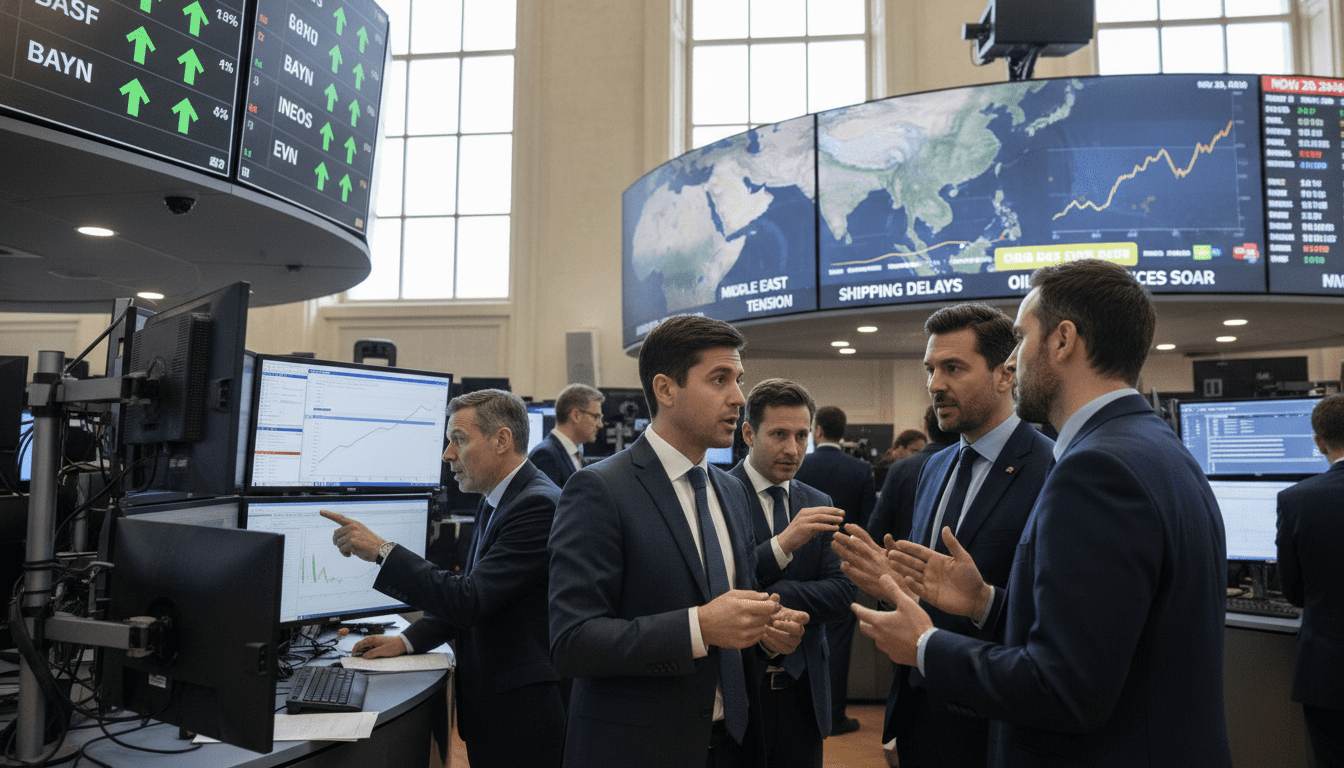
European chemical industry gains from supply shocks as prices rise and local producers benefit
European chemical industry gains as Strait of Hormuz disruptions and Asia force-majeure filings raise prices, benefiting companies with secure local supply.
The European chemical industry is experiencing a short-term boost as disruptions linked to the Strait of Hormuz and a surge in force-majeure declarations across Asia push prices higher and favor suppliers with local output. Major producers such as BASF, Lanxess and Evonik have announced broad price increases and reported stronger order trends since March. Companies and trade bodies warn, however, that the uplift may be temporary and that longer-term risks to demand and employment remain.
BASF and peers signal price increases
BASF and several specialty chemical makers have issued successive price notifications this spring, citing rising raw-material costs tied to the crisis in the Persian Gulf. Announcements include increases of up to 25% for plastic additives, up to 30% for standard amines and roughly 20% for pharmaceutical auxiliaries. Executives say these measures are intended to pass through wartime-related cost inflation to customers.
Producers report that this pricing stance has so far been accepted by parts of the market, helping margins in the near term. Company leaders also caution that these steps reflect a volatile environment and are not a substitute for stable, long-term demand.
Import patterns and the Strait of Hormuz impact
Industry chiefs have linked improving order books to reduced import pressure from China and constrained flows through the Strait of Hormuz. BASF’s chief executive noted a decline in import volumes from China since early March, while warning that imports from other regions, notably the United States, are rising. Analysts say reopening shipping lanes would not instantly restore normal trade; supply chains could require several months—up to six—to re-stabilize.
The logistical bottleneck has produced visible congestion at key choke points and elevated transport costs, amplifying already higher oil and gas prices. Those energy-driven expense increases feed into chemical production costs and have knock-on effects across European manufacturing.
Local production gives German firms a competitive edge
German specialty groups say their ability to deliver product where others cannot is a current competitive advantage. Lanxess reported firmer demand and said its delivery capability has translated into a modest positive momentum since March. Evonik expects an especially strong second quarter on the back of tightened supplies and some buyers accelerating purchases to refill inventories.
Companies that operate steam crackers and upstream feedstock facilities in Europe, and that make intermediate products domestically, are better positioned to capture displaced volumes. But executives and analysts emphasize this edge depends on the duration of the disruption and on whether European producers can maintain access to feedstocks and staff needed to ramp output.
Force majeure filings spread across Asia
Trade associations and companies report a wave of force-majeure notifications moving from the Gulf region into East and Southeast Asia. These declarations, used when external shocks prevent contractual delivery, have proliferated in a matter of days and affected a wide range of commodities. Industry sources describe the current surge as the largest since the outset of the Ukraine war.
Leaders of chemical distributors and traders say their own supply to customers remains intact but that they have adjusted sourcing and risk management to respond to the volatility. The rapid proliferation of force-majeure events has intensified short-term scarcity for certain widely traded base chemicals.
Certain bulk chemicals cannot be replaced quickly
While some mass polymers such as polyethylene and polypropylene can be substituted by European production to an extent, trade bodies warn that key industrial inputs are much harder to replace. Large-volume imports like cyclohexane, glycols, melamines and various amines are sourced globally in quantities beyond immediate local replacement. The industry expects these imported intermediates to become both costlier and, in some cases, scarce if disruptions persist.
The complexity of value chains means impacts vary sharply by product. For example, butadiene—used to make synthetic rubber for tires and seals—has tightened as steamcracker output in China, Korea and Singapore fell, benefiting producers that still manufacture it in Europe.
Capacity constraints and limits to reshoring
Despite pockets of unused or activatable capacity in Europe, practical limits hinder a broad production shift. Companies cite shortages of raw materials, skilled personnel and regulatory or permitting barriers that slow rapid expansions. The chemical sector has also already shed capacity and jobs in recent years, which constrains flexibility in a suddenly tighter market.
Since 2022, Europe has reduced roughly 37 million tonnes of chemicals capacity, equal to about nine percent of regional output, and the industry has cut around 40,000 jobs. Trade association leaders stress that any current sales uptick must be weighed against a fragile demand outlook and structural challenges for scaling production.
The recent market adjustments have prompted many firms to strengthen risk controls, adjust inventories and reroute sourcing where possible. These measures have so far allowed some suppliers to convert disruption into short-term opportunity, but executives warn that sustained higher energy costs and declining consumer purchasing power would quickly undermine gains.
The sector faces a balancing act: capitalize on transient advantages from disrupted trade while preparing for weaker downstream demand and the need for resilient, longer-term supply solutions.
