
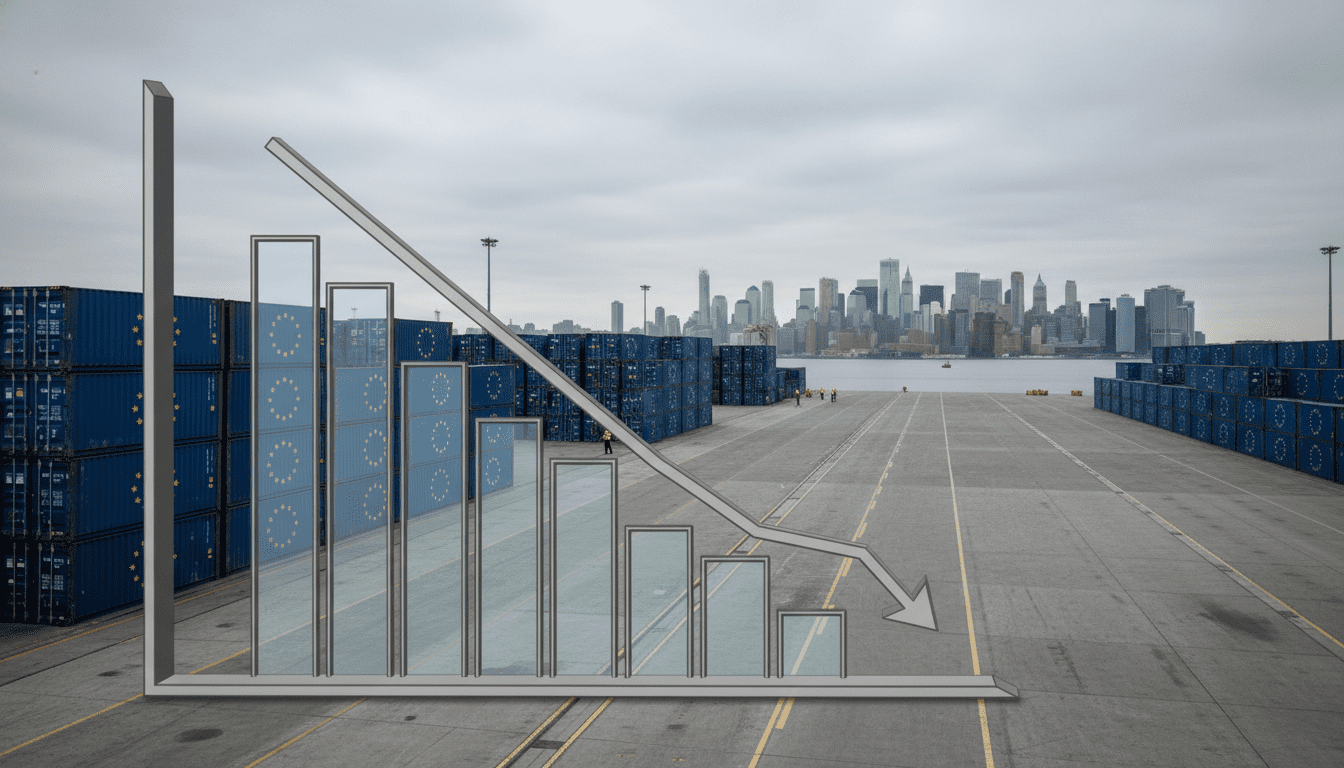
EU exports to the United States plunge 30.4% in Q1 as tariff uncertainty weighs
EU exports to the United States fell 30.4% in Q1 to €119.4bn, Eurostat reports; overall third-country exports decreased 8.8% amid tariff disputes and legal uncertainty.
The European Union’s exports to the United States dropped sharply in the first quarter of 2026, with Eurostat reporting a 30.4% year‑on‑year fall to €119.4 billion. EU exports to the United States remained the single largest destination, accounting for 18.6% of third‑country shipments despite the steep decline. The fall to the United States was the most pronounced among the union’s major trading partners and helped drive an overall reduction in exports to non‑EU countries.
Magnitude of the fall to the United States
The €119.4 billion figure represents a dramatic contraction compared with the first quarter of 2025, underscoring how sensitive trade flows have become to policy and market disruptions. The United States retained its role as the EU’s top third‑country market by share, even as volumes fell sharply. Analysts say sectors such as machinery and automobiles — cited in recent tariff negotiations — are likely contributors to the drop.
Broader export pattern across partners
Overall, the EU exported goods worth €640.5 billion to third countries in Q1, a decline of 8.8% from the same period a year earlier. The United Kingdom was the EU’s second‑largest export market at €88.7 billion, representing 13.8% of third‑country exports. Switzerland, China and Turkey followed as important destinations, though several of these markets also saw contraction over the year.
Imports softened while China remained top supplier
Imports into the EU fell to €627.8 billion in the quarter, down 3.3% year‑on‑year, narrowing the goods surplus compared with Q1 2025. China continued to be the EU’s largest external supplier, exporting €145.3 billion in goods to the bloc and holding a 23.1% share of third‑country imports. Other notable import declines occurred for goods from Turkey (‑7.5%), the United States (‑5.7%) and the United Kingdom (‑3.4%).
Trade agreement approved by member states after delays
A diplomatic trade agreement reached between the United States and the European Commission in August 2025 sought to calm tensions by suspending certain industrial tariffs and capping US duties on most EU products at 15% through the end of 2029. Implementation of that deal has been slow, however. After months of procedural delays in the European Parliament and frequent threats of additional US levies, EU member states voted to approve implementing legislation on May 27, 2026, with a parliamentary confirmation scheduled for mid‑June 2026.
Emergency clause and conditional rollback of tariffs
The legislation adopted by EU governments includes an emergency clause enabling the European Commission, with member‑state approval, to reinstate tariffs if the United States breaches the deal. The safeguard is intended to provide leverage should Washington reimpose higher duties. Policymakers in Brussels say the clause is a pragmatic measure to protect sensitive industrial sectors while keeping the diplomatic path open.
Legal rulings add uncertainty to tariff picture
The legal environment on the US side has complicated the talks. In February 2026 the US Supreme Court ruled that a 10% global tariff programme pushed by the administration was unconstitutional, a decision that directly affected one strand of Washington’s tariff architecture. Sector‑specific duties on goods such as steel, aluminum and vehicles were not overturned by that ruling, and subsequent replacement measures and legal challenges have left parts of the US tariff regime in flux. Appeals and interim enforcement actions have, at times, restored duties temporarily, increasing uncertainty for exporters on both sides of the Atlantic.
Business and policy implications for European exporters
Companies and trade bodies responding to the Eurostat figures warned that policy uncertainty can depress orders and investment decisions even when underlying demand remains stable. The drop in exports to the United States — the EU’s largest third‑country market by share — is likely to prompt closer monitoring by officials and may accelerate diversification strategies among firms. European policymakers face the task of balancing rapid ratification of the agreement with safeguards that reassure affected industries.
The Eurostat data for Q1 2026 show that despite diplomatic steps to stabilise transatlantic trade, real‑world shipments have already been hit by months of tariff signaling and legal contestation. Businesses, officials and markets will watch the European Parliament’s mid‑June confirmation and any US follow‑up measures closely for signals on whether trade flows will resume more normal patterns or remain volatile.
