
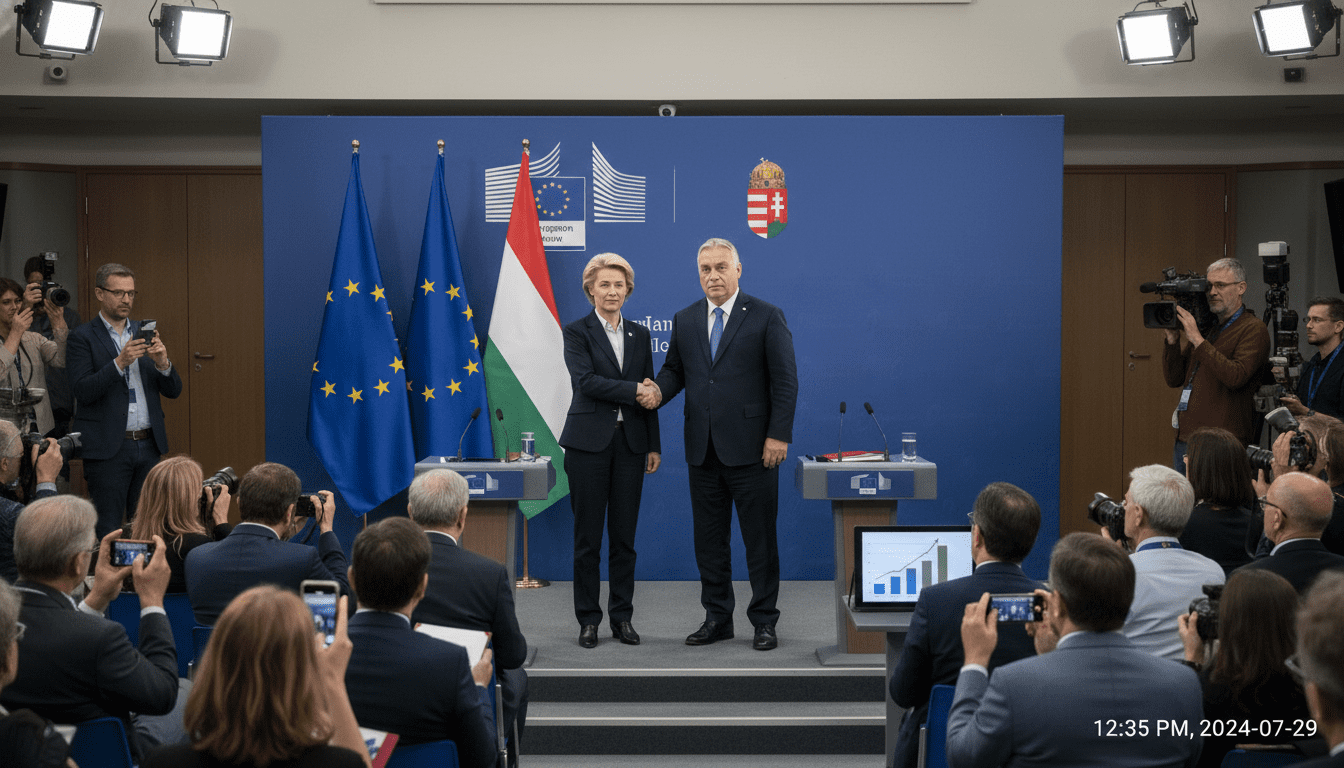
EU funds for Hungary: €16.4bn to be unlocked after Magyar–von der Leyen agreement
EU funds for Hungary poised to be released after Ursula von der Leyen and Prime Minister Péter Magyar agreed reforms and anti‑corruption measures, unlocking €16.4bn to support recovery and cohesion.
A pivotal meeting in Brussels on May 29 produced an agreement that could restore access to EU funds for Hungary after years of suspension over rule‑of‑law concerns. European Commission President Ursula von der Leyen and Hungary’s new prime minister, Péter Magyar, announced a framework intended to strengthen anti‑corruption controls and the judiciary, and signalled that roughly €16.4 billion held back by Brussels can be largely released. The move marks a rapid shift in relations between Budapest and the EU following Magyar’s election victory and the end of Viktor Orbán’s long tenure. (apnews.com)
Brussels meeting and key commitments
In a joint appearance after the talks, von der Leyen said she felt a “wind of change” and described the outcome as a political reset between the Commission and the Hungarian government. Commission officials and the new Hungarian leadership agreed to design a “robust architecture” of safeguards to tackle corruption and reinforce judicial independence as conditions for payments. The public accord was framed as both a reward for early reform steps and a technical pathway for the Commission to move forward on frozen disbursements. (telex.hu)
Breakdown of the €16.4 billion package
The package discussed in Brussels covers a mix of cohesion, regional and research funds and includes money linked to the EU’s post‑Covid recovery programme. Officials in Brussels and Budapest identified about €10.4 billion tied to the Recovery and Resilience Facility as a priority that would be re‑enabled if Hungary meets milestone commitments, alongside additional cohesion and research allocations that total the announced €16.4 billion. Commission statements stressed that the release is conditional on verifiable implementation of the agreed safeguards and financial management arrangements. (theguardian.com)
Conditions and the rule‑of‑law architecture
Under the deal, disbursement will hinge on a set of institutional and procedural reforms designed to prevent misuse of EU money and to protect judicial autonomy. The Commission and Hungary agreed to monitoring, audit and anti‑fraud mechanisms that Brussels describes as stronger than previous arrangements, with timelines and verifiable benchmarks. Brussels officials said those measures aim to convert political commitments into binding, operational checks before payments are authorised. (telex.hu)
Legal background and outstanding challenges
The restoration of funds comes after years of friction in which EU institutions froze payments over concerns about democratic backsliding, conflicts of interest and politicisation of the judiciary during the prior administration. Legal scrutiny of earlier Commission decisions has continued in EU courts, and the Commission’s capacity to reopen transfers has been challenged in the past by legal advisers and court procedures. Brussels observers caution that the political deal must be matched by durable, verifiable changes to withstand both domestic resistance and possible legal challenges. (apnews.com)
Timeline and technical steps for disbursement
Brussels has set out a staged approach: verification missions, legal instruments to lock in new arrangements and a rolling schedule of payments tied to milestone checks. For money coming from the Recovery and Resilience Facility, Hungary faces specific procedural deadlines later this year to demonstrate compliance with agreed reforms before critical tranche dates. Commission teams are expected to work closely with Hungarian authorities in Budapest to validate reforms, adapt administrative procedures and clear audits that will trigger each payment. (euronews.com)
Domestic reaction and political implications
In Budapest, the announcement was welcomed by government officials who called the move a necessary step to stabilise public finances and revive stalled investment projects. Opposition groups and civil society actors welcomed the prospect of funds returning but warned they would closely monitor implementation and enforce accountability measures on any government backsliding. EU capitals viewed the outcome as a test of Brussels’ conditionality toolkit and as a signal that political change in a member state can lead to a rapid restoration of financial ties if clear, enforceable reforms are adopted.
Hungary’s economy stands to gain immediate relief from the thawing of payments, with regional development projects, university research funding and recovery investments among the areas likely to receive a rapid boost. The Commission framed the agreement as a precedent for calibrated, reversible incentives that tie access to the single market’s financial benefits to concrete rule‑of‑law guarantees.
The deal will now move into technical implementation, where the pace of reforms, the rigour of monitoring and potential legal delays will determine when and how quickly the promised €16.4 billion reaches projects and programmes across Hungary.
