
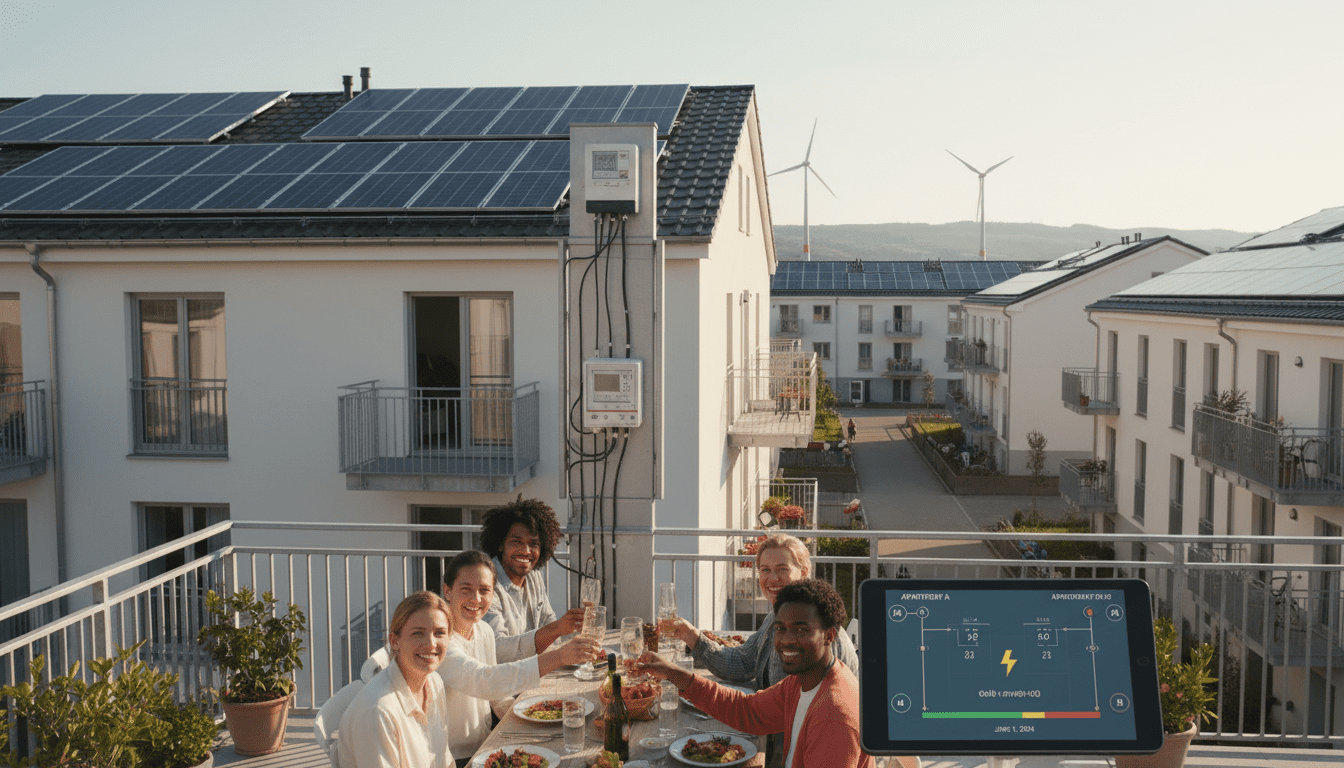
Energy Sharing to Start June 1, 2026: Neighbours in Germany Can Now Form Solar Power Communities
From June 1, 2026, Energy Sharing lets neighbours install and share solar power, widening access to renewables while exposing regulatory and technical gaps.
Germany will allow citizens to form small energy communities and share electricity from locally installed renewable systems starting June 1, 2026, under an amendment to the Energiewirtschaftsgesetz (EnWG) passed by the Bundestag in November 2025. Energy Sharing aims to let people who lack private roofs — including many renters — participate directly in the energy transition by pooling generation and consumption within neighbourhoods. Proponents say the move could improve the economics of photovoltaic projects and raise public support for green power, while critics warn of outstanding legal and technical obstacles.
New legal pathway established by the Bundestag
The Bundestag’s November 2025 amendment to the EnWG creates a legal framework for citizens to jointly install renewable-energy systems and allocate the electricity among members of a community. The change removes a long-standing barrier that limited community-operated generation and gives local groups a clearer status under national energy law. Lawmakers framed the revision as a step toward democratizing energy production and enabling broader participation in the decarbonization agenda.
Implementation will depend on secondary rules and guidance from regulators and distribution grid operators, who must translate the new statute into operational procedures. The law establishes the principle; the practicalities of metering, billing and grid connection will be set out in forthcoming regulations and local network agreements.
Who can join and how neighbourhood projects might look
Energy Sharing is designed to be flexible: neighbours, housing cooperatives, and small communities can collaborate to install shared photovoltaic arrays on communal buildings, carports or other suitable sites. The model also creates scope for investors and community funds to co-finance installations that serve multiple households, expanding options beyond individual rooftop owners.
For renters and those in multi-unit buildings, the law offers an alternative to the limited measure of balcony solar kits, which produce only modest annual output. Local pilot projects are likely to combine rooftop arrays, shared storage and simplified contractual arrangements to channel generation directly to participating households.
Economic rationale and potential benefits
Supporters argue Energy Sharing will increase the utilisation rate of small-scale photovoltaic systems by matching generation more closely with local demand and reducing export to the wider grid at low wholesale prices. By pooling consumers, communities can allocate generated power where it is needed and reduce individual payback times compared with standalone systems that rely heavily on grid feed-in revenues.
Beyond pure economics, policymakers expect the measure to strengthen social acceptance of the energy transition by giving citizens tangible control over production and consumption. Community ownership models could also attract local investment and create new opportunities for municipal energy planning.
Technical and administrative hurdles remain
Despite the law’s promise, significant operational issues must be resolved before Energy Sharing delivers on its potential. There is currently no uniform standard for communication and data exchange between community members, inverters, storage systems and utility billing platforms. This fragmentation threatens to complicate precise allocation of generation, real-time balancing and transparent billing.
Metering technology, settlement rules and responsibilities for balancing must be clarified to prevent disputes and ensure network stability. Distribution system operators will need guidance on how to incorporate community allocations into grid management and on whether new charges or exemptions will apply to shared consumption.
Questions over tariffs, incentives and grid integration
How shared energy will be valued remains an open question: participants will need clarity on whether community-supplied kilowatt-hours will offset retail consumption at full price, be treated as self-consumption, or be subject to distinct settlement rules. The design of tariffs and any transitional incentives will influence uptake, as cost-effectiveness is central to household decisions about joining or forming communities.
Grid integration could also pose bottlenecks in densely populated areas where capacity for additional solar generation is limited. Local network upgrades, connection procedures and prioritisation rules will shape where and how rapidly Energy Sharing can expand.
Early pilots and next steps for communities
Municipalities, cooperatives and energy service providers are expected to launch pilot schemes to test technical solutions and contractual templates ahead of broader roll-out. Pilots will be crucial to developing best practices for metering, peer-to-peer accounting and dispute resolution mechanisms. Authorities have signalled they will consult with stakeholders to produce implementable rules that align with the EnWG amendment.
For households interested in joining a community, the immediate steps will include identifying a host site for panels, clarifying legal ownership, and agreeing a distribution and billing model with neighbours and the local grid operator. Professional advice and well-drafted community agreements will be important to manage expectations and responsibilities.
The Energy Sharing reform marks a notable shift in Germany’s approach to decentralised renewables, opening the door for many who were previously excluded from direct participation in solar generation. If regulators and network operators can quickly close the remaining technical and administrative gaps, small-scale energy communities could become a visible and locally embedded pillar of the country’s energy transition.
