
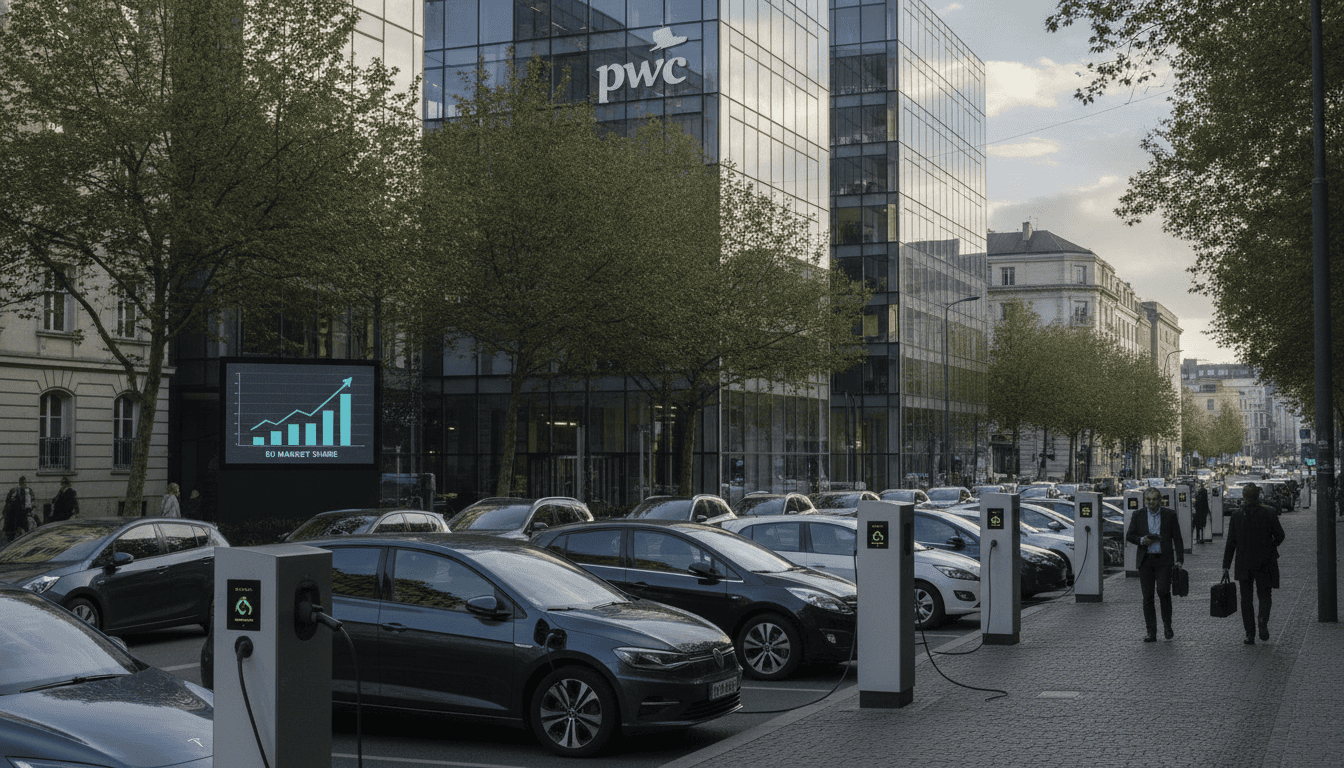
EV market share in Europe hits record 22% as oil-price swings and used EV demand lift sales
PwC: EV market share in Europe reached a record 22% in Q2 2026, driven by oil-price swings, Germany’s strong sales and a surging used EV market globally.
The electric car market share in Europe climbed to an unprecedented level in the second quarter of 2026, with pure battery-electric vehicles accounting for 22 percent of new registrations across the EU and nearby markets. PwC reported that more than 600,000 BEVs were registered in the quarter, marking the highest volume of electric-car sales seen in a single quarter. Germany emerged as a major driver, with BEVs taking 28.4 percent of June registrations, narrowly surpassing hybrids.
EU BEV Market Reaches New High
PwC’s analysis of 43 global markets shows the EU and associated European countries recorded a significant jump in BEV uptake, producing a 22 percent market share in Q2. The firm counted roughly 1.6 million BEV registrations across the EU, United Kingdom, Norway, Switzerland, Iceland and Liechtenstein in the first half, a 33 percent increase year-on-year. France, Italy and Germany recorded particularly strong gains, with Germany remaining the largest single market in Europe.
Global Sales Climb but Growth Is Moderating
Worldwide, BEV sales hit a quarterly record of about 3.9 million in Q2, according to the consultancy, but the pace of growth is cooling from the rapid expansions of earlier years. Total new vehicle registrations in the 43 markets studied were approximately 6.6 million, leaving BEVs with an outsized share of the global market but showing a smaller year-on-year percentage increase than in 2024 and early 2025. PwC noted the sector’s growth remains positive but less explosive than the double-digit surges seen previously.
China’s Market Softening Slows Global Momentum
China’s performance was a central factor in the slowing global uptick, with the world’s largest EV market contracting by about five percent in the first half of the year to just under 3.6 million BEVs. Despite that decline, BEVs still comprised roughly 44 percent of new registrations in China during Q2 as the overall market also contracted. The combined effect of a softer Chinese market and steadier demand elsewhere tempered worldwide growth rates for electrified vehicles.
U.S. Registrations Retreat Significantly
By contrast, the United States recorded a marked downturn in BEV registrations, with around 460,000 battery-electric vehicles sold in the first half—down about 22 percent year-on-year. BEVs represented only about six percent of the U.S. passenger vehicle market in that period, underscoring a divergent regional picture. Analysts point to factors including policy differences, consumer preferences and lower gasoline price sensitivity as contributors to the weaker U.S. performance.
Used-EV Market Expands Sharply in Germany
The secondary market for electric cars has begun to grow rapidly, a trend PwC ties to elevated fuel costs and greater model maturity. In Germany the share of used electric vehicles in the used-car market roughly doubled from three percent in May 2025 to more than six percent in May 2026. Industry observers say expanding availability of affordable, higher-range models on the used market is lowering the barrier for mainstream EV adoption and is likely to support further growth in registrations.
Oil-Price Volatility and Technology Improvements Drive Demand
PwC’s automobile market team highlights recent oil-price fluctuations as an external accelerator of electrification, while stressing that product improvements underpin sustained adoption. Harald Wimmer, PwC’s automotive market expert, pointed to longer ranges, more competitive pricing and improved operating costs as decisive factors for buyers. Together, these market and technological dynamics have sharpened consumer interest whenever fuel prices spike, amplifying the impact of broader economic trends on EV uptake.
Taken together, the data sketch a European market that is moving toward electric mobility at a faster clip than many other regions, even as the global picture shows mixed momentum. Policymakers and manufacturers will watch whether rising used-EV availability and technology improvements can sustain growth if oil prices stabilize or decline.
