
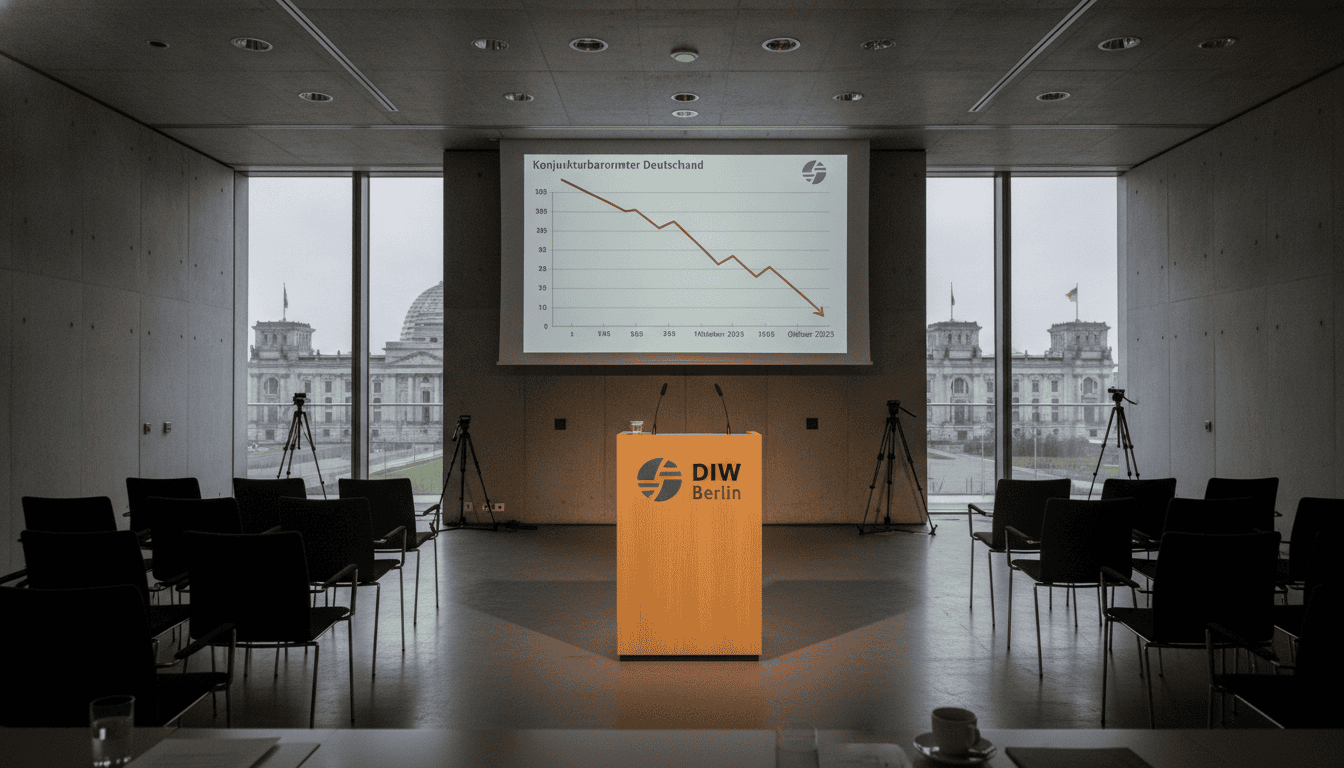
DIW economic barometer tumbles to 91.3 as German business sentiment weakens
DIW economic barometer falls to 91.3, the lowest since October 2025, as geopolitical risks, high energy costs and weak domestic demand weigh on German growth prospects.
DIW Barometer Drops to 91.3, Weakest Since October 2025
The DIW economic barometer fell by 4.8 points in July to 91.3, moving the indicator further below the 100-point mark that represents average growth expectations. The drop marks the lowest reading since October 2025 and continues a pattern of monthly swings that have characterized the index over the past year.
DIW researchers note the barometer exceeded 100 points only once in the last twelve months, in February 2026, underlining a persistent weakness in overall business sentiment. The institute framed the decline as reflective of heightened uncertainty among firms and households.
Geopolitical tensions over Iran cited as key driver of volatility
DIW economic head Geraldine Dany-Knedlik attributed the latest deterioration in confidence in part to geopolitical uncertainty surrounding the Iran conflict. She said the conflict has amplified swings in the barometer, producing alternating monthly gains and losses since February.
Analysts at the institute emphasized that geopolitical shocks increase risk premia for businesses and dampen investment appetite, particularly in export-oriented sectors. The ongoing conflict has also complicated supply chains and elevated risk assessments for trading partners.
Sustained high energy prices erode purchasing power and margins
High energy costs remain a persistent drag on sentiment, DIW researchers warned, reducing household purchasing power and adding uncertainty for firms across manufacturing and services. Elevated energy bills are squeezing consumer budgets and eroding profit margins for energy-intensive industries.
The institute highlighted that energy-related expenses continue to act as a tax on domestic demand, limiting consumption growth even as wage and employment conditions show more mixed signals. For several firms, high input costs have delayed hiring and pushed back investment decisions until price paths become clearer.
Export dependence leaves Germany vulnerable to weak global demand
DIW experts reiterated that Germany’s structural reliance on exports amplifies the economy’s exposure to slower global growth. With world demand remaining muted, the institute said export orders show no sustained signs of recovery and are a major reason for subdued industrial expectations.
Guido Baldi, DIW’s specialist on cyclical trends, argued that without stronger domestic demand the economy will remain sensitive to external shocks. He noted that falling consumer willingness to spend — driven by inflationary pressures — is also weighing on the services sector, limiting the potential for compensatory growth at home.
Additional risks: AI cooling, logistics bottlenecks and investment uncertainty
Beyond geopolitical and energy factors, DIW flagged several other risks to the near-term outlook, including the possibility of a slowdown in the artificial intelligence investment boom. The institute also pointed to rising freight costs and logistical strain caused by low river levels during a hot summer as tangible headwinds for trade.
Uncertainty about the scope and implementation of debt-financed government investment programs in infrastructure and climate measures was another factor cited. DIW economists said questions over how these funds will be deployed and when they will translate into measurable demand continue to cloud the investment outlook.
Markets and official statistics set to refine near-term picture this week
The DIW release comes ahead of an official first estimate from the Federal Statistical Office for second-quarter GDP, due Thursday, which will give a clearer read on recent economic momentum. Economists surveyed by Reuters expect only a marginal expansion of roughly 0.1 percent year-on-year for the quarter, down from 0.3 percent in the first quarter of 2026.
Market participants and policymakers will watch that estimate closely for signs of whether the barometer’s drop is mirrored in hard output data. The DIW highlighted that survey indicators can react quickly to shifting sentiment, but that official GDP figures are needed to assess whether those changes have translated into sustained growth moves.
Germany now faces the task of balancing near-term stabilization with longer-term reforms, according to DIW analysts, who stressed that strengthening domestic demand would reduce vulnerability to external shocks. They added that targeted public investment and measures to relieve energy cost pressures could help shore up consumer and corporate confidence.
The DIW economic barometer’s sharp decline underscores the fragile state of sentiment in Europe’s largest economy, where external events and domestic cost pressures are intersecting to slow momentum. Policymakers will face mounting pressure to demonstrate that fiscal and structural measures can support a transition to steadier growth, even as global uncertainties persist.
