
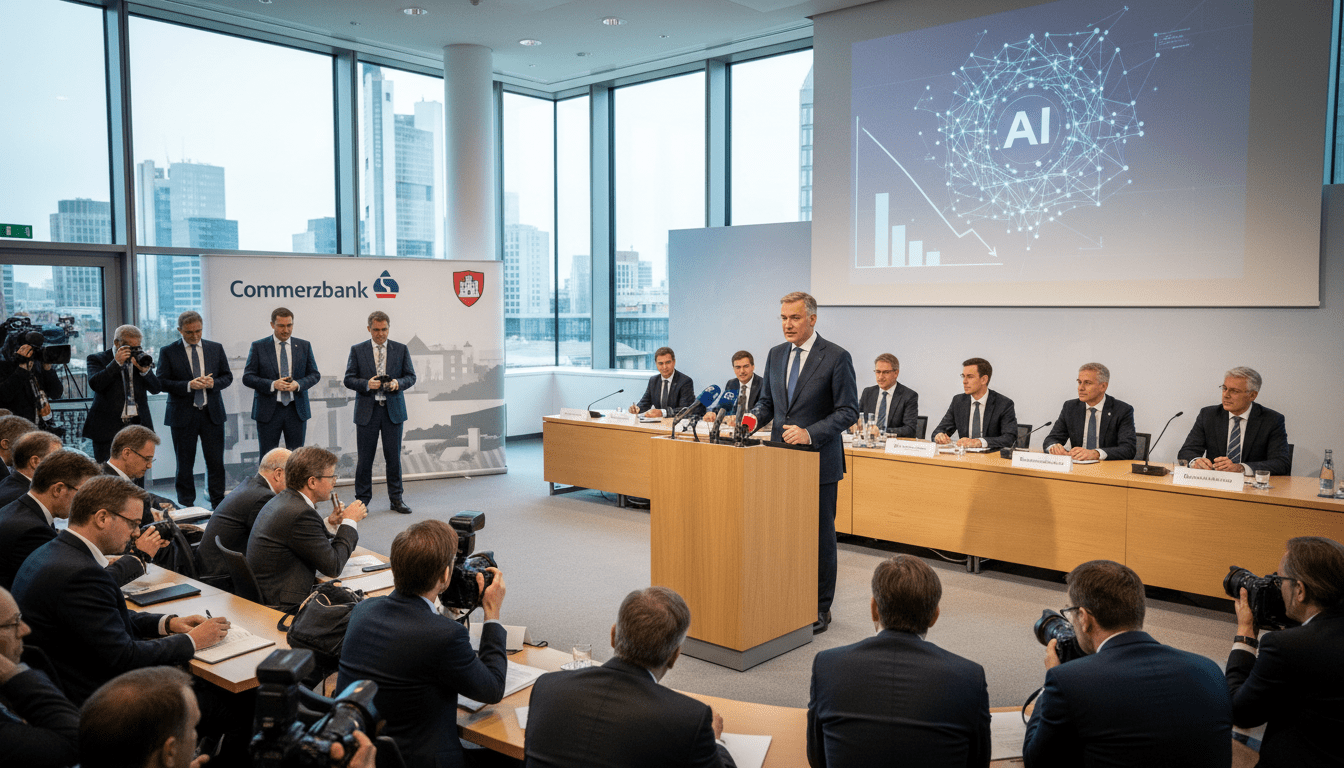
Commerzbank Job Cuts: Bank to Shed About 3,000 Positions, Cites AI as Key Cost Driver in Bid Defense
Commerzbank job cuts: the bank plans roughly 3,000 role reductions tied to AI and fewer external contractors while pursuing targets to deter UniCredit’s takeover bid.
Commerzbank announced plans to cut about 3,000 positions as part of a wider cost and efficiency programme, with chief executive Bettina Orlopp attributing much of the savings to the rapid advance of artificial intelligence. The decision comes as the bank seeks to shore up profitability and deter an acquisitive move by UniCredit, which already holds close to 30 percent of the shares. Management said the measures will emphasise reductions among external providers while aiming to limit compulsory layoffs of internal staff.
AI cited as a major source of efficiency gains
Bettina Orlopp told staff and investors that artificial intelligence has evolved faster than anticipated and can now assume many routine tasks across the bank. She described AI as “very powerful in different areas,” and positioned the technology as a central tool to lower ongoing costs. Management expects that automating processes will deliver a significant portion of the planned savings that underpin the reduction programme.
Executives framed the move as forward-looking rather than purely defensive, saying the bank must modernise its operations to meet profit and return targets through 2030. The emphasis on AI follows similar initiatives across European banking as institutions seek higher efficiency amid low-margin environments.
External contractors targeted, core staff largely protected
Commerzbank said it will prioritise cuts among external call-centre providers and third-party IT contractors rather than broad internal redundancies. Orlopp noted the bank still relies on many external capacities in IT and client service operations, and those relationships will be reviewed to capture savings. The intention, she said, is to reduce external spend while preserving as many permanent Commerzbank roles as possible.
Management repeatedly stressed that the plan seeks to avoid large-scale, operationally driven dismissals and that measures will be implemented “maximally socially compatible” given the bank’s workforce demographics. Works councils and employee representatives are expected to be involved as the bank outlines specific measures and timelines.
Job cuts framed as defensive strategy against UniCredit bid
The announcement of the job reductions is inseparable from Commerzbank’s stated effort to fend off a takeover approach from UniCredit. Executives presented the restructuring and ambitious profit targets through 2030 as part of a package to persuade shareholders to retain their stakes. Commerzbank executives argue that a stronger standalone performance makes selling shares less attractive and protects the bank’s strategic independence.
Shareholder pressure has increased since UniCredit launched an offer in early May, aiming to consolidate its position in Germany. Commerzbank’s board and management have signalled that operational improvements and cost discipline form a credible alternative to an external acquisition.
UniCredit stake and terms of the offer
UniCredit currently holds close to 30 percent of Commerzbank’s shares and has proposed a stock-swap offer that would give Commerzbank shareholders 0.485 UniCredit shares for each Commerzbank share. UniCredit’s tactic is structured to allow the Italian lender to collect additional shares until June 16 without triggering a full mandatory takeover offer, with the window extendable until July 3. The Milan-based group already operates in Germany through HypoVereinsbank and has identified potential billions in synergies from a full integration.
Commerzbank has criticised the approach as aggressive, saying the offer undervalues the bank’s standalone prospects and risks destabilising operations. Management and some institutional investors are weighing whether the proposed exchange ratio and strategic fit justify a sale.
Government backing and regulatory friction
The German federal government, which holds just over 12 percent of Commerzbank shares, has expressed concern about destabilising moves and signalled support for a stable resolution that protects the bank’s systemic role. Orlopp warned against actions that could disrupt organisational stability during the bid period. The state’s stake adds political weight to the debate over any potential change in control.
Regulatory tensions have also surfaced: UniCredit was criticised by Germany’s financial regulator, BaFin, for a social-media campaign that targeted Commerzbank, an approach the regulator deemed inappropriate. Commerzbank has pointed to those public tactics as further reason to reinforce internal stability while addressing market questions through a formal strategic plan.
Outlook for employees and investors
Commerzbank has committed to shaping the restructuring to be socially responsible and to minimising involuntary dismissals, though it acknowledged that some roles will disappear as processes are automated. The bank intends to prioritise internal redeployment, natural attrition and retraining where feasible, while identifying immediate savings through cuts in external contracts. For investors, the management package — including the cost programme and medium-term targets — is designed to demonstrate a credible path to improved returns without a sale.
Analysts will be watching whether the cost plan and AI-driven efficiency gains materially change Commerzbank’s trajectory and whether shareholders respond by rejecting UniCredit’s overtures. The outcome will determine whether the bank pursues a standalone revival or enters merger negotiations.
Commerzbank now faces the twin challenge of implementing substantial operational change while navigating a contested shareholder landscape, with employee protections, regulatory scrutiny and shareholder sentiment all shaping the next phase of the dispute.
