
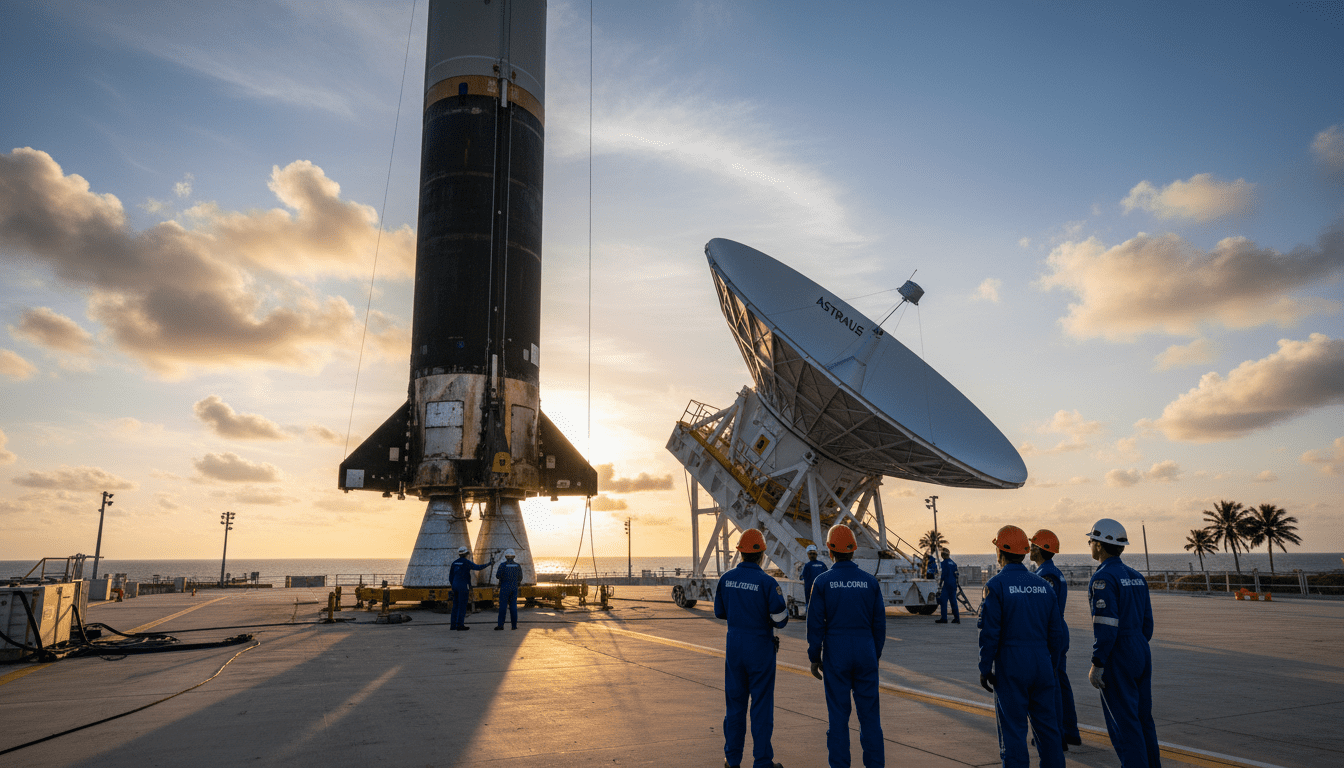
Blue Origin’s New Glenn Reused Successfully but AST SpaceMobile Satellite Reaches Off‑Nominal Orbit
Blue Origin reflies New Glenn booster, but AST SpaceMobile’s satellite reached an off‑nominal orbit after an upper‑stage issue; investigation is underway.
Blue Origin achieved a long‑planned reuse of its New Glenn rocket by recovering a previously flown booster on a drone ship, marking a major milestone for the heavy‑lift vehicle. The company also confirmed payload separation and said AST SpaceMobile reported its satellite had powered on, but mission engineers flagged the spacecraft as being in an off‑nominal orbit following deployment. The mixed outcome leaves Blue Origin celebrating a reusability success while investigating a potential upper‑stage anomaly that may have affected the satellite’s insertion.
Booster Reuse Achieved on New Glenn’s Third Flight
The launch represented the third flight of the New Glenn rocket and the first time Blue Origin has redeployed the same booster for a subsequent mission. The booster had previously been used on the program’s earlier commercial mission, and engineers recovered it on a drone ship roughly ten minutes after liftoff during this latest flight. Repeating a recovery is a technical and logistical step that Blue Origin has prioritized as it seeks to lower launch costs and increase cadence for New Glenn operations.
The recovery underscores progress in the vehicle’s operational maturity, with the booster performing descent and landing maneuvers consistent with the company’s reuse objectives. Successful retrieval on the sea‑based platform provides Blue Origin with hardware for inspection and rapid refurbishment cycles intended to support frequent launches. Nonetheless, reuse alone does not guarantee overall mission success, and flight controllers are now focused on evaluating the rest of the ascent profile.
Satellite Reported in Off‑Nominal Orbit After Deployment
Minutes to hours after liftoff, Blue Origin and AST SpaceMobile issued statements confirming payload separation and that the communications satellite had powered on. Despite that power‑on confirmation, AST SpaceMobile later reported the satellite was in an off‑nominal orbit, indicating it did not achieve the intended orbital parameters. An off‑nominal orbit can affect the satellite’s ability to meet its mission objectives without additional maneuvers or ground intervention.
AST SpaceMobile and Blue Origin said teams were assessing telemetry and orbit data to determine the root cause and to evaluate corrective options. While the satellite’s systems appear to be receiving power, mission planners will need to confirm whether orbital adjustments can be performed from the spacecraft or if other remediation is required. The immediate priority for all parties is to secure stable communications and to preserve the satellite’s ability to fulfill its commercial mission.
Upper Stage Second Burn Is Central Focus of the Probe
According to the launch timeline, New Glenn’s upper stage was scheduled to perform a second engine burn approximately one hour after liftoff to place the payload into its target orbit. Blue Origin has indicated it is reviewing the upper stage’s performance and guidance data to determine whether the second burn executed as planned or if a deviation occurred. The apparent timing of the anomaly places particular scrutiny on the upper stage propulsion and guidance systems.
Investigators will analyze telemetry from both the stage and the satellite to reconstruct events during the critical coast and burn sequences. If the second burn underperformed or was omitted, engineers will look for possible causes such as engine shutdowns, guidance errors, or fuel system anomalies. The findings will shape any software or hardware changes before future missions and will be important for customer confidence in New Glenn’s orbital insertion accuracy.
Commercial and Contractual Stakes for Blue Origin and AST SpaceMobile
The mission carried commercial significance beyond a single satellite: Blue Origin and AST SpaceMobile have an ongoing agreement to launch multiple communications satellites as part of plans to expand space‑based broadband services. Any complication that reduces confidence in orbital insertion reliability could affect near‑term scheduling and the cadence of subsequent launches tied to that deal. Satellite operators often budget for contingency maneuvers and insurance coverage, but launch vehicle performance directly influences deployment timelines and service rollout.
For Blue Origin, maintaining customer relationships and meeting contract milestones is critical as the company scales New Glenn operations and competes for commercial payloads. AST SpaceMobile’s reported power‑on status is a positive sign, yet the off‑nominal orbit may require additional maneuvers that consume onboard propellant and constrain the satellite’s operational lifetime. Both companies will be weighing technical fixes, contractual obligations, and public communications as the situation develops.
Strategic Implications for New Glenn and NASA Partnerships
The reusable New Glenn is a central element of Blue Origin’s strategy to supply heavy‑lift capability for commercial, civil and national security customers. The rocket has been pitched to NASA and other partners for lunar missions and deep‑space cargo, and reliability in orbital insertion is a prerequisite for such assignments. Blue Origin is also advancing a separate lunar lander project and has discussed supporting Amazon’s satellite ambitions, making consistent launch performance a strategic necessity.
A verified anomaly on the upper stage would prompt closer scrutiny from customers and regulators and could influence future bids and manifesting decisions. Conversely, demonstrating rapid investigation and corrective action can restore confidence and highlight the company’s commitment to operational rigor. The balance between demonstrating reuse economics and ensuring precise mission delivery will shape how New Glenn fits into the broader launch market dominated by reusable systems.
Blue Origin and AST SpaceMobile have said they will provide updates as data analysis continues, and teams are working to confirm whether the satellite can reach its planned orbital slot through onboard maneuvers or ground‑assisted solutions. The coming days will likely reveal whether the incident is a recoverable insertion deviation or evidence of a deeper systems issue needing design or procedural changes.
