
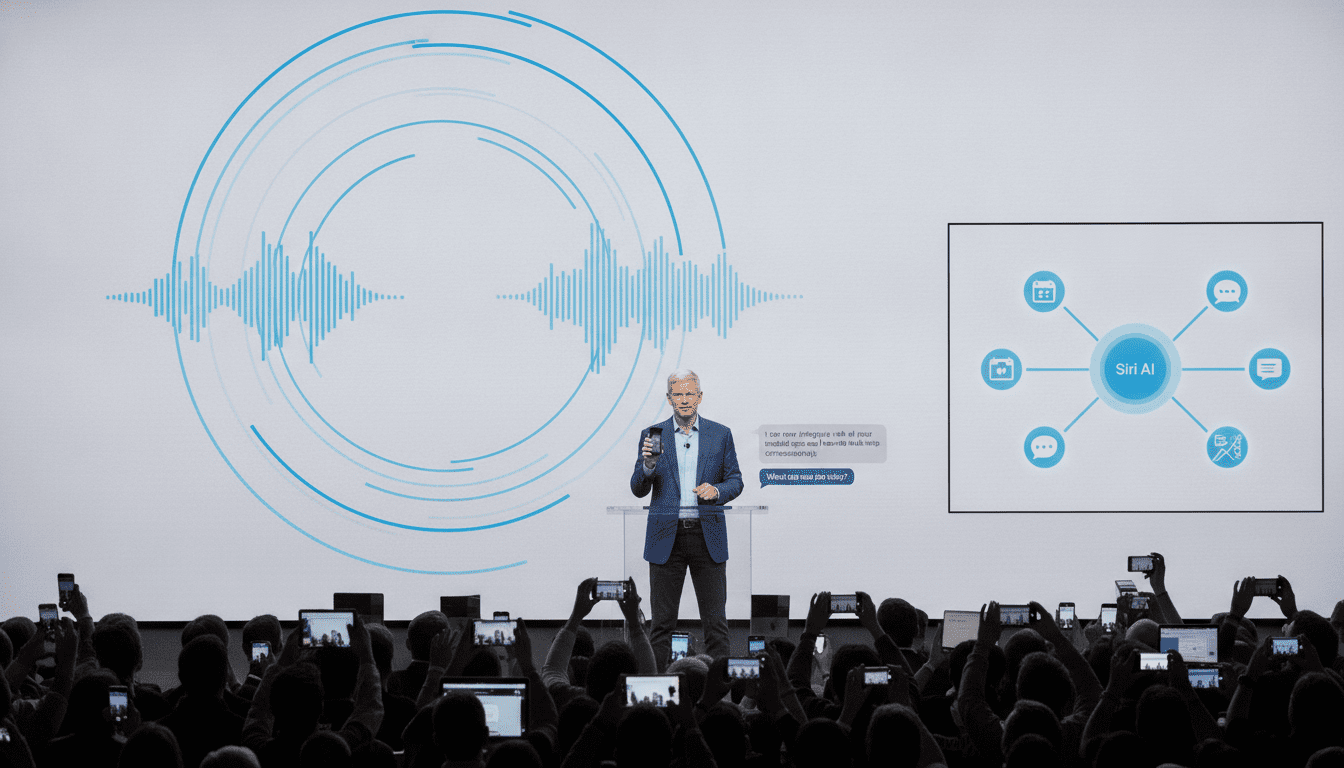
Apple unveils AI-powered Siri with conversational skills and deep app integration at WWDC
Apple introduces an AI-powered Siri at WWDC, demonstrating conversational responses, app automation, developer APIs and privacy-focused on-device processing.
Apple CEO Tim Cook on Monday introduced a new AI-powered Siri during the company’s Worldwide Developers Conference, presenting a version of Siri able to carry on natural conversations and perform complex tasks across apps. The new Siri uses generative and conversational models to answer multi-turn queries and take actions inside third-party applications. Apple’s demonstration emphasized personal context — the assistant can reference recent interactions, documents and local data to complete requests more accurately.
Cook introduces AI-powered Siri at WWDC
Apple’s WWDC keynote framed the update as a major overhaul of Siri rather than an incremental upgrade. Tim Cook and other executives showed how the AI-powered Siri manages follow-up questions, disambiguates user intent and summarizes content within apps. The presentation highlighted scenarios such as scheduling, composing messages and summarizing meeting notes as examples of the assistant’s expanded role.
Conversational model and practical capabilities
The new Siri responds in free-form dialogue rather than the single-command model Apple has used historically. Demonstrations included multi-step workflows where Siri retained context across turns, executed app-level commands and produced written summaries. Apple said the assistant can draft replies, extract relevant information from documents, and attend to consecutive tasks without requiring repeated clarifications.
Integration with apps and personal context
A central element of the rollout is closer integration with native and third-party apps, allowing Siri to act inside calendars, email, messaging and productivity tools. The assistant can draw on a user’s recent activity and local files to complete requests, such as composing an email based on a draft in Notes or scheduling a meeting by scanning availability across multiple calendars. Apple framed this as making Siri more useful for everyday workflows rather than limiting it to isolated voice commands.
Privacy and on-device processing assurances
Apple emphasized privacy safeguards as it expands Siri’s intelligence, saying key computations will run on-device where possible to reduce external data exposure. The company reiterated that personal context used by the assistant — like local documents or recent messages — will be handled under its privacy policies and not treated as general training data. Apple’s executives acknowledged trade-offs between performance and privacy, and presented on-device processing and encryption as cornerstones of the new architecture.
Developer tools, APIs and App Store implications
Apple announced developer frameworks enabling apps to expose capabilities to Siri through standardized APIs and intents. The new tools let developers specify which app actions are accessible to the assistant and how data should be handled when Siri invokes those actions. Apple indicated that the App Store submission and review processes will account for assistants that act on behalf of users, with new guidelines to govern what third-party services can access via Siri.
Rollout timeline and supported devices
Apple said the updated Siri will roll out to supported devices in the coming months, with availability tied to the next major OS updates across iPhone, iPad and Mac platforms. The company listed device compatibility with a focus on newer models capable of the computational demands of on-device AI. Apple also signaled staged feature deployment, where more advanced capabilities will become active after initial release as backend services and developer integrations mature.
The company’s presentation placed the AI-powered Siri within a broader industry push toward large-language models and conversational assistants, but Apple sought to differentiate its approach through privacy controls and deep app-level functionality. Analysts will watch whether the combination of local processing, developer APIs and incremental rollout is sufficient to win back users who have shifted to other virtual assistants for complex tasks.
Beyond the technical details, Apple emphasized real-world productivity gains in its examples, showing how the AI-powered Siri can cut time from routine tasks like triaging email, drafting responses and coordinating schedules. The demonstrations aimed to position Siri not only as a voice interface but as an assistant that can operate autonomously inside the apps people use every day.
As Apple moves forward with its new assistant, the company faces the challenge of balancing ambitious AI capabilities with the privacy and reliability expectations of its user base. The coming weeks will reveal more about exact device support, developer adoption and the real-world accuracy of Siri’s conversational reasoning as the new system reaches public beta and final release.
