
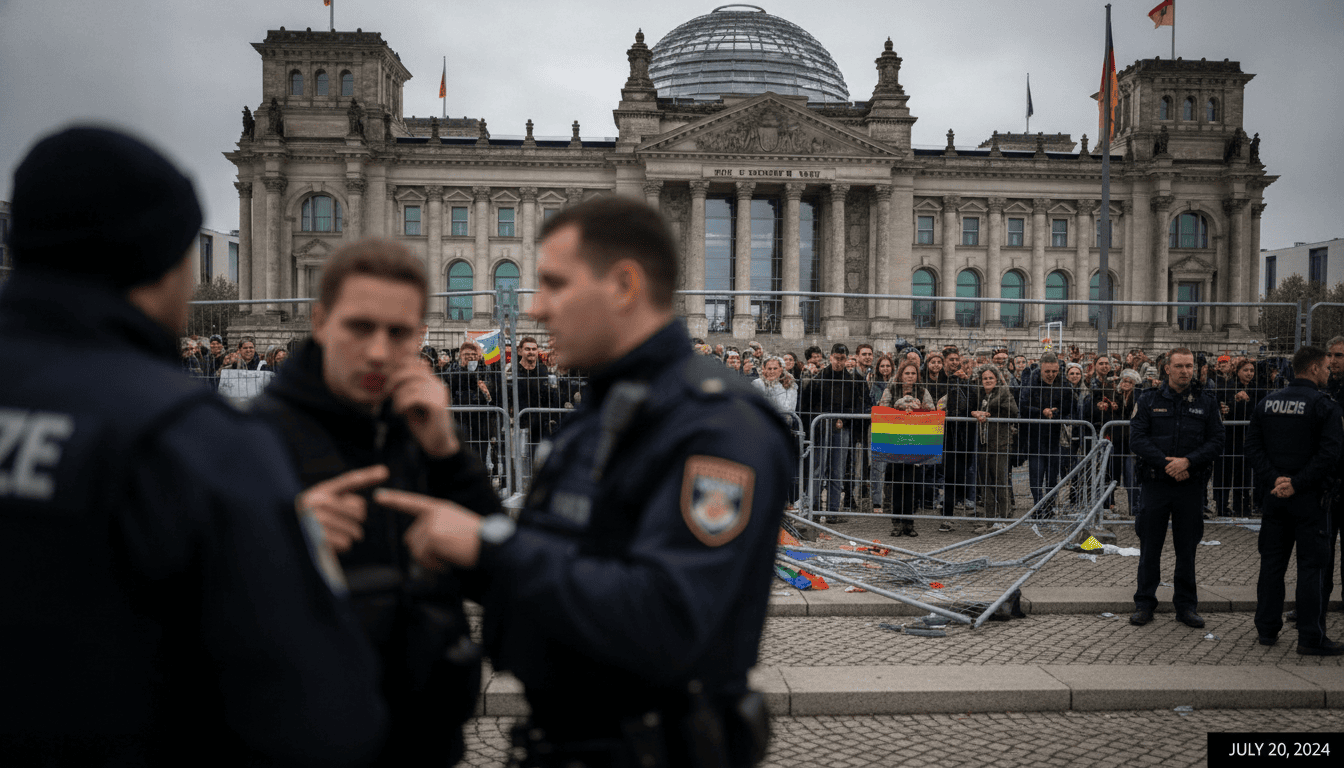
Berlin Christopher Street Day attack exposes lapses in surveillance and court decisions
A Berlin Christopher Street Day attack by an identified “Gefährder” has left one dead and more than 30 injured, reigniting debate over surveillance, judicial discretion and Islamist radicalization.
Attack and immediate aftermath
The attacker, identified by authorities as Abdul Ballout, drove a rented van into crowds at the Christopher Street Day (CSD) event in Berlin before continuing an assault on foot, state investigators say. Police recovered a confession video on his phone and surveillance footage showing him leaving his residence at 20:58 on the day of the attack. One Polish tourist was killed and over thirty people were wounded in the incident, which ended when special forces shot the assailant during an arrest operation in Spandau.
Emergency services and investigators described chaotic scenes at the Tiergarten route where the vehicle struck pedestrians, and residents reported tire tracks and the damaged vehicle left at the scene. Authorities later located the suspect in a Kleingartenanlage in Spandau, and rifle-bearing special units moved in after a tip; the suspect died at the scene from gunshot wounds sustained during the confrontation.
Suspect’s background and prior monitoring
Ballout’s recent history shows multiple attempts to join extremist groups abroad, including a failed effort to reach the Islamic State and a prior unsuccessful travel to Mauritania. He was detained in a Lebanese military prison from July 2025 and repatriated to Germany in November 2025, when he was arrested at the airport and placed in a youth detention facility. In January 2026 federal and state counterterrorism bodies classified him as a “Gefährder,” placing him in the highest risk category at the Joint Counter-Terrorism Centre that coordinates police and intelligence information.
Berlin authorities say the Landeskriminalamt monitored Ballout in the weeks before the attack, conducting wiretaps, physical surveillance and a constant camera opposite his residence. The LKA vice president, Stefan Redlich, told a parliamentary interior committee that the surveillance did not reveal specific indicators that would have prevented the attack.
Court ruling, release and contrasting assessments
In May 2026, an Amtsgericht in Tiergarten tried Ballout on charges related to prior violent offenses and sentenced him to one year and ten months, a decision that was suspended and led to his release in mid-May. Court records describe the defendant as a young man with “catch-up-able maturity and developmental deficits” and note his interest in vocational training, with references to regular mosque attendance in past judgments. Those judicial assessments, focused on rehabilitation and youth provisions, contrasted sharply with security agencies’ classification of Ballout as a top-tier terror risk.
Security services had anticipated the release and set up a special two-shift surveillance team a week before the main hearing. Despite the heightened monitoring, the suspect was able to post images online with a handgun, prompting a police raid that recovered a replica firearm, but it is unclear whether the court was informed of that development during its deliberations.
How security measures failed on the day
The attack highlighted gaps between preventive surveillance and operational containment. On the day of the incident more than 2,000 police officers were deployed in the vicinity for event security, with reinforced measures such as bollards and traffic controls at many entrances. Nonetheless, the assailant found an entry point at Lennéstraße, where tire marks later evidenced his route, and he managed to access a rented vehicle despite being newly released from custody and subject to monitoring.
Investigators noted that Ballout acquired a long knife or machete in addition to using the vehicle as a weapon. After the vehicle stopped at a tree roughly 500 meters from where the attack began, the assailant continued his assault on foot before escaping via public transport to the outskirts of the city, eluding immediate arrest until the tip placed him in Spandau.
Political reactions and calls for legal change
The attack prompted immediate and bipartisan condemnation at the federal level. Chancellor Friedrich Merz said extremists “have no place in the middle of our society” and vowed to defend liberty and openness, statements echoed across the political spectrum. Ministers and lawmakers demanded answers about how a monitored “Gefährder” could carry out such an operation.
Interior Minister Alexander Dobrindt announced plans to tighten measures, proposing electronic monitoring as standard for high-risk individuals, limitations on youth criminal law applicability for such suspects and nationwide, uniform rules on preventive detention. Younger CDU and FDP MPs pushed for even more stringent reforms, presenting a “ten-point plan” that recommends prioritizing the termination of residency for foreign nationals deemed dangerous and tougher minimum sentences for support of terrorist organizations.
Community impact and debates over Islamist networks
Local officials and community representatives in Neukölln said the attack exposed long-standing concerns about radicalization within certain networks and the persistence of ideologically driven congregation points. Güner Balci, the Neukölln integration commissioner, criticized what she described as permissiveness toward organizations with radical inclinations and questioned continued public funding for groups the intelligence services monitor. She cited mosques and affiliated social infrastructures that, she said, propagate hostility toward Jews and LGBTQ people and draw vulnerable youth into an “ideological pull.”
The broader debate now centers on whether Germany’s current balance between civil liberties, integration efforts and security enforcement needs recalibration. Intelligence statistics cited by officials show thousands of people flagged for Islamist potential and several thousand considered oriented toward violence, a trend that has driven intensified prevention and policing but not always apparent success in averting attacks.
The events in Berlin have reopened familiar controversies about judicial discretion, information-sharing between security agencies and courts, and the allocation of resources to both prevention and deradicalization programs.
Authorities have pledged a thorough review of intelligence handling, court notification practices and event-security measures, and parliamentary committees have scheduled inquiries into the surveillance and decision-making that preceded the attack.
The coming weeks are expected to see legislative proposals, police after-action reports and community consultations aimed at addressing gaps revealed by the Berlin CSD attack, while investigators continue to piece together the suspect’s final movements and motive.
