
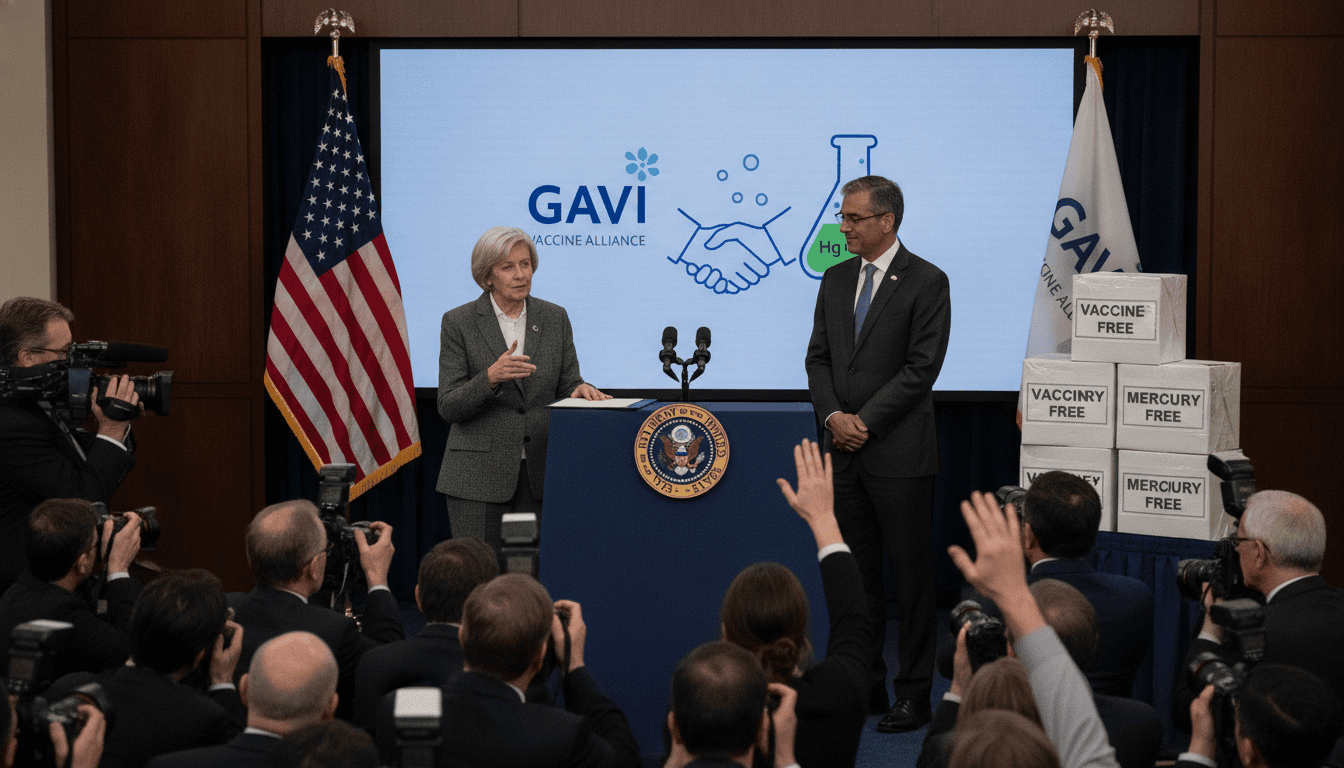
US releases $600 million to Gavi after 2025 freeze, conditional on mercury‑free vaccines
US frees $600m for Gavi after a 2025 freeze; Washington says the funds depend on Gavi switching to mercury-free vaccine alternatives for low-income countries.
U.S. releases $600 million to Gavi
The United States has authorized the release of $600 million in previously withheld funds to Gavi, the global vaccine alliance, ending a funding pause that began in June 2025. The move restores a major tranche of U.S. support to the Geneva-based organization, which coordinates supply and financing of routine immunizations in low-income countries. Washington’s decision was framed as contingent on Gavi’s commitment to transition toward mercury‑free vaccine formulations.
The funding had been approved by Congress but kept on hold by the U.S. Department of Health and Human Services after public objections from a senior official. The reinstated money represents a significant portion of the U.S. contribution to Gavi’s pooled financing, where the United States has historically been one of the largest single donors.
Why the payments were frozen
The freeze of U.S. payments was initiated after concerns were raised about the use of thiomersal, a mercury-containing preservative used in some multi-dose vaccine vials. The official who halted the funds argued that Gavi was not adequately addressing safety questions related to the preservative. Critics of that stance say the action reflected political pressure and a long-standing anti-vaccine narrative rather than new scientific evidence.
U.S. officials later indicated the funding would resume if Gavi committed to sourcing and prioritizing mercury‑free alternatives where feasible. That condition was presented by Washington as a policy alignment rather than a reversal of prior scientific positions, and it served as the basis for releasing the $600 million.
Gavi’s role in global immunization
Gavi acts as a central purchaser and distributor of vaccines for the world’s poorest countries, negotiating prices with manufacturers and co-financing national immunization programs. The alliance supports delivery of vaccines against diseases such as measles, diphtheria, polio and others that remain significant causes of childhood illness and death in low‑resource settings.
Interruptions in funding to Gavi can delay procurement and delivery schedules, complicate shipment planning, and strain relationships with vaccine manufacturers. Because many low-income countries depend on predictable disbursements and pooled procurement, donor pauses can ripple through national programs and increase the risk of outbreaks of vaccine-preventable diseases.
Scientific consensus on thiomersal
Thiomersal has been used for decades as a preservative in multi-dose vaccine vials to prevent bacterial contamination. Over the past two decades, reviews by major public health bodies and independent researchers have found no credible evidence linking thiomersal in vaccines to autism or other neurodevelopmental disorders. Those findings underpin the continued use of thiomersal in certain formulations where it enables multi-dose packaging and broader immunization reach.
Nevertheless, some countries and manufacturers have moved toward single‑dose vials or mercury‑free formulations where cost and logistics allow. The transition can be complex: single‑dose vials increase per-dose costs and cold‑chain volume, while multi-dose vials with preservatives can be more economical for mass campaigns in places with limited refrigeration.
Donor landscape and financial risks
Before the freeze, the United States provided roughly 13 percent of Gavi’s external funding, making it one of the alliance’s most consequential contributors. Other major donors, including several European governments such as Germany, also sustain a large share of Gavi’s budget. That diversified donor base is meant to buffer the alliance against shocks, but concentrated reductions or political disputes can still create substantial shortfalls.
Analysts say reliance on discretionary annual appropriations in donor capitals leaves Gavi vulnerable to changing political priorities. Conditional restorations of funds, like the current U.S. release tied to procurement policy, may set precedents for future negotiations between donors and global health institutions about supply choices and technical standards.
Potential effects on vaccination campaigns and next steps
Restoring the $600 million is likely to avert immediate disruptions to vaccine procurement for scheduled campaigns and routine immunizations that Gavi supports. Officials in countries reliant on Gavi have signaled relief at the funding news, though operational effects will take time to show in immunization coverage statistics. Procurement cycles, cold‑chain logistics and national program planning will determine how quickly restored funding translates into delivered doses.
Gavi now faces the practical challenge of defining what a transition to mercury‑free options means in procurement and in contracts with manufacturers. That process will require technical assessments of supply availability, cost implications and timeline feasibility, as well as consultations with recipient countries and manufacturers. Donors may press for milestones and reporting on progress, while public health experts will weigh the balance between preserving vaccine access and implementing formulation changes.
The funding episode has also highlighted broader tensions between scientific guidance and political considerations in global health financing. Observers note that decisions tied to single ingredients or formulations can have outsized consequences when used as leverage in donor–recipient relationships.
The reinstated funds should reduce short-term uncertainty for Gavi-supported programs, but the episode underscored how political disputes in donor countries can affect the steady delivery of vaccines to vulnerable populations.
