
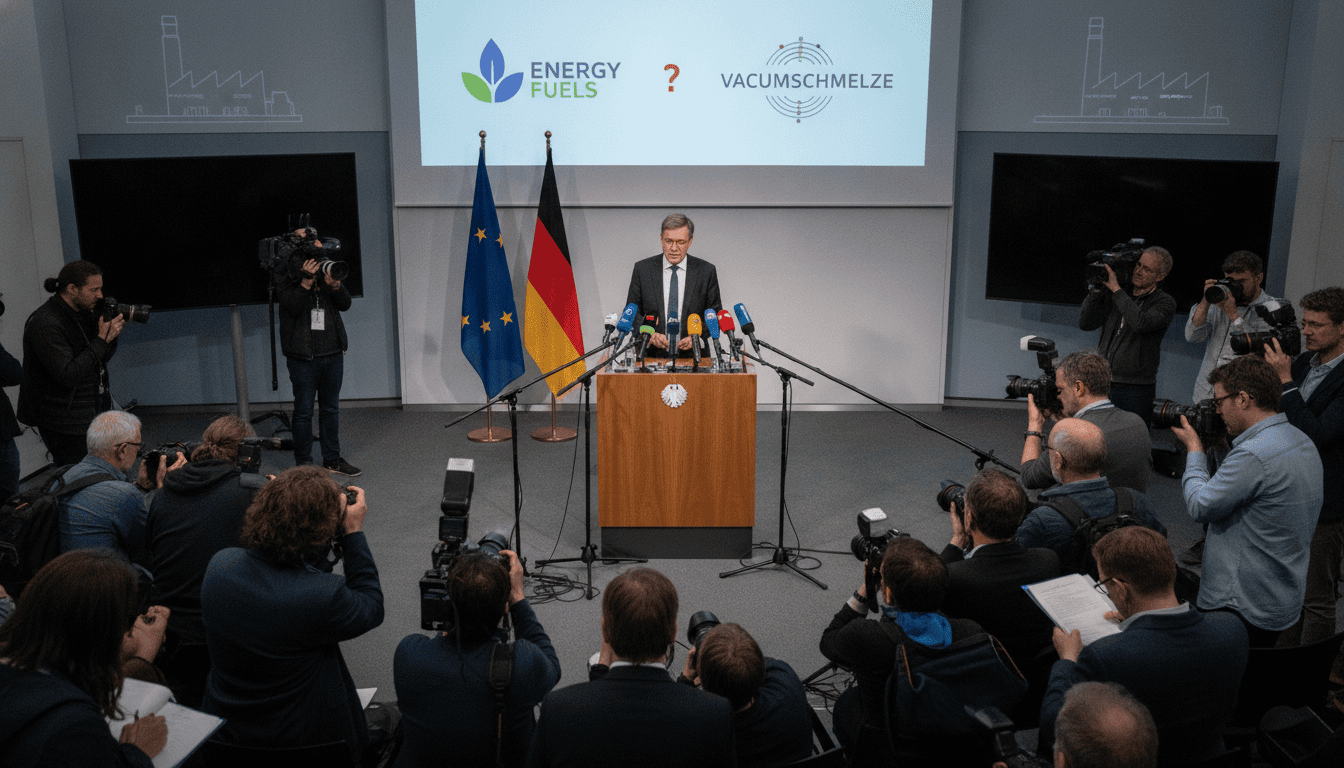
Germany launches review of Vacuumschmelze takeover by Energy Fuels
Germany opens an investment review into Energy Fuels’ $1.9B Vacuumschmelze takeover, probing strategic magnet supply links to aerospace, defense and EV sectors.
The German government has initiated a formal investment review into the Vacuumschmelze takeover, marking a regulatory check on Energy Fuels’ $1.9 billion bid. The Vacuumschmelze takeover is now under scrutiny because the magnet maker operates in sectors deemed strategic for national security and industrial resilience. The Federal Ministry for Economic Affairs confirmed the review in a letter to a member of parliament, a development first reported by Bloomberg.
Details of the bid and companies involved
Energy Fuels announced its intention to acquire Vacuumschmelze late in June in a deal valued at $1.9 billion. The U.S.-based miner and processor is positioning the purchase as a step toward becoming one of the largest non-Chinese producers of high-performance magnets. Vacuumschmelze, commonly known as VAC, employs about 3,600 people and sells to more than 1,000 customers across multiple industries.
VAC has long supplied magnets to the automotive sector, including companies such as General Motors, and serves aerospace, defense and renewable energy clients. Energy Fuels has said the acquisition would expand its vertical footprint in magnet supply chains and tie it more closely to raw material sources. The scale of VAC’s customer base and its role in critical industries are central to why regulators flagged the transaction for review.
Scope and legal basis of the German review
German officials characterized the probe as a routine investment-screening procedure that applies to deals affecting strategic or critical economic sectors. The ministry’s communication to parliamentarians follows statutory rules that allow intervention where national security, critical infrastructure or supply chain dependencies could be affected. Such reviews assess whether a foreign acquisition would endanger public order or security, or compromise access to sensitive technologies and materials.
Officials did not indicate a timeline for a decision or whether remedies could be imposed to preserve domestic capabilities. Investment-screening outcomes can range from unconditional clearance to conditional approvals with behavioral or structural measures, and in rare cases to blocks of proposed transactions. Observers say Germany is increasingly using these mechanisms amid geopolitical competition over critical industrial inputs.
Comments from VAC and potential political considerations
VAC’s chief executive, Erik Eschen, told Bloomberg he expected the review and that other European countries were also examining the transaction. Eschen expressed willingness to reaffirm VAC’s commitment to its German operations while noting the process would be complex. He also suggested the takeover could offer Germany a route to secure raw materials through Energy Fuels’ existing channels, but he acknowledged concerns that U.S. customers might be prioritized post-sale.
Energy Fuels has framed the deal as a strategic industrial investment that would scale non-Chinese magnet production globally. German policymakers must weigh those economic arguments against political and security considerations, including the strategic nature of magnet technology for defense and aerospace systems. The company and VAC have not announced detailed plans for operational changes pending regulatory clearance.
Strategic importance of VAC’s magnet technology
High-performance permanent magnets sit at the heart of electric motors, generators, missile guidance systems and wind turbines, making them critical components across defense, transport and renewable energy sectors. The supply chain for rare-earth elements and magnet production has become a geopolitical focus, with a limited number of large manufacturers concentrated in China. This concentration has driven industrial policy debates in Europe and the United States about domestic and allied capacity for advanced materials.
VAC’s product portfolio and longstanding ties to original equipment manufacturers place it squarely in that strategic context. Regulators often consider not only ownership but whether control by a foreign buyer could alter procurement, technology transfer or access to inputs. Analysts say maintaining diversified, reliable magnet supply is a priority for countries seeking to safeguard both industrial competitiveness and national security.
Potential consequences for the market and next steps
If Germany’s review results in conditions or restrictions, the structure of the deal could change or require guarantees to preserve supply commitments to European customers. Other European authorities reviewing the transaction could coordinate with Berlin or reach independent conclusions, complicating the path to closing. The outcome will be watched by manufacturers, investors and policymakers concerned about near-term disruptions and the longer-term geography of magnet production.
For now, the process introduces uncertainty into an acquisition that Energy Fuels has pitched as a major consolidation move in the magnet sector. Stakeholders will be watching for formal filings, any regulatory remedies proposed by the companies, and public statements from the ministry as the review proceeds. The case underscores the growing intersection of industrial policy and foreign investment oversight in critical technology supply chains.
The German investment review will determine whether the proposed sale to Energy Fuels proceeds unmodified, proceeds with safeguards, or is blocked, with implications for supply chains serving aerospace, defense, automotive and renewable energy customers.
