
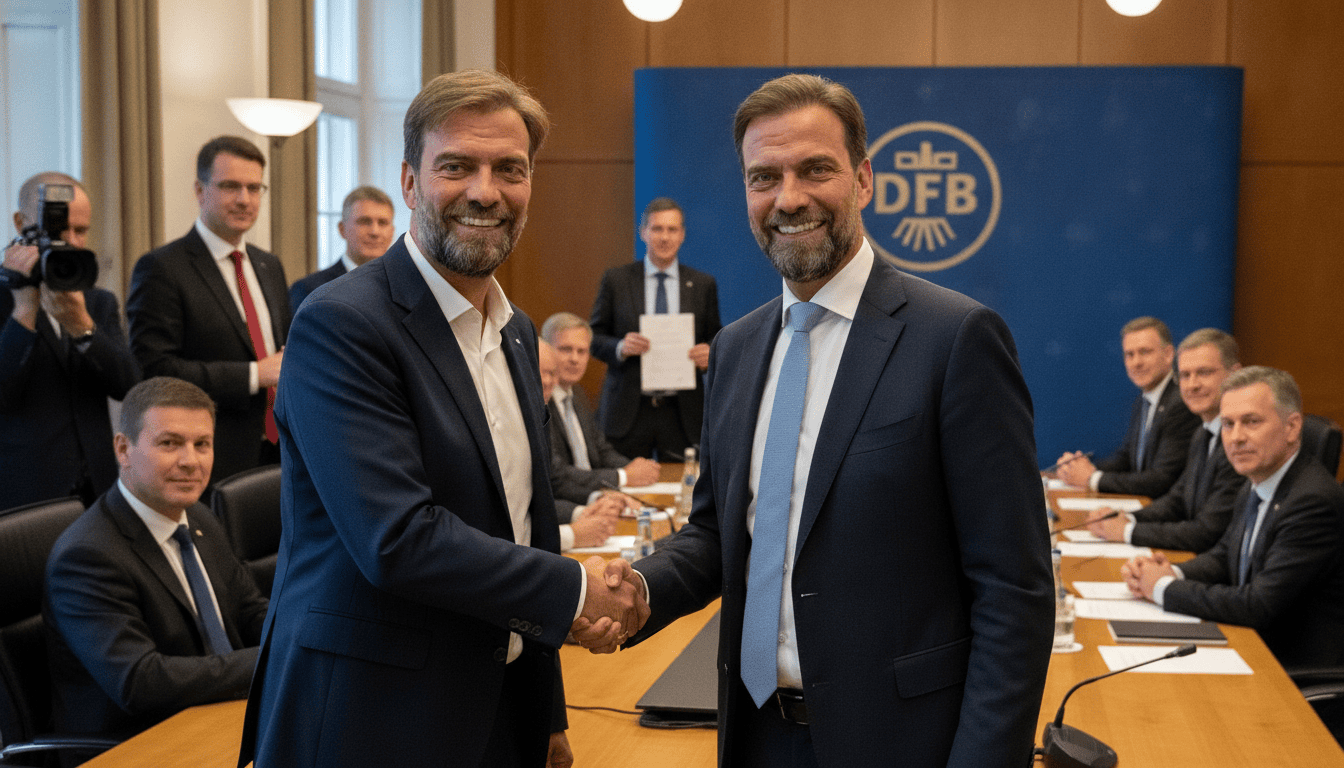
Jürgen Klopp’s Kosicke at DFB: New advisor given full access sparks governance questions
Klopp brings manager Marc Kosicke into the DFB fold as an external adviser with wide access, raising questions about authority and decision-making at the federation.
Klopp’s debut and the Kosicke disclosure
Jürgen Klopp used his first public appearance as Germany’s national coach to set a combative tone and to introduce Marc Kosicke as a close collaborator. Klopp said he would “turn every stone,” and immediately identified Kosicke as his co-trainer for strategy, development and innovation, signaling the adviser’s central role in his plans.
The revelation surprised observers because Kosicke’s name was absent from the DFB’s initial announcements and the president’s opening remarks. Klopp’s framing made clear that Kosicke is not merely an auxiliary consultant but an integral partner in the coach’s approach to the national team.
DFB confirms external advisor with full access
DFB President Bernd Neuendorf later described Kosicke as an “external adviser” while saying the federation had accepted Klopp’s conditions. Neuendorf added that Kosicke would receive broad access across the organization, including entry up to the president’s office, which effectively embeds him inside the federation’s operational structure.
That concession underscores the extent to which the DFB accommodated Klopp’s staffing preferences to secure his appointment. The public acknowledgment that the pair came “only as a package” makes Kosicke’s role a governance as well as a sporting decision.
“Only in a package” — how the agreement was framed
Neuendorf’s language emphasized that Klopp and Kosicke were inseparable in the recruitment process, and that this was communicated and accepted from the outset. The president’s phrasing suggested the DFB had limited bargaining power over the composition of the coaching team during negotiations.
Observers say the “package deal” formulation signals a shift from traditional appointment processes at the federation. It also raises questions about precedent: future hires may expect similar leeway, altering how the DFB balances external demands with internal oversight.
Authority and accountability concerns inside the federation
Granting an external adviser unfettered access to a national association invites scrutiny about lines of authority and accountability. An adviser who can “turn every stone” from outside the payroll blurs the distinction between consultant and decision-maker and complicates who is ultimately responsible for policy changes.
Some federation officials are likely to be wary of an outsider influencing core processes without having been subject to the DFB’s employment and oversight mechanisms. The arrangement poses practical questions about confidentiality, data access, and the advisory role’s boundaries in matters such as talent development and technical strategy.
What Kosicke’s brief could include
Klopp described Kosicke’s responsibilities in broad terms — strategy, development and innovation — areas that typically cover scouting, youth pathways, coaching methodology and structural reform. If Kosicke pursues a full audit of federation practices, as Klopp implied by pledging to “turn every stone,” that could lead to substantial institutional recommendations.
Such a mandate would require cooperation from multiple DFB departments and potentially touch sensitive contracts and legacy programs. The extent to which Kosicke will operate by consensus or push for rapid, top-down change remains to be seen.
Implications for DFB decision-making and culture
The Kosicke arrangement may mark a cultural shift at the DFB toward a more centralized, coach-driven model where senior playing and coaching figures shape organizational reform. That could speed decision-making but also concentrate influence in a small informal circle tied to the coach.
There are broader implications for governance: ensuring transparency, maintaining clear reporting lines, and protecting the federation’s independent functions will be important if an adviser exerts ongoing influence. How Neuendorf and the DFB executive reconcile Klopp’s demands with the federation’s institutional responsibilities will shape the tenure’s early months.
Klopp’s appointment and the prominence of Marc Kosicke in the national team’s structure present a clear test of how far the DFB will cede control for the sake of performance and stability. Observers and stakeholders will be watching how access is used, what reforms are proposed, and whether the federation can maintain accountability while adapting to a coach-led vision.
