
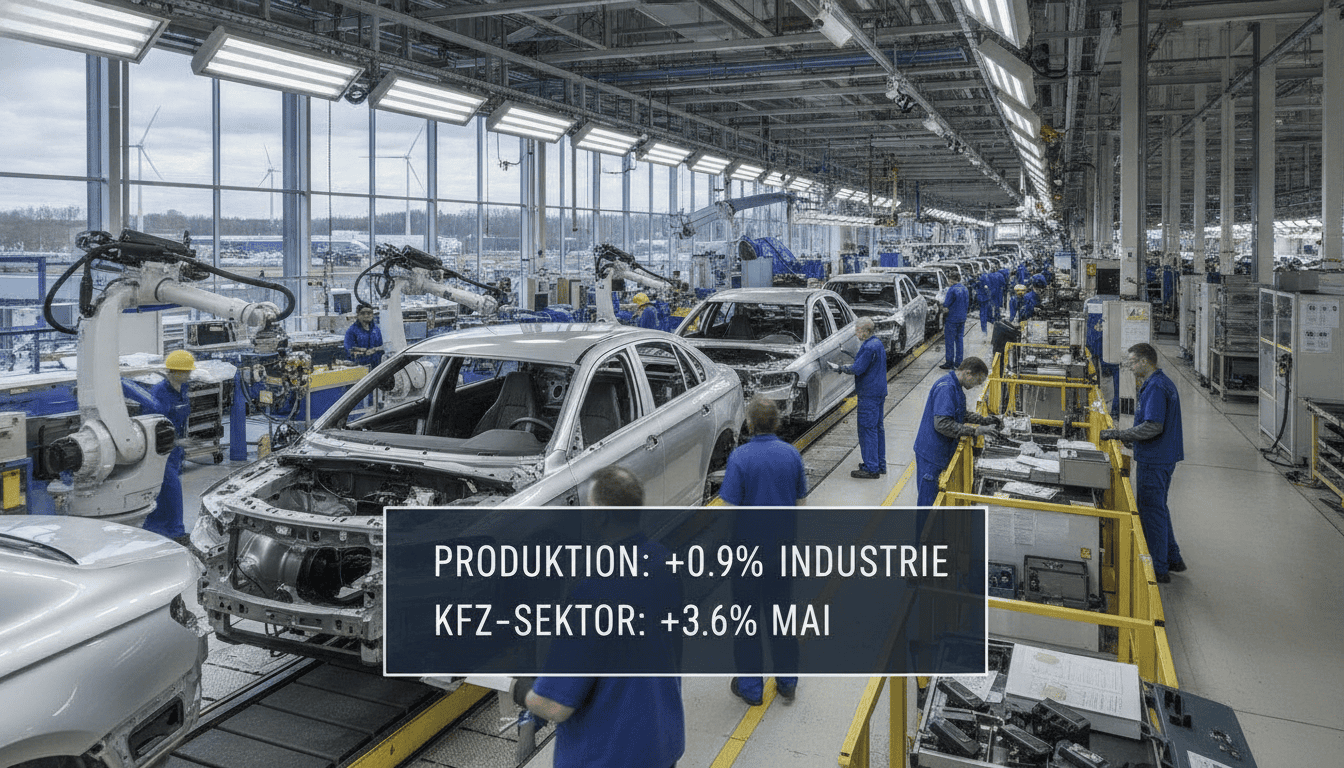
German Industrial Production Climbs 0.9% in May, Autos Lead Recovery
German industrial production rose 0.9% month-on-month in May 2026, driven largely by a 3.6% jump in the automotive sector, the Federal Statistical Office reported. The rise, reported on a seasonally and calendar-adjusted basis, exceeded consensus forecasts and followed a modest downward revision to April’s figures. Economists cautioned that the gain may mark a gradual stabilization rather than a robust upturn, with external and structural headwinds still limiting momentum.
Production Jumps in May
The Federal Statistical Office said total industrial output in Germany increased by 0.9% in May compared with April after seasonal and calendar adjustments. Analysts had expected only a 0.1% rise, making the reported result a clear upside surprise for the headline measure.
Such monthly swings are volatile and often reflect sector-specific shifts, but the magnitude of the May increase stands out against recent low-level lateral movement in the industrial cycle. The revision of April’s preliminary reading underlines how short-term data can be reshaped as more information becomes available.
Automotive Sector Drives Gain
The statistical release identified the automotive industry as the principal contributor to the May increase, with production in that segment rising 3.6% month-on-month on an adjusted basis. Auto manufacturers and suppliers thus accounted for the bulk of the headline improvement in German industrial production.
Auto output can amplify headline numbers because the sector represents a large share of manufacturing value added and tends to swing with changes in orders, inventories and export demand. For May, the lift in vehicle-related production outweighed weaker readings in other sub-sectors.
April Revision Lowers Momentum
April’s preliminary month-on-month gain was revised down from 0.4% to 0.2%, a change that tempers the picture of sustained improvement heading into May. The downward revision signals that momentum in the spring was more muted than initially reported, leaving the May rise partly corrective.
Statisticians and market watchers noted that revisions are common and that a single stronger month does not necessarily indicate a durable recovery. Still, the revised series and May’s uptick together imply that the second quarter may have avoided a contraction in industrial output.
Analysts See Gradual Revival Amid Uncertainty
Jens-Oliver Niklasch, chief economist at Landesbank Baden-Württemberg, characterized the May increase as a continuation of a slow industrial revival and emphasized the unusual backdrop of geopolitical uncertainty. He suggested the figures likely indicate that Germany’s industrial sector did not shrink in the second quarter, despite international tensions affecting sentiment.
By contrast, Commerzbank’s chief economist Jörg Krämer warned the rise does not signal a decisive turnaround, noting that production remains broadly stuck at low levels. Krämer highlighted that while the recent drop in oil prices could support activity in the latter half of the year, deeper structural issues constrain a faster recovery.
Policy and External Headwinds Curb Upside
Economists cited a range of headwinds that could limit further gains in German industrial production, including intensified competition from China and perceived shortcomings in domestic policy measures. Commentary from market analysts referenced a government reform package that, despite some advances, has yet to fully restore Germany’s competitiveness in key areas.
Geopolitical tensions and global demand patterns also continue to shape industrial prospects, with changes in commodity prices and trade flows feeding through to manufacturer order books. These factors combine to make the recovery tentative and dependent on both external demand and domestic policy follow-through.
Indicators to Watch for Sustained Recovery
Forward-looking indicators that will be closely watched include new orders, export trends and business investment intentions, all of which feed directly into industrial output figures. A consistent uptick in those indicators would lend weight to the argument that the May rise is more than a one-off.
Labour market dynamics and corporate capital expenditure decisions will also influence the pace of any rebound, as will developments in supply chains and semiconductor availability for key sectors. Policymakers and market participants will be monitoring these signals to assess whether modest gains translate into broader momentum.
The May report gives a fragile but meaningful signal that German industrial production may be stabilizing after an extended period of weakness, with the automotive sector providing a clear near-term lift; however, analysts caution that sustained improvement will depend on stronger demand, effective policy measures and a benign external environment.
