
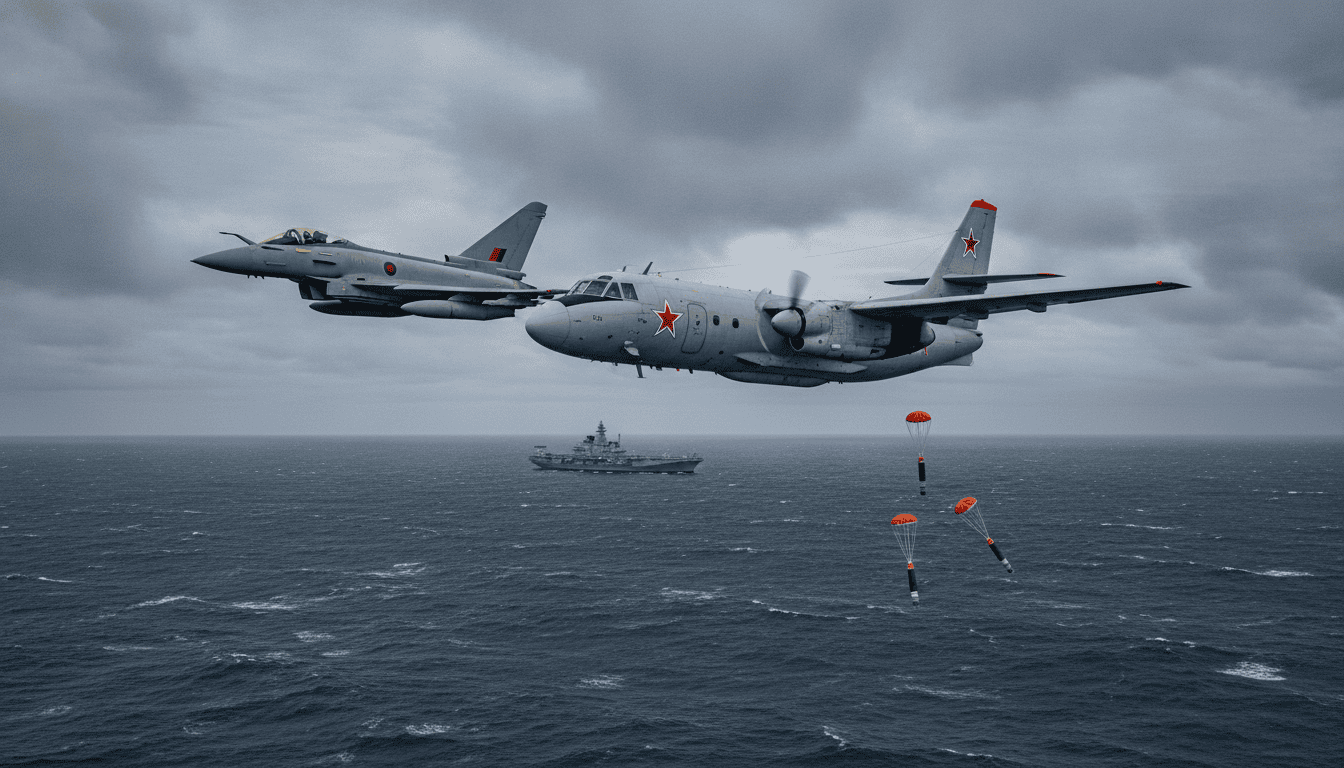
HMS Prince of Wales escorted after Russian Tu-142 drops sonar buoys near British carrier
A Royal Navy carrier strike group centering on HMS Prince of Wales was escorted by British F-35 fighters after a Russian Tupolev Tu-142 flew close and released sonar buoys near the formation, the UK Ministry of Defence said. The interception, which occurred last Thursday, followed failed radio contact with the Russian crew and prompted two F-35s to scramble and shadow the aircraft until it left the area. The incident unfolded during the carrier group’s deployment on the British Arctic mission Firecrest, part of NATO’s wider Arctic Sentry operation.
British jets intercept and shadow Russian Tu-142
Two Royal Air Force F-35 combat aircraft were launched when the Tupolev did not respond to repeated attempts at communication, the Ministry of Defence reported. The jets intercepted and escorted the Russian long-range maritime patrol plane away from the carrier strike group to ensure the safety of the vessels and personnel. The Ministry emphasized that the response was defensive and measured, designed to de-escalate the situation while protecting the task force.
Sonar buoys dropped adjacent to carrier formation
The Tu-142 reportedly deployed multiple sonar, or passive acoustic, buoys close to the carrier group; these devices are used to detect submarines by listening for underwater sounds. The presence of such buoys near a carrier strike group raises tactical concerns because they can provide data on the group’s anti-submarine posture and movements. British officials described the proximity and the timing of the buoy drops as unnecessarily close to the formation, prompting heightened caution among the escorting ships and aircraft.
Activity took place during Firecrest deployment in the Arctic
The carrier strike group was operating under the banner of Firecrest, the UK’s contribution to NATO’s Arctic Sentry mission in the high north. Firecrest places the carrier and its accompanying vessels in a region of growing strategic importance as melting ice opens new shipping routes and access to resources. British defence officials said the deployment aims to demonstrate persistent presence, reassure allies and improve interoperability with NATO partners operating in the Arctic and North Atlantic.
NATO Arctic Sentry links to wider alliance deterrence
Arctic Sentry, launched in February, brings together NATO members to deter threats and secure lines of communication in the northern approaches. The multinational operation includes maritime, air and undersea assets coordinated to monitor activity and deter destabilizing actions. NATO officials have framed the mission as defensive, intended to prevent escalation and protect collective security in a region where geopolitical competition has intensified.
Multinational participation and Germany’s contribution
Several NATO members are contributing forces to the operation, with participating nations supplying aircraft, ships and surveillance assets to strengthen situational awareness. Germany has deployed Eurofighter jets as part of the alliance’s rotational air policing and maritime security efforts in the high north. Allies have emphasized interoperability and information-sharing as key priorities for sustaining longer-range operations in harsh Arctic conditions.
Operational risks and diplomatic implications
The close approach and buoy deployment highlight the overlap between routine military practice and tense strategic signalling in contested waters and airspace. Encounters of this type increase the risk of miscalculation, particularly when aircraft fail to acknowledge radio calls or deviate near sensitive naval formations. Diplomatic channels are likely to be used following the incident to convey concerns and seek assurances, even as military commanders maintain readiness to respond to further encounters.
The Royal Navy carrier group continued its mission after the interception, with commanders stressing the importance of professional conduct and adherence to international rules of the air and sea. NATO spokespeople reiterated that the alliance will continue routine patrols and surveillance to protect shipping lanes and maintain regional stability. The incident adds to a series of recent encounters in northern waters that have prompted Western capitals to underscore the strategic significance of the Arctic and to press for predictable, transparent behaviour among all operators there.
