
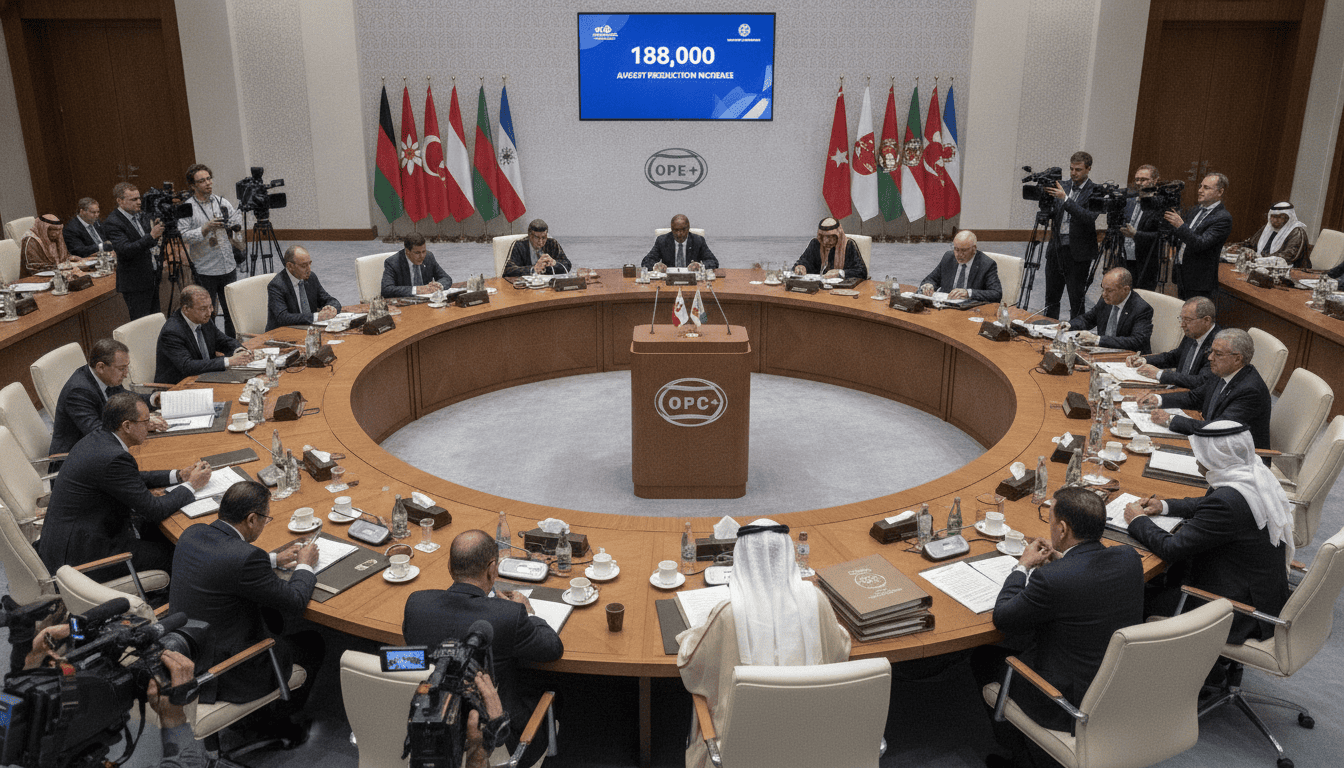
OPEC+ to Raise Oil Output by 188,000 Barrels per Day in August
OPEC+ will expand oil production in August by 188,000 barrels per day, the group announced, a measured increase that officials say is contingent on market developments and could be altered if conditions change.
OPEC+ announced a planned production increase of 188,000 barrels per day for August as part of a continued, gradual expansion of output. The move was made by the seven core member states that coordinate the alliance and was presented as conditional, with officials reserving the right to speed up, pause, or reverse the increase depending on market signals. The statement did not reference recent tensions affecting regional shipping lanes, leaving some analysts to weigh the decision against heightened geopolitical risk.
OPEC+ Announces August Output Increase
The core OPEC+ group said the August adjustment will add 188,000 barrels per day to global supply, with each barrel equal to about 159 liters. The announcement framed the change as a step in an ongoing, gradual policy of easing previous cuts that were introduced in earlier months. Members emphasized that the timetable for additional increases will depend on price trends, inventories, and broader market conditions.
Size and Mechanics of the Increase
The 188,000 barrels per day increase is modest compared with global consumption but continues a multi month programme of calibrated production rises. OPEC+ has in recent months signalled a preference for incremental adjustments rather than abrupt shifts in output, seeking to avoid excessive price swings. The group made clear that planned supply additions are reversible, so future changes can be accelerated, suspended, or rescinded in response to evolving indicators.
Core Group Membership and Decision Rights
The kerngroup steering the policy comprises Saudi Arabia, Russia, Iraq, Kuwait, Kazakhstan, Algeria, and Oman. These seven states coordinate closely inside the wider OPEC+ framework and are central to setting production pacing for the alliance. The group said it will convene on August 2 to review market data and decide on any further steps, reaffirming that final decisions will reflect observed market behavior.
Market Implications for Prices and Supply
A limited rise of 188,000 barrels per day is unlikely by itself to dramatically alter global oil balances, but it sends a signal to markets that OPEC+ intends to continue easing cuts cautiously. Traders may take the announcement as a cautious approach to supply normalization, leaving room for price volatility if demand surprises or geopolitical events disrupt shipments. Refiners, inventory managers, and futures markets will monitor consumption reports and weekly stock data for signs of tighter or looser balances.
No Comment on Strait of Hormuz Developments
OPEC+ did not address recent developments in the Strait of Hormuz or other regional security issues in its release. That silence leaves a degree of uncertainty because the waterway remains a critical artery for crude exports and any disruption there can have outsized effects on shipments and freight costs. Analysts note that geopolitical tensions can quickly change market sentiment and that OPEC+ flexibility could be used to respond to such shocks.
Next Meeting on August 2 and Possible Scenarios
The scheduled August 2 meeting will be closely watched for signals about the pace and durability of future output increases. Possible outcomes include a confirmation of the gradual path, an acceleration if supply data weakens, or a pause if prices fall or volatility rises. Investors and policymakers will parse the language used by members for indications of thresholds or triggers that would prompt a change of course.
OPEC+ has continued to prioritize managed, incremental adjustments to production, balancing member interests with the need to sustain market stability, and its decision to keep changes conditional reflects an effort to retain flexibility as the global economy and regional security dynamics evolve.
