
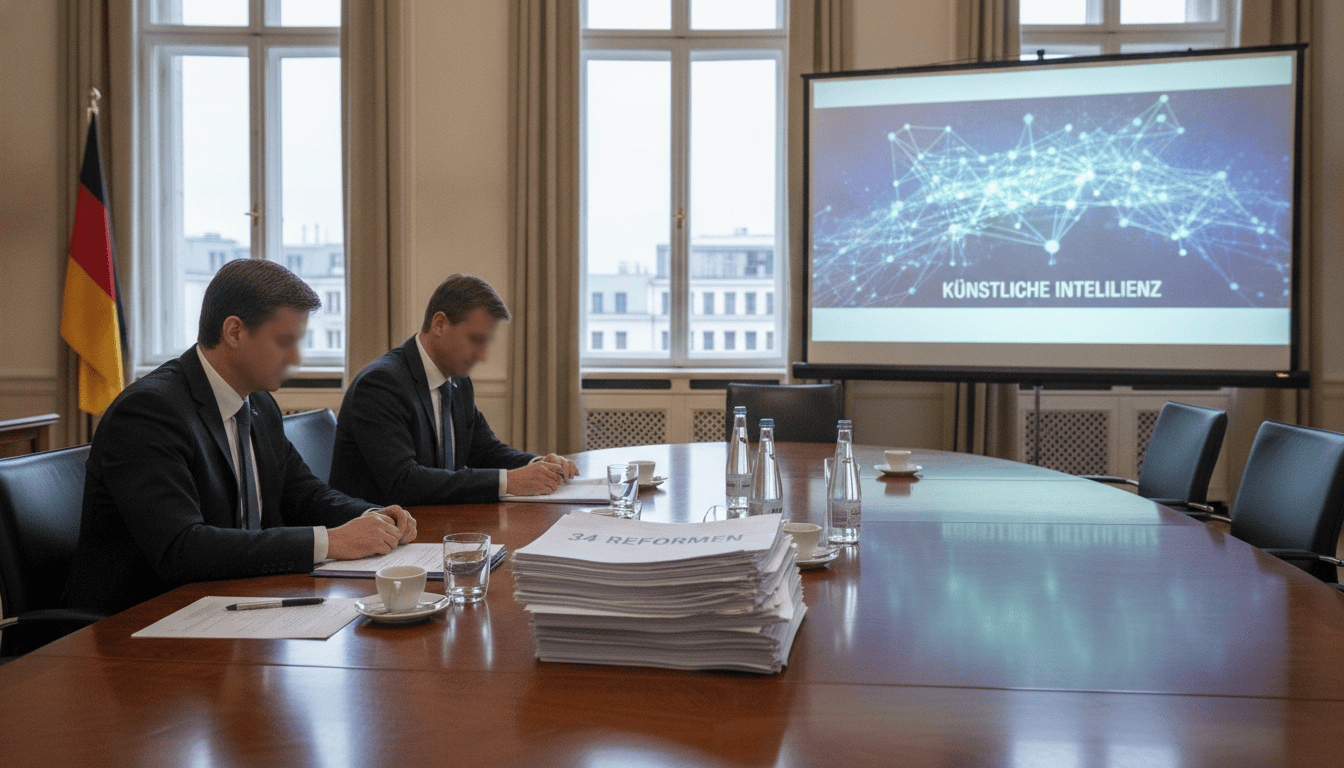
Germany reform package faces test as coalition’s 34 measures await implementation
Coalition’s 34-point Germany reform package outlines tax, social and business changes, but implementation lags amid calls for strategic focus on AI and growth.
The governing coalition has agreed on a 34-measure Germany reform package intended to address taxation, social benefits and business regulation, but the commitments remain largely unlegislated and face internal resistance. The announcement marked a rare consensus between parties with divergent priorities, yet many observers warn that agreement on paper does not guarantee effective execution. With economic growth lagging and geopolitical competition intensifying, the package’s impact will depend on swift legislative follow-through and strategic clarity.
Coalition Agrees 34-Measure Germany Reform Package
The coalition unveiled a broad set of proposals covering healthcare, pensions, income tax and deregulation aimed at boosting competitiveness. Party leaders framed the package as a compromise that balances social fairness and business relief, reflecting the SPD’s and the Union’s competing priorities. Officials presented the measures as a necessary step to modernize key systems, but emphasized that further legislative work is required to translate commitments into statutes.
Agreement Has Yet to Become Law
Despite the headline-grabbing accord, none of the major reforms have been enacted into law at this stage, leaving implementation timelines uncertain. Sources within government circles report early grumblings among some parliamentary factions about detail and feasibility, signalling potential delays. Legal drafting, committee review and inter-ministerial negotiation now stand between the announcements and concrete policy change.
Measures Target Taxes, Social Systems and Business Red Tape
The reform package proposes adjustments to income tax, measures to shore up health and pension arrangements, and steps intended to reduce administrative burdens on companies. Provisions include simplified reporting for businesses, tightened controls on social benefit fraud, and changes aimed at discouraging casual sick-leave claims. Advocates argue these moves could lower costs for employers and improve public finances, while critics caution that social protections must not be undermined in the pursuit of deregulation.
Economic Performance and International Standing Lag
Germany’s economy has shown limited growth over the past seven years, a trend that officials say places urgency on the reform agenda. Comparative data cited by policymakers point to faster expansion in competitors such as the United States and China, intensifying concerns about shifting global economic weight. Analysts warn that incremental tweaks will be insufficient if the goal is to restore Germany’s position as a technology and industrial leader.
AI Seen as Strategic Imperative, Government Response Slow
A recurrent theme among critics is that the government has been slow to treat artificial intelligence as a strategic instrument rather than a mere technological novelty. Officials in Berlin and Brussels have only recently acknowledged AI’s potential to reshape economic power and security relationships, prompting calls for a more coherent, well-resourced national strategy. Observers argue that without concentrated investment in talent, infrastructure and regulatory frameworks, Germany risks falling behind in areas that will determine long-term competitiveness.
Calls for Mentality Shift and Structural Reform
Voices across the political spectrum are urging a broader mindset change that prioritizes “world-class” ambition, entrepreneurial risk-taking and sustained investment over technical fixes within the status quo. References to historical appeals for moral and civic renewal underscore the scale of cultural and institutional adjustment proponents say is required. Some senior politicians have invited citizens and stakeholders to support deeper reforms, framing the current package as a provisional first step rather than a final solution.
Now that a compromise exists, the clock is a political reality: the coalition still has nearly three years in office to enact meaningful change, yet the window for decisive, structural reforms is narrower than many acknowledge. Translating the Germany reform package from agreed text into effective policy will demand not only legal work but also visible leadership, coordination among ministries, and public engagement to sustain politically difficult measures. The coming months will test whether agreement can be converted into action that meaningfully alters Germany’s economic trajectory.
