
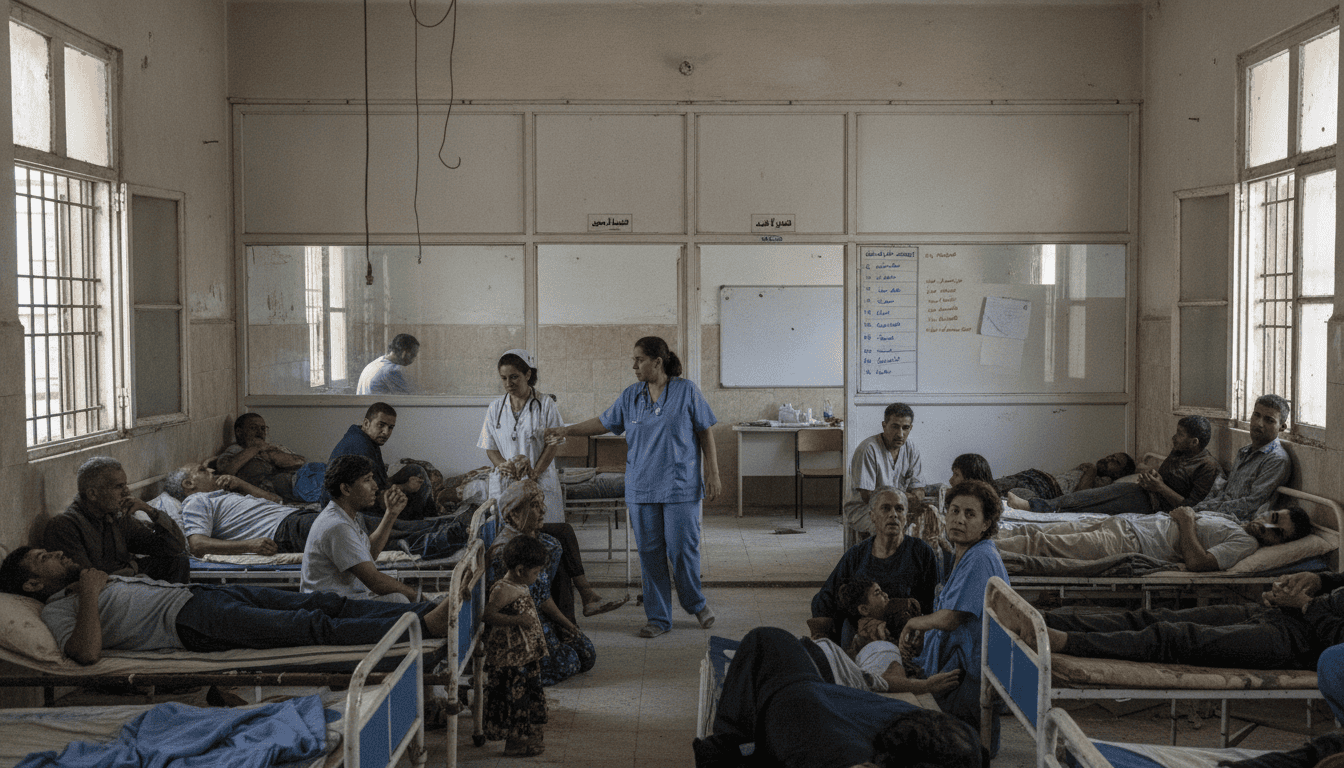
Yemen healthcare crisis strands patients as brain drain empties hospitals
Yemen healthcare crisis leaves patients in Taiz and beyond without specialists, as a decades-long brain drain, low pay and broken facilities force reliance on costly foreign doctors.
Ahmed Nagi, a porter in Taiz, and Taha Nabil, a man who lost sight in one eye after local surgery, represent growing numbers of Yemenis who cannot access basic specialist treatment because of the country’s deteriorating health system. The Yemen healthcare crisis has pushed families to choose between catastrophic medical bills and no care at all, a dynamic that aid groups and local officials say is worsening. International agencies report that large swathes of the country lack doctors entirely, compounding the humanitarian emergency.
Porter sidelined by liver disease in Taiz
Ahmed Nagi, in his 50s, worked for more than three decades carrying goods in al-Turbah market before a progressive liver condition forced him off his feet. He now depends on a walking stick and intermittent charitable donations for medication that he cannot sustain. Local hospitals told him a specialist was required in Sanaa or Aden, but travel and treatment costs put that option out of reach for his family of seven.
Nagi says non-specialist clinicians could not confirm the root cause of his illness and that temporary donations of medicine offered only brief relief. His story illustrates how chronic conditions go untreated when referral pathways and specialized centres are inaccessible. Health officials say cases like his are increasingly common across Taiz and other governorates.
Failed cataract surgery leaves patient blind in one eye
Taha Nabil, 45, saved to pay for cataract surgery in Taiz after no ophthalmologist was available in his district of al-Shimayateen. He said the operation, intended to restore clearer vision, left him completely blind in his right eye and facing the risk of losing sight in his remaining eye. Finding a qualified ophthalmologist and funding the roughly $4,000 needed for corrective treatment are obstacles beyond his means.
Locals and clinicians described Nabil’s situation as symptomatic of a wider problem: before 2015, many specialists practised in Yemen, but years of conflict have driven much of that expertise abroad. Patients who once accessed surgery and follow-up care locally are now forced to travel overseas or await rare visiting specialists.
Physician numbers collapse across Yemen
International data show a severe drop in medical staffing nationwide. The World Bank records roughly 0.1 doctors per 1,000 people in Yemen, far below regional and global averages, while the World Health Organization estimates nearly one in five districts completely lacks a doctor. These shortages coincide with a health-facility collapse that leaves half of clinics and hospitals non-functional in many areas.
Local health officials in Taiz say the workforce decline has been acute: roughly 41 percent of medical staff have been displaced or left the country, according to the deputy director of the governorate’s public health office. The Ministry of Health in Aden and other authorities cite low and irregular salaries, lack of equipment, and repeated power outages as primary drivers of migration among qualified staff.
Foreign doctors fill gaps but face risks
To plug urgent gaps, hospitals have increasingly recruited foreign medical personnel, including Syrian doctors, to provide specialist care and on-the-job training for Yemeni colleagues. The measure has delivered short-term relief in surgery and critical care but has not reduced the high cost of complex treatments for ordinary patients. Recruitment also carries security and financial costs and does not substitute for a stable, locally based workforce.
The security risks are real: on June 12, 2026, two Syrian doctors working in Aden were killed after gunmen opened fire at the governor’s residence, underscoring the dangers medical staff face. Surgeons who remain report heavy caseloads; one orthopaedist said he performs roughly ten major operations a month, far above typical workloads, which strains service quality and staff endurance.
Authorities and aid groups pursue stopgap measures
Officials say the ministry and humanitarian partners are seeking short-term fixes such as financial incentives, contracts for visiting specialists, and support for functioning facilities. These measures aim to retain remaining staff and prevent further collapse, but financing is limited and donor fatigue is a growing concern. Equipment shortages, intermittent supplies and electricity blackouts continue to undermine clinical capacity even where personnel are present.
Public-health experts warn that without sustained investment in salaries, training and infrastructure, Yemen will struggle to control outbreaks and manage chronic disease burdens. Recent waves of cholera and diphtheria have highlighted how fragile the system is when specialists and functioning facilities are scarce.
Patients and families are left to make untenable choices between exposure to substandard local care, costly travel for treatment abroad, or no treatment at all. The result is a humanitarian crisis in which clinical need exists alongside dwindling capacity to meet it, leaving individuals like Nagi and Nabil dependent on charity and the infrequent arrival of skilled clinicians.
Long-term recovery, health officials say, will require coordinated international support to rebuild training pipelines, stabilise wages and restore essential services so Yemen can reverse the brain drain and expand access to specialist care. For now, ordinary Yemenis continue to bear the human cost of lost medical expertise and collapsing infrastructure.
