
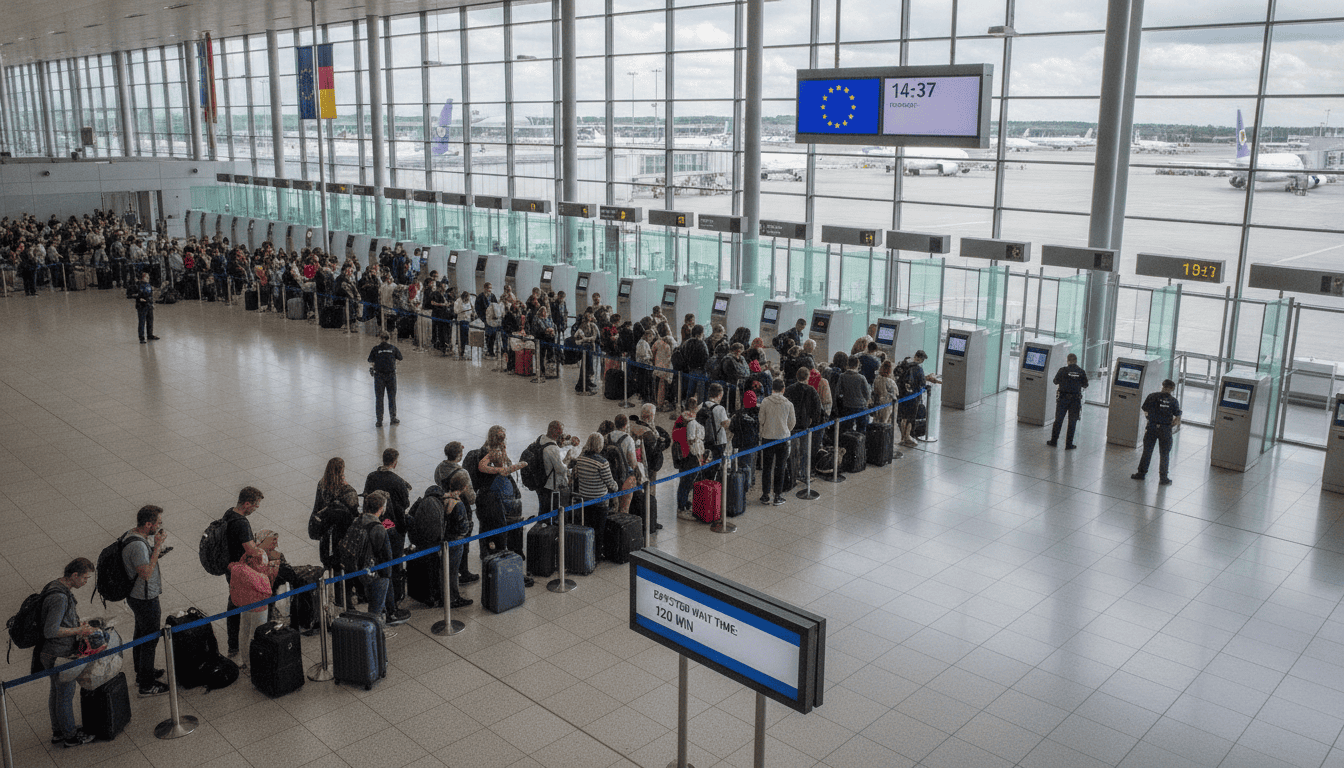
German airports warn of two‑hour queues after EU Entry/Exit System rollout
German airports warn of two-hour queues after EU Entry/Exit System rollout; they demand rapid pre-clearance app adoption, extra staff and use of flexibility.
The German airport association ADV has raised alarms about unusually long border-control waits since the introduction of the EU Entry/Exit System, saying some passengers have faced delays stretching to two hours. ADV president Aletta von Massenbach, who also runs Berlin’s airports, told the news agency dpa that the new biometric procedures for third‑country nationals have lengthened processing times at several locations. The association says the slowdowns have created “unacceptable” queues and urged faster deployment of digital tools to restore passenger flow.
Airports report queues of up to two hours
The ADV said the most severe bottlenecks appear where first‑time EES registrations are processed, with some arrivals experiencing waits of up to 120 minutes. Airport operators described scenes of long lines at passport control, particularly at busy international terminals during peak arrival windows. The association called the current situation untenable and warned of reputational and operational impacts if the delays persist.
Biometric first‑entry process slows passenger flow
Under the EU Entry/Exit System, travelers from non‑Schengen countries must submit biometric data — a photograph and fingerprints — alongside passport details at initial border crossings. That registration is conducted primarily through self‑service kiosks and automated lanes, a process that has proven slower than traditional visual passport checks. Airport representatives say the combined time for kiosk registration and secondary checks is the principal driver of the longer processing times.
EES aims to strengthen security while modernizing borders
EU authorities implemented the EU Entry/Exit System to improve identification, support counter‑terrorism and criminal investigations, and modernize external border controls across member states. The system replaces paper‑based stamping and creates a central record of third‑country entries and exits, enabling faster cross‑border checks once data are in place. Officials stress the security benefits, but airports caution that operational preparations and passenger interfaces must match the new technical requirements to avoid disruptions.
EU reports thousands refused entry and hundreds identified
The European Commission has said that in the months after the EES rollout thousands of passengers were refused entry and hundreds of individuals were flagged for further investigation. The commission’s figures are being presented as evidence that the system is functioning as intended for security screening, though they also underscore the processing burden at busy ports of entry. The ADV noted that citizens within the Schengen area are not subject to EES registration and therefore are unaffected by the new procedures.
Call for pre‑clearance app and broader digital adoption
Airport operators are pressing for rapid deployment of digital pre‑clearance tools that would let travelers complete much of the EES registration on their smartphones before arrival. The ADV specifically called for prioritizing a preparatory app that the EU has developed to streamline biometric capture and data entry. According to the association, the app has been taken up so far only in a small number of member states, and wider adoption by airlines and national authorities is needed to reduce kiosks’ workload.
Authorities urged to use temporary suspension powers
The ADV has also asked Germany’s Federal Ministry of the Interior and the Federal Police to make full use of EU flexibility provisions that allow temporary suspension of biometric enrollment in exceptional circumstances. Under EU rules, biometric capture can be paused when queues become unacceptably long, with alternative identification measures used to clear passengers. Airport leaders say judicious use of that mechanism, combined with operational changes, could blunt the worst delays while digital solutions are scaled up.
Operational measures already under discussion include increasing staffing at passport control, expanding the number of self‑service kiosks, clearer passenger communications ahead of arrival and adjustments to flight scheduling to smooth peaks. Airport officials say coordination with airlines on passenger information and boarding procedures will be crucial to steering travelers toward available pre‑registration options and reducing concentration at arrival halls.
The ADV framed its demands as pragmatic steps to balance the security aims of the EU Entry/Exit System with the practical need to keep airports functioning efficiently, and it called for a concrete timetable for app rollout and additional resources. German airports are now awaiting responses from federal authorities and the Bundespolizei, while monitoring passenger flows and adjusting operations to limit further disruptions.
