
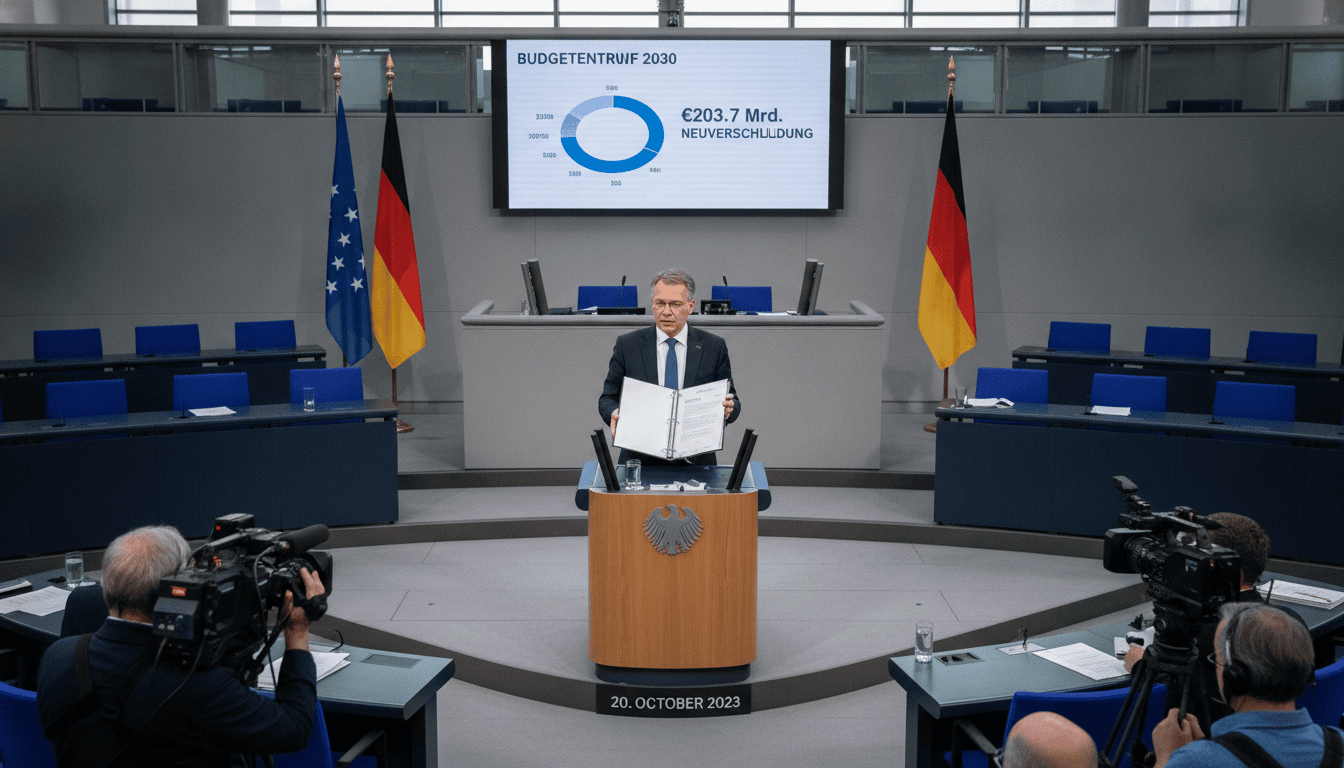
German federal budget: Klingbeil proposes €203.7bn new borrowing in 2027 draft
German federal budget draft: €203.7bn new borrowing planned for 2027 by Finance Minister Klingbeil; deficits persist through 2030. Cabinet vote July 6, 2026.
The federal government’s draft budget, submitted by Finance Minister Lars Klingbeil, proposes net new borrowing of €203.7 billion for the coming year as part of a plan that keeps Germany’s federal budget on a high-debt footing through 2030. The German federal budget draft features a €118.7 billion core deficit alongside nearly €55 billion added through a special investment fund and a €30 billion side-budget for the Bundeswehr, according to the cabinet proposal. The government is scheduled to formalize the budget draft and the financial plan through the decade at a cabinet meeting on Monday, July 6, 2026.
Breakdown of the €203.7 billion borrowing
The cabinet document allocates €118.7 billion to the core federal budget while channeling roughly €55 billion through a special fund intended for infrastructure and climate-neutral investments. In addition, the draft uses the side-budget mechanism one last time to route about €30 billion for defence-related spending, a move the finance ministry says is justified by security needs. These figures form the headline net borrowing number of €203.7 billion that will underpin next year’s fiscal plan.
Debt trajectory remains consistently above €200 billion
The draft projects that the level of new borrowing will not be a one-off but rather a sustained trajectory, with net deficits staying above the €200 billion threshold through 2030 and even approaching nearly €220 billion at the end of the decade. Finance Minister Klingbeil flags remaining “handlungsbedarf” — gaps between revenues and expenditures — but the paper claims that much of the immediate shortfall will be closed by 2027 and reduced compared with previous projections through 2030. The plan still records notable residual gaps in later years, with the so-called handlungsbedarf for 2030 listed at about €47 billion.
Core spending and investment totals climb sharply
At the center of the draft lies a marked expansion in planned outlays: the core federal budget is set at €555.4 billion, roughly €30 billion higher than this year’s figures, and total spending including credit-financed special funds tops €640 billion. Investment spending, when special-fund allocations are included, is estimated at €117.5 billion for next year and is projected to remain around the €120 billion mark in subsequent years. The government presents the special funds as a tool to frontload climate and infrastructure investment while distributing costs over time.
Major ministry allocations and lineup of priorities
The largest single budget plan belongs to the labour ministry, with Labour Minister Bärbel Bas assigned responsibility for nearly €201.5 billion in expenditures in the draft. The Defence Ministry is slated to receive well over €110 billion in the core budget, reflecting the continued emphasis on security-related spending that benefits from statutory exceptions to standard debt rules. These allocations underline the government’s prioritization of social spending and defence as central pillars in the near-term fiscal strategy.
Cuts and reductions in transport and development budgets
Not all ministries see growth: the transport budget falls from €27.9 billion this year to €26.5 billion in the proposed plan, reflecting a modest downward revision in that portfolio. The development cooperation envelope also declines, losing nearly €600 million and slipping below the €10 billion mark it narrowly exceeded this year; overall official development assistance lines are set at about €18.1 billion in the draft. Analysts and sector stakeholders will likely scrutinize these cuts amid competing demands for infrastructure and international commitments.
Rising interest costs and agency liquidity pressures
The government warns that higher debt levels and a markedly elevated interest-rate environment will drive debt-service costs sharply upward, with interest payments on federal debt budgeted at €43.6 billion next year and climbing to roughly €82 billion by 2030. By contrast, interest expenses were approximately €4 billion in 2021, underscoring the scale of the change in public finance dynamics. The draft also flags a sizable deficit at the Federal Employment Agency, which the government proposes to address through an intergovernmental liquidity loan of about €5.2 billion in 2027.
Political reaction to the plan has been immediate, with opposition figures questioning the ministry’s control over public finances and the realism of projected efficiency gains. Green Party critic Sebastian Schäfer told the press the plan raises concerns about depleted reserves, optimistic investment accounting and the absence of concrete consolidation measures. The draft’s mix of higher spending, special funds and lingering budget gaps sets the stage for heated debate in parliament.
The cabinet vote on the budget draft on Monday, July 6, 2026 will launch formal parliamentary consideration, where lawmakers will negotiate amendments and scrutinize the government’s assumptions on investment, debt sustainability and interest-cost trajectories. The Finance Ministry frames the package as a necessary response to investment needs and security pressures, while critics caution that sustained high borrowing and rising debt service will complicate fiscal choices in the coming years.
