
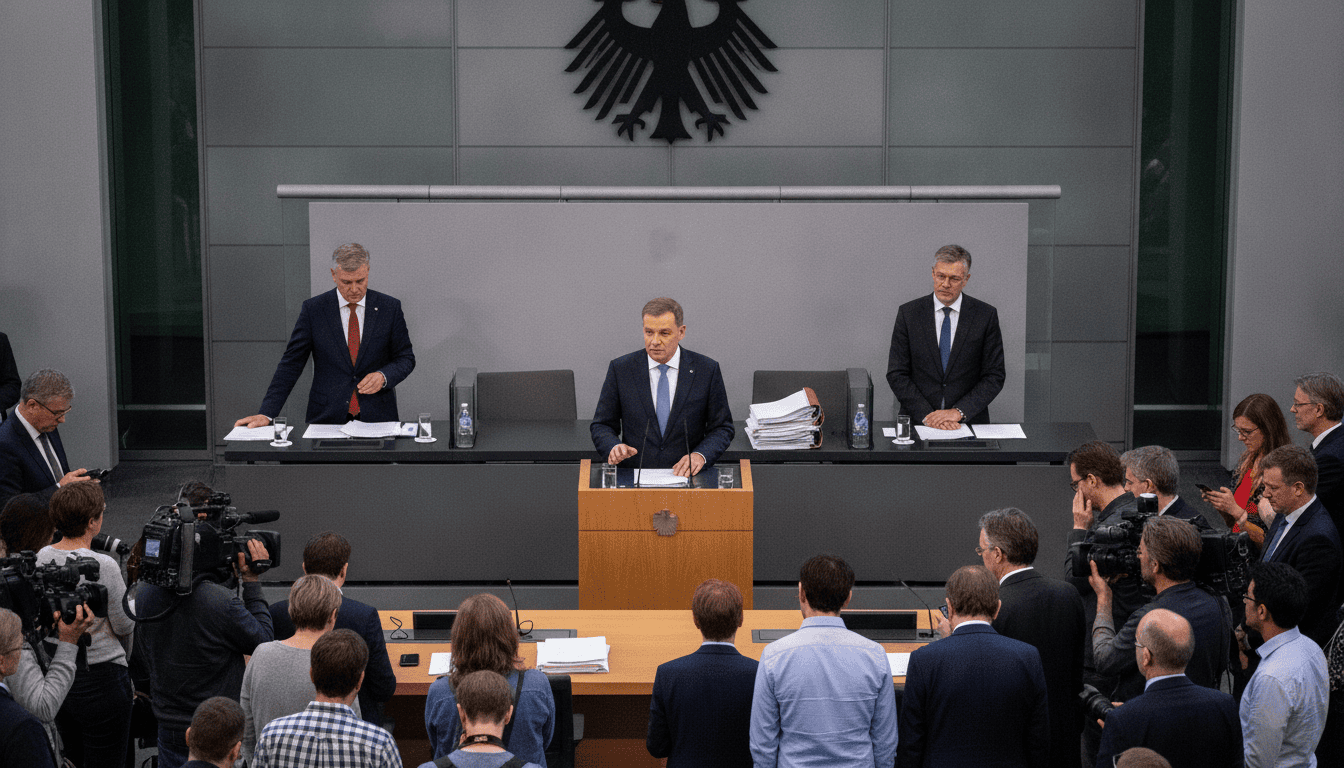
German government reforms deliver modest relief but fall short of solving structural economic crisis
Germany’s new government reforms offer limited measures to boost business confidence and ease some regulatory burdens, but analysts warn the package will not resolve deep structural problems in the economy.
Coalition agrees modest program for growth and employment
The coalition unveiled a package described publicly as a “Program for Growth and Employment” after tense negotiations, aiming to ease burdens on firms and shore up the labour market before the summer recess. The German government reforms include targeted tax relief, adjustments to employment rules and a rollback of certain national additions to EU supply-chain rules.
Supporters say the measures send a signal that policymakers intend to lighten the regulatory load on companies and prevent further investment flight. Critics argue that the political cost of the compromise does not translate into the scale of change necessary to reverse decades-long structural decline.
Changes to work rules are symbolic, economists say
Among the most visible moves are adjustments to rules on sick leave and temporary contracts, measures many employers welcomed as practical relief. The reforms allow longer use of fixed-term contracts until 2030 and provide employers with options to limit some forms of absence management.
Economists caution, however, that these are largely symbolic steps with uncertain macroeconomic impact. While they may ease hiring in the short term, they are unlikely to raise productivity or prompt sustained investment without complementary policies to improve energy costs and market demand.
Tax relief is small relative to the economy
The package includes about €10 billion in tax relief intended primarily for lower and middle incomes, a concession designed to ease household budgets and stimulate spending. That reduction equals roughly one percent of a roughly €1 trillion annual tax take, underscoring its limited fiscal scale.
At the same time, the plan introduces a higher top tax rate to help finance the relief for the middle classes. That measure could blunt incentives for some smaller, pass-through businesses that face higher effective tax burdens, reducing the stimulus effect on corporate investment.
Regulatory rollbacks target bureaucracy but carry trade-offs
Lawmakers agreed to curb certain national add-ons to the EU supply-chain law and to cut reporting duties if ministries cannot justify them, moves intended to ease administrative pressures on firms. These changes are intended to restore some predictability and reduce compliance costs for businesses.
Yet bureaucratic simplification alone will not offset larger disadvantages that companies now face: high energy prices, elevated social contributions and a complex tax-and-transfer system. Business leaders say regulatory relief helps, but only as part of a broader package that includes stable, affordable energy and clearer investment incentives.
Global shifts and demographics compound domestic weaknesses
Long-term challenges weigh more heavily than the new measures: demographic change, the loss of cheap energy sources and a repositioning of China in global trade are undermining Germany’s traditional growth model. The German government reforms do little to address these fundamental drivers, analysts say.
An independent expert council has estimated near-zero potential growth for the economy, meaning output per year may not expand without a marked rise in productivity or investment. With fewer workers supporting more retirees, the fiscal pressure on public finances and wage costs will complicate any recovery that relies solely on short-term stimulus.
China’s industrial turn and energy uncertainty squeeze manufacturers
The rise of Chinese domestic production and a shift away from passive supplier roles has reduced foreign markets for German exporters, particularly in sectors such as automotive and machinery. That structural shift limits the payoff from small-scale domestic reforms.
Energy security remains a critical constraint. The disappearance of cheap pipeline gas and persistently costly power reduce the attractiveness of manufacturing investment in Germany compared with previous decades. Policymakers face hard choices to rebuild an industrial base under these conditions.
The government has achieved a fragile political truce, but the economic remedy it offers is modest and risks being overtaken by larger forces. The coalition’s immediate priority was to avert a domestic political collapse before the parliamentary recess, and the result reads as a compromise that shores up parties more than it transforms the economy.
Longer-term recovery will require measures that go beyond tinkering: a credible plan to lower and stabilise energy costs, targeted investment incentives that raise productivity, and structural reforms to make entrepreneurship and large-scale investment more attractive. Without such steps, Germany’s present reforms may provide short-lived relief but little lasting momentum for growth and employment.
