
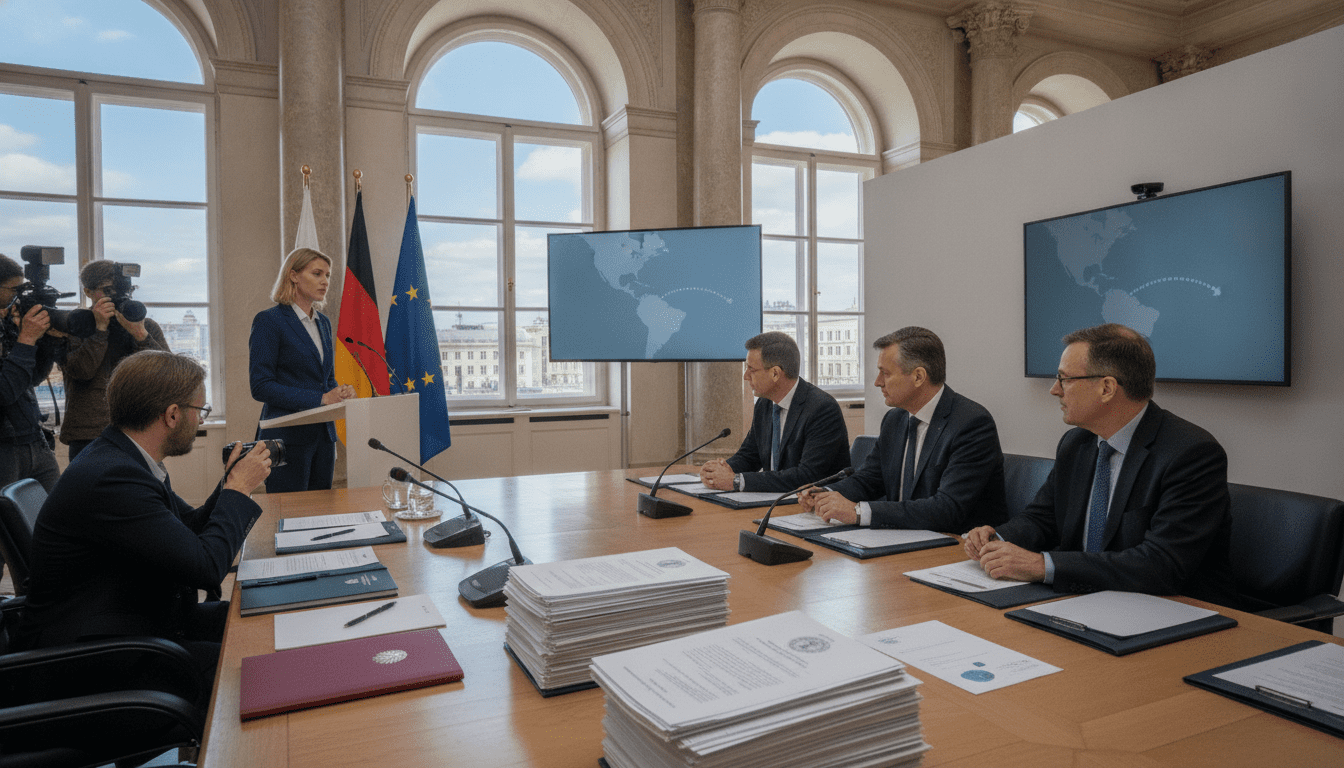
Germany Mercosur partnership: Berlin to begin ratification in July 2026
Germany will begin formal ratification of the EU-Mercosur partnership in July 2026, aiming to deepen ties, secure critical minerals and boost trade for German industry and Europe.
The German government said on the eve of the Mercosur summit in Asunción that it will move quickly to formalize the Germany Mercosur partnership, with Foreign Minister Johann Wadephul (CDU) announcing plans to initiate ratification in July 2026. The decision was presented as part of a broader push to elevate political relations with Mercosur members Brazil, Argentina, Uruguay and Paraguay. German officials framed the step as both an economic opportunity and a strategic effort to diversify supply chains for key raw materials.
Berlin’s July move and political framing
Wadephul told summit delegates in Asunción that Germany intends to be among the first EU governments to start the formal ratification of the political partnership component in July 2026. He described the accord as a historic step that lifts a long-standing relationship to a higher political level, signaling renewed commitment on both sides. The announcement makes Germany one of the most visible backers in Europe of turning the provisional trade framework into a fuller, state-level partnership.
Strategic aims: reducing reliance on China
A core rationale for the Germany Mercosur partnership is to lessen European dependency on China for critical minerals and rare earths used in future technologies. German officials highlighted the need for diversified sources of inputs for electric vehicles, batteries and advanced electronics. By deepening ties with Mercosur producers, Berlin seeks to secure supply lines for materials that are central to industrial modernization and climate-related technologies.
Industry prospects and economic effects
German industry leaders in the automotive, machinery and pharmaceutical sectors see new openings if the pact moves from provisional status to full political implementation. The EU-Mercosur frameworks, first provisionally applied in early May 2026, aim to lower tariffs and remove trade barriers that have long complicated transatlantic flows of goods and services. German exporters are expected to intensify outreach to South American markets, while Mercosur producers may gain more predictable access to European supply chains.
Legal hurdles and parliamentary review
Despite provisional application of the trade elements, the agreement faces legal and procedural hurdles in Europe. In January 2026 a narrow majority in the European Parliament requested a review of the text by the European Court of Justice, which has constrained the deal to provisional status pending judicial scrutiny. To address competences and ratification mechanics, the EU separated the package into an interim trade deal—subject to exclusive EU competence—and a political partnership that requires approval by member states and Mercosur signatories.
Diplomacy at the Asunción summit
At the margins of the Mercosur summit in Asunción, Wadephul held bilateral talks with regional leaders including Chilean President José Antonio Kast and Chile’s foreign minister, Pérez Mackenna. He was also scheduled to meet Paraguay’s President Santiago Peña and Foreign Minister Rubén Ramírez Lezcano to advance implementation plans. German officials said those engagements were intended to coordinate technical steps and to underscore Berlin’s readiness to back implementation once legal issues are resolved.
Timetable, coordination and remaining challenges
Germany’s announcement that it will open ratification in July 2026 sets a tangible timetable but does not guarantee a swift finalization. Ratification of the political partnership still requires coordinated action by EU member states and the Mercosur governments, and any adverse findings from the European Court of Justice could reshape implementation. Environmental and agricultural concerns voiced by some European stakeholders remain politically sensitive and may complicate domestic consideration in several capitals.
The German government presented the move as an effort to harness economic opportunity while managing geopolitical risks, coupling trade ambitions with a message of strategic diversification.
Germany’s decision to act now reflects a balancing of economic and geopolitical priorities: securing access to raw materials for key industries, expanding market opportunities for exporters, and sending a political signal about Europe’s approach to global trade partnerships. The coming weeks will show whether Germany’s early push prompts other EU capitals to accelerate their own ratification processes and whether legal reviews alter the pact’s long-term shape.
