
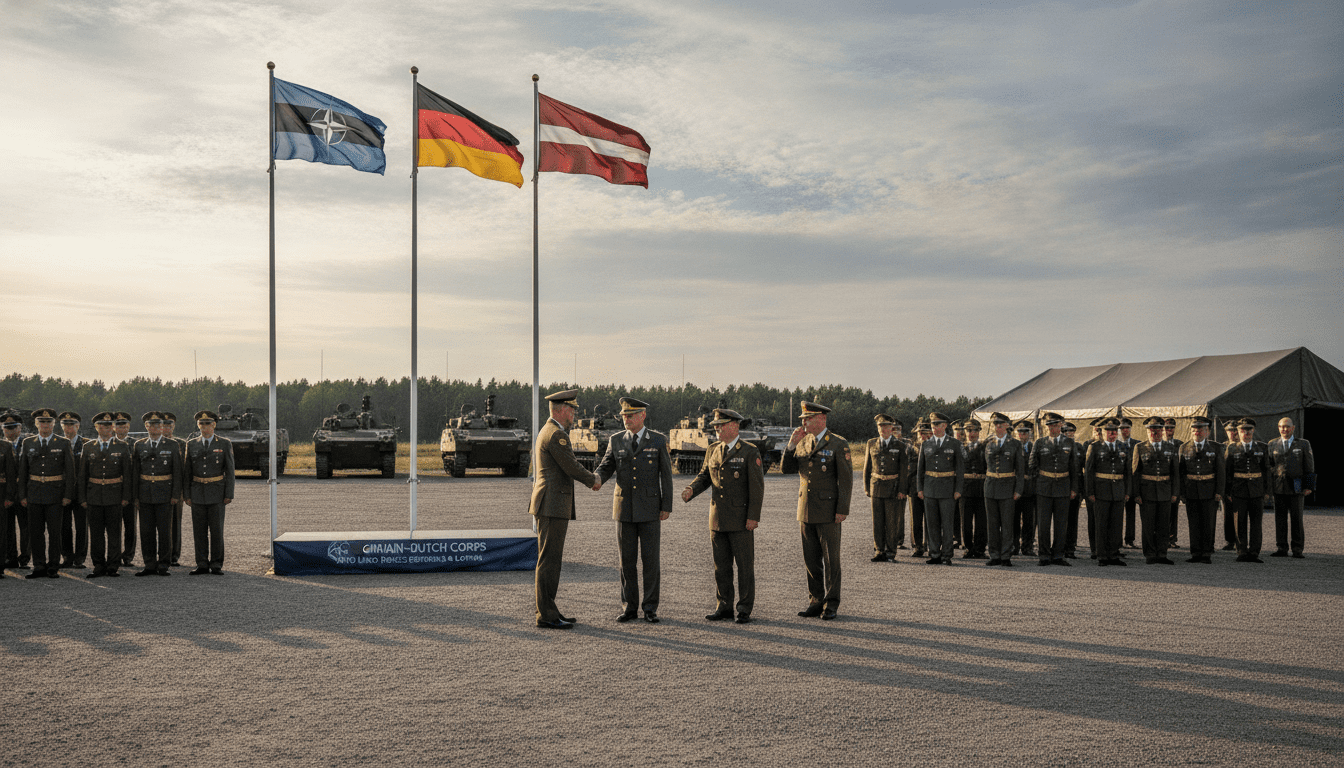
German-Dutch Corps assumes command of NATO land forces in Estonia and Latvia
German-Dutch Corps to lead NATO land forces in Estonia and Latvia, establishing a tactical HQ to reinforce the alliance’s eastern flank ahead of the summit.
The German-Dutch Corps will assume command of NATO land forces in Estonia and Latvia, marking a significant shift in alliance responsibilities on the eastern flank. Germany and the Netherlands announced the handover as the corps prepares to establish a second tactical headquarters in the Baltic region. The transfer, set to take place at the Estonian-Latvian border town of Valga, underscores NATO’s reliance on European allies for regional command and deterrence.
German-Dutch Corps assumes Baltic land command
The German-Dutch Corps, a binational headquarters headquartered in Münster, will now lead NATO land operations in Estonia and Latvia. The move places the corps at the center of planning, exercises and — if required — the defence of the two Baltic allies. Officials described the decision as a way to deepen European responsibility for the alliance’s eastern deterrence posture.
Transfer of authority at Valga on the Estonian-Latvian border
The formal command handover will occur in Valga, a town straddling the Estonian-Latvian boundary where allied officials will mark the change of responsibility. Until now, oversight for the land component in the region has been run from NATO’s headquarters in Poland, but the new arrangement creates a forward tactical headquarters closer to the area of operations. German and Dutch ministers said the relocation will shorten decision-making lines and improve coordination with Baltic partners.
Operational role: exercises and territorial defence
Under its increased remit, the German-Dutch Corps will plan and coordinate multinational exercises across Estonia and Latvia, and direct forces tasked with territorial defence in a crisis. The corps will also assume responsibility for readiness cycles and integrate contributions from other NATO members assigned to the Baltic region. Commanders emphasized the corps’ dual role: routine training to deter aggression and operational command authority if a real-world contingency arises.
Scale and capabilities of the corps headquarters
Established in 1995, the German-Dutch Corps has a rotating leadership pattern between Germany and the Netherlands and can command an international force of roughly 50,000 troops. Its staff already includes personnel from more than a dozen allied countries, giving it the capacity to lead complex, multinational operations. Creating a second tactical headquarters in the Baltics is intended to provide both surge command capacity and a dedicated staff focused on local terrain, logistics and partner coordination.
Germany’s expanded Baltic commitments since 2022
Germany has substantially increased its military engagement in the Baltics since Russia’s 2022 invasion of Ukraine, deploying a brigade-ready force to Lithuania and regularly rotating air policing assets over the region. Berlin’s stepped-up presence is part of a wider NATO effort to reinforce deterrence along the alliance’s eastern edge. Defense officials framed the German-Dutch Corps’ new duties as an extension of that commitment, signalling that European allies will play prominent, sustained roles in regional security.
Baltic partners deepen equipment and industrial ties with Germany
Beyond troop deployments, Estonia and Latvia have pursued closer procurement and industrial links with Germany, including joint acquisitions of air defence systems and partnerships for munitions production. Estonia and Latvia have moved to buy the German Iris-T air defence system, and the first firing unit has already been delivered to Estonian forces. Latvia has signed agreements for domestic munitions production with German companies, reflecting a broader trend of defense industrial cooperation alongside operational integration.
The handover to the German-Dutch Corps arrives less than a week before a NATO summit where alliance cohesion and burden-sharing are slated to be central topics. By putting a European-led corps in charge of land forces in Estonia and Latvia, Germany and the Netherlands aim to demonstrate a concrete example of shared responsibility for deterrence on NATO’s eastern flank. Observers say the arrangement will be watched closely as a barometer of the alliance’s preparedness and the effectiveness of closer European contributions to collective defence.
