
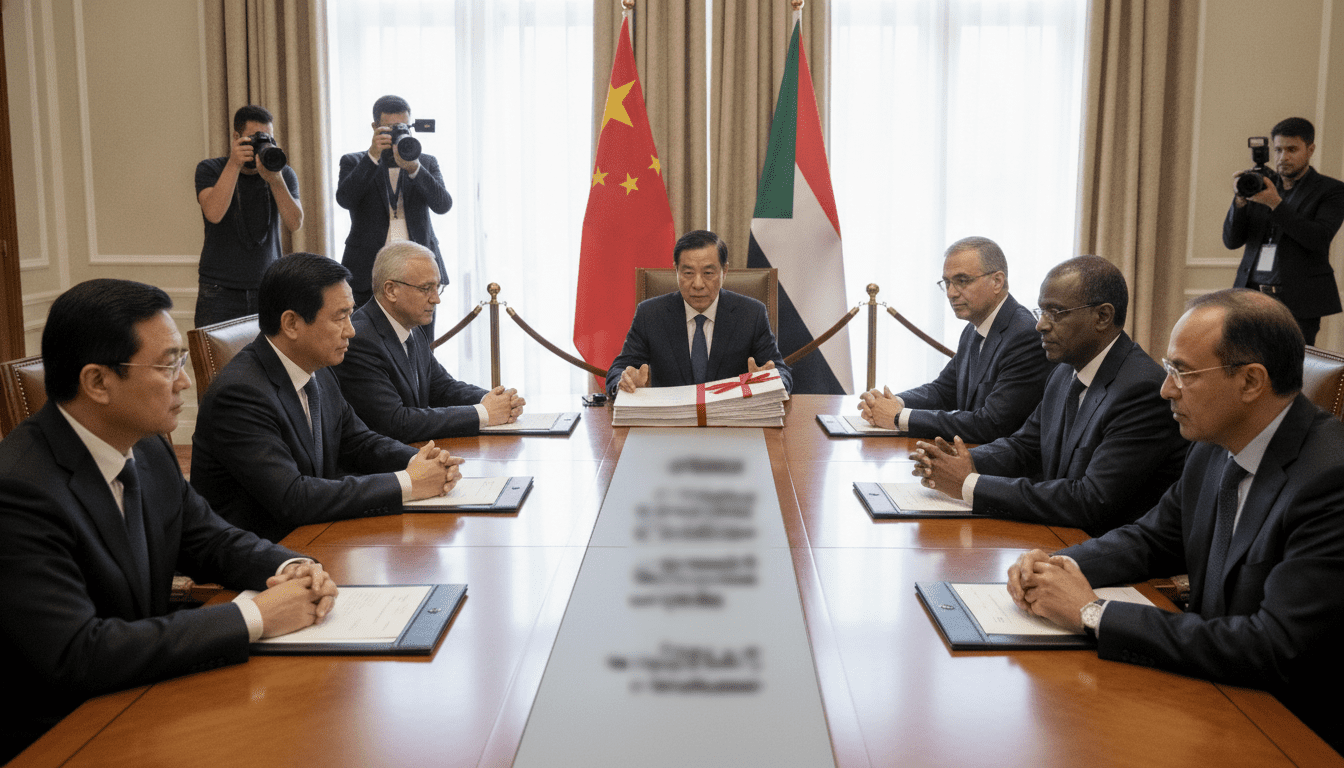
China waives $50m loan to Sudan amid three-year war
China waives $50m loan to Sudan, canceling four interest-free credits as Khartoum seeks support during a three-year war that has devastated its economy.
China waives $50m loan to Sudan, canceling four interest-free credits with immediate effect as Khartoum seeks international support amid a devastating three-year conflict, the governments said. The relief covers four interest-free loans totaling 344 million yuan, roughly $50 million, and was formalized at a signing in Port Sudan. Chinese and Sudanese officials framed the move as a gesture of support while Sudan’s options for new external financing have narrowed under Western pressure.
Agreement signed in Port Sudan
The protocol signed in Port Sudan cancels four interest-free loans amounting to 344 million yuan, according to Sudan’s state news agency. Sudanese Finance Minister Gibril Ibrahim attended the ceremony and publicly welcomed the waiver as timely assistance. China’s charge d’affaires in Khartoum, Xu Jian, said Beijing is prepared to help rebuild infrastructure and services damaged by the conflict. Officials characterized the measure as immediate debt relief rather than part of a wider restructuring plan.
Relief small against massive external obligations
While politically significant, the $50 million cancellation is a sliver of Sudan’s external liabilities, which were estimated at over $56 billion before the war. The sum amounts to less than 1 percent of Sudan’s pre-war external debt and will not reverse broader solvency strains. A 2021 debt-relief trajectory under the IMF and World Bank’s HIPC framework had promised far larger write-offs, but that process was derailed by the October 2021 military coup and suspended a year later. For now, the Chinese waiver provides targeted breathing room without addressing the structural debt burden.
Humanitarian and economic collapse at home
The debt relief comes as Sudan endures severe humanitarian and economic deterioration linked to the conflict now in its third year. The United Nations estimates the economy has contracted by roughly 40 percent, while UN figures cited at the signing place cumulative fatalities at more than 1.5 million and forced displacement at about 14 million people. The World Health Organization reports fewer than 14 percent of health facilities are still functioning, and employment opportunities have largely vanished in many areas. The Sudanese pound’s collapse—from about 600 to the dollar before the war to more than 5,000 by June 2026—has compounded the crisis for ordinary households.
China’s long-term Africa strategy in play
Beijing’s decision fits a pattern of diplomatic debt relief that complements its broader economic footprint in Africa. Over recent decades China has been Africa’s largest trading partner and has periodically forgiven small, interest-free loans as part of bilateral summit diplomacy. Academic analyses have documented routine cancellation of modest credits, while larger state-backed commercial loans are typically more difficult to restructure. China’s National Petroleum Corporation had been a major investor in Sudan’s oil sector but formally sought to exit the country in December 2025, reflecting security and commercial calculations.
Geopolitical signaling to Western powers
The waiver also carries geopolitical significance as Western states have largely held back significant financial engagement with Sudan amid concerns over governance and sanctions. Sudan’s finance minister, Gibril Ibrahim, was added to a US Treasury sanctions list in September 2025, a designation cited by US officials as linked to alleged involvement in the conflict and ties to external actors. In that context, even modest Chinese relief can be read as a political signal that Beijing remains willing to engage with Khartoum when Western capitals step back. Analysts say such moves can deepen China’s influence in a country situated at the crossroads of the Middle East and sub‑Saharan Africa.
Limits of the waiver and path ahead
Despite the diplomatic value, the waiver’s practical limits are clear: it does not substitute for large-scale reconstruction finance, comprehensive debt restructuring, or restored access to international capital markets. Sudan will still need coordinated multilateral engagement to address immediate humanitarian needs and to stabilize macroeconomic conditions. Chinese state banks and commercial creditors hold larger claims that are unlikely to be forgiven without complex negotiations, and any substantive long-term recovery will require wider international participation. Beijing’s stated readiness to assist with rebuilding will be tested by security conditions and by the willingness of other creditors to engage.
The $50 million waiver highlights how small but timely financial gestures can matter politically even when they do little to alter a country’s overall indebtedness. For Sudan, the cancellation is a short-term relief amid a deeper collapse that requires coordinated global action, while for China it is a continuation of a pragmatic engagement strategy in Africa that balances economic interests with diplomatic influence.
