
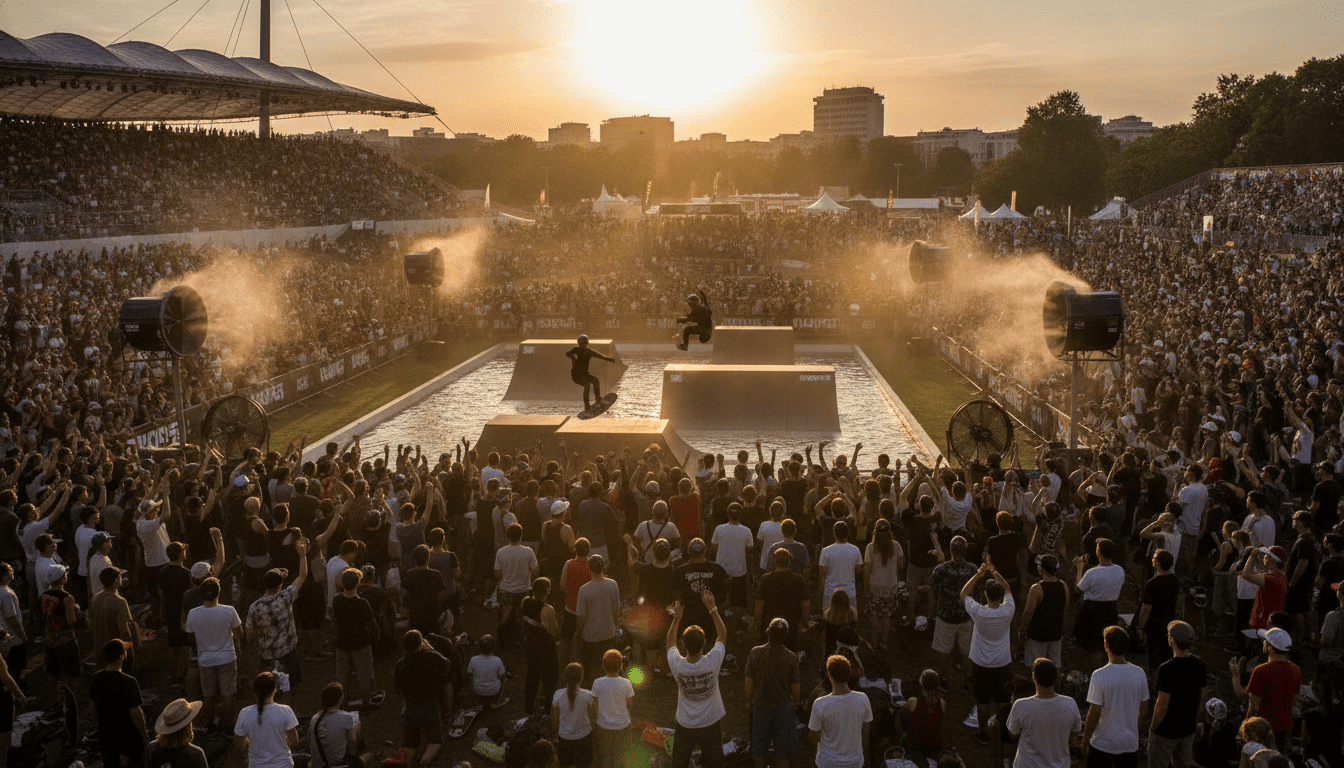
Munich Mash Draws 60,000 as Heat and Gusty Winds Challenge Riders
Munich Mash brought 60,000 spectators to the Olympiapark on Sunday as near-39°C heat and gusty winds tested the field across BMX, skate, mountain bike and wakeboard events. The multi-discipline festival completed its 11th edition with top international winners — and notable German finishes — despite tricky conditions that made some high-risk maneuvers precarious. Munich Mash remained a showcase for world-class athletes and a rare venue where so many action sports meet in one place. Organizers reported a strong turnout and few serious injuries, underlining the event’s growing stature.
Heat and Gusts Test Riders at Munich Mash
The weekend’s high temperatures offered little relief even as occasional breezes cooled the crowd in the stands. For riders launching tricks seven metres above the ground, however, those same gusts altered lines and timing, increasing the margin for error during aerials and flips. Athletes and teams adjusted runs to account for shifting wind, and event medical teams were on heightened alert for crashes and heat-related problems. Spectators nevertheless filled the bowl and ramps, drawn by the rare convergence of disciplines and elite competitors.
BMX Podium and German Breakthrough
BMX delivered one of the day’s most dramatic finals, with Colombia’s Juan Caicedo and Britain’s Kaine Mitchell finishing ahead of Germany’s Lars Kindermann, who took third. Kindermann, now ranked inside the world’s top 20, described how crosswinds can turn an otherwise routine double flip into a dangerous landing if the bike and rider do not align. The result underlined his status as Germany’s leading BMX athlete and fed his ambition to qualify for the Los Angeles Olympics. The podium mix reflected the sport’s international depth and the technical precision demanded at this level.
Skate Halfpipe and Mountain Bike Return
Skateboarding returned to a classic format this year as athletes competed in a massive halfpipe rather than park discipline, and Italy’s Alessandro Mazzara emerged victorious. The switch to halfpipe brought bigger airs and a renewed focus on amplitude and flow, pleasing purists and fans alike. Mountain biking also made a notable comeback to the program after a decade-long absence, with Sweden’s Alex Alanko taking top honors in front of an enthusiastic audience. Both wins highlighted Munich Mash’s ability to showcase varied formats and to revive disciplines within a single, festival-style event.
Wakeboard Finale Remains Munich Mash Trademark
The wakeboard contest, a signature element of Munich Mash absent from the X-Games line-up, closed the event with a field stacked by global specialists. Britain’s Liam Peacock claimed the top spot in the final, while Germany’s Nico von Lerchenfeld finished a strong fifth overall. Local favorite Dominik Gührs impressed with high-flying tricks but was eliminated in qualification amid the exceptionally deep world-class roster. Wakeboard’s presence at the Mash continues to differentiate the festival and to attract elite water athletes who rarely compete in the same venue as skate and BMX riders.
Event Origins, Organization and Audience Appeal
Munich Mash was launched after the X-Games left the Olympiapark in 2014, an initiative driven by the Olympiapark Munich GmbH under the leadership of Marion Schöne. Organizers aimed to keep extreme action sports alive in the city, and the strategy has paid off: the event reliably draws large crowds and top international talent. Beyond competition results, the Mash’s appeal lies in its festival atmosphere, where skateboarding, BMX, mountain biking, wakeboarding and street dance converge in one venue. That mix has helped cultivate a communal ethos among athletes, who often describe themselves more as peers than cutthroat rivals.
The event’s running order and discipline choices also reflect a careful balance between spectacle and athlete safety, a priority heightened by the weekend’s weather. Course designers and judges adjusted technical expectations where necessary, and event staff monitored conditions to limit additional risk. The combination of meticulous planning and robust turnout signaled that Munich Mash remains a leading stop on the international actionsports calendar.
Munich Mash’s 11th edition left organizers and athletes looking ahead to further development, with several competitors already citing the event as key preparation for bigger international goals. The blend of high-level competition, a packed Olympiapark and a diverse program reinforced the festival’s role as a national showcase and an international draw for extreme sports.
