
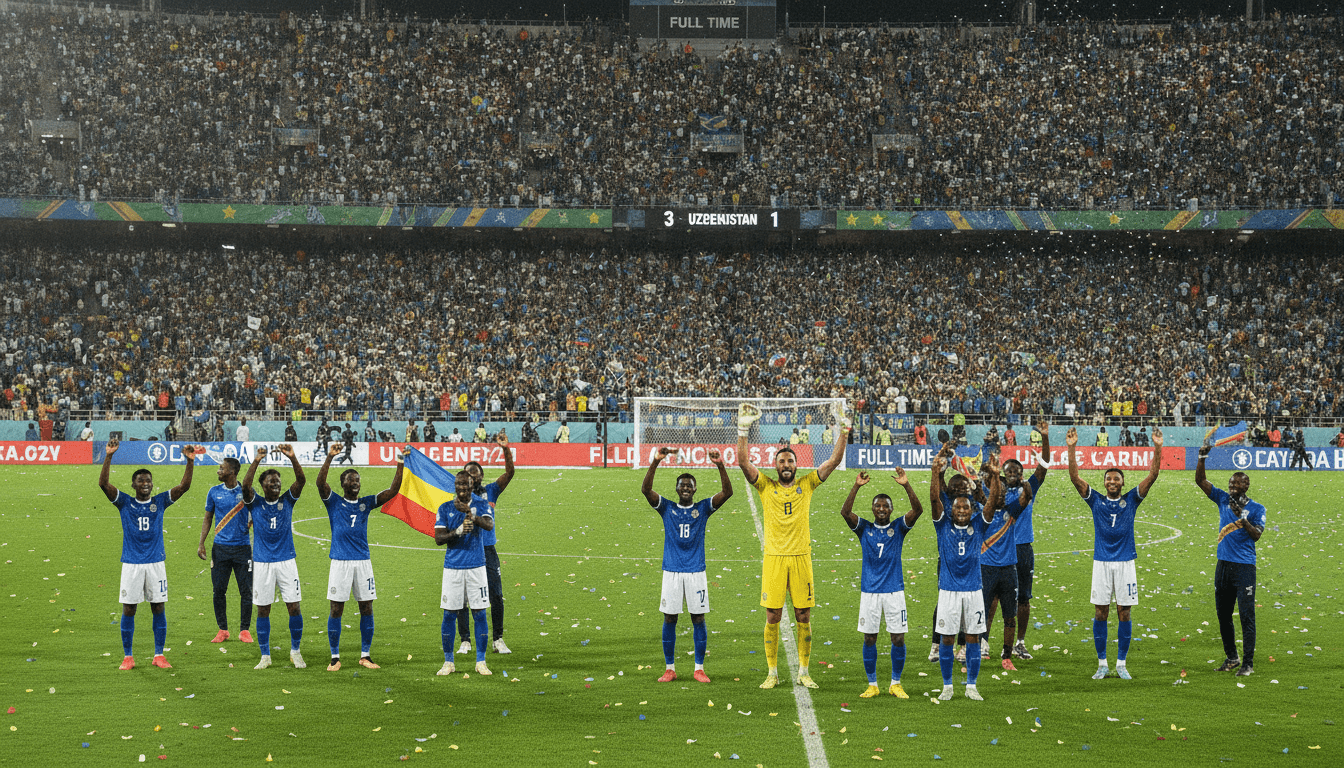
DR Congo World Cup: Team Reaches Last 16 with 3-1 Win Over Uzbekistan
DR Congo reach World Cup last 16 with 3-1 win over Uzbekistan on June 28, 2026; Desabre hails resilience as Congo prepare to face England in Atlanta on July 1.
The Democratic Republic of Congo advanced to the World Cup round of 16 after a 3-1 victory over Uzbekistan on June 28, 2026, overturning an early deficit to secure one of the best third-place finishes. The DR Congo World Cup run was highlighted by a disciplined second-half comeback and decisive finishes from Yoane Wissa and Fiston Mayele. The win came despite the notable absence of the team’s famed supporter Michel Nkuka Mboladinga, known as Lumumba Vea, who was unable to enter the United States. The side now heads to Atlanta to face England on July 1, 2026, with momentum and widespread national attention.
Match outcome and decisive moments
An early lob from Eldor Shomurodov put Uzbekistan ahead and threatened to derail DR Congo’s qualification hopes in the opening minutes. A late first-half equalizer by Nathanael Mbuku was overturned after VAR review and referee Felix Zwayer ruled the goal invalid for a hand obstruction. The match swung in DR Congo’s favor in the second half when Yoane Wissa converted a penalty to level the score and lift the team’s spirits.
Following the penalty, Fiston Mayele capitalized on sustained pressure to make it 2-1, and Wissa sealed the victory with a composed strike to finish the scoring at 3-1. The bench and coaching staff maintained tactical patience, allowing the team to build rhythm and convert opportunities under increasing intensity. The result fulfilled the Congolese requirement of a win to advance as one of the tournament’s best third-placed teams.
Fan Lumumba Vea barred from Atlanta
Michel Nkuka Mboladinga, who dresses as Patrice Lumumba and has become an emblematic figure for DR Congo supporters, attended the team’s match in Zapopan, Mexico, earlier in the tournament. He was not present in Atlanta after U.S. authorities reportedly denied him a visa, a development that drew attention from both fans and observers. The absence of Lumumba Vea removed a visible piece of the team’s emotional support, though players and staff repeatedly acknowledged his symbolic role.
Team officials did not publicly link on-field performance to the fan’s absence, but supporters and commentators noted the morale impact of such a visible advocate being unable to attend. The episode also raised questions about travel and diplomatic hurdles faced by some national delegations and their supporters during the tournament. Despite the setback, the victory demonstrated the squad’s ability to focus amid off-field distractions.
Coach Desabre’s reaction and team resilience
Coach Sébastien Desabre lauded his players’ character after the match, saying that the side had shown the same grit it displayed against Portugal and during qualifying fixtures. He highlighted the group’s collective sacrifice and renewed commitment to the cause after a difficult start in Atlanta. Desabre’s rotations and in-game adjustments were credited with restoring balance and unlocking space for the forwards.
Players echoed the coach’s assessment, pointing to concentration and belief as key factors in overturning the early deficit. Yoane Wissa’s penalty composure and late finish were singled out as examples of clinical execution under pressure. The squad framed the triumph as a unifying achievement for a nation seeking positive representation on football’s biggest stage.
From Zaire 1974 to DR Congo 2026: historical backdrop
The qualification carries resonance beyond the tournament itself, recalling DR Congo’s solitary previous World Cup appearance in 1974 when the country competed as Zaire. That team suffered three defeats and an aggregate 0-14 goal difference amid a politically charged era under Mobutu Sese Seko. Contemporary players and supporters have repeatedly contrasted the current campaign with that troubled debut, describing the 2026 run as an opportunity to rewrite the national football narrative.
Media retrospectives and long-form coverage have noted how perceptions of African teams at past World Cups were often colored by prejudice and misunderstanding. For DR Congo, advancing from the group stage in 2026 represents not just sporting progress but also a counternarrative to decades-old impressions. The squad’s progress has been portrayed at home as a symbol of national pride and a milestone in the country’s footballing history.
Tactical outlook and the July 1 showdown with England
The immediate challenge for DR Congo is a last-16 tie against England on July 1, 2026, again in Atlanta, where tactical planning will be scrutinized and margins will be fine. England will enter the match as favorites on paper, but DR Congo’s coaching staff have emphasized freedom and attacking intent as a way to unsettle a heavily favored opponent. The Congolese side may adopt a compact defensive shape with rapid transitions to exploit England’s high line, particularly through the pace and movement of their forwards.
Match preparation will also consider disciplinary records, set-piece allocation, and managing player fatigue after a physically demanding group phase. Analysts note that teams with nothing to lose often pose unexpected threats in single-elimination fixtures, and DR Congo’s recent form suggests they will approach the game without excessive caution. The fixture offers both a stern test and a chance for further national celebration should the team perform above expectations.
DR Congo’s advance to the World Cup last 16 is a landmark moment for the nation’s football program, achieved through a blend of individual finishing and collective resolve. As the squad prepares for the England match on July 1, 2026, the country will watch closely to see whether this team can extend its tournament run and cement a new chapter in its World Cup story.
