
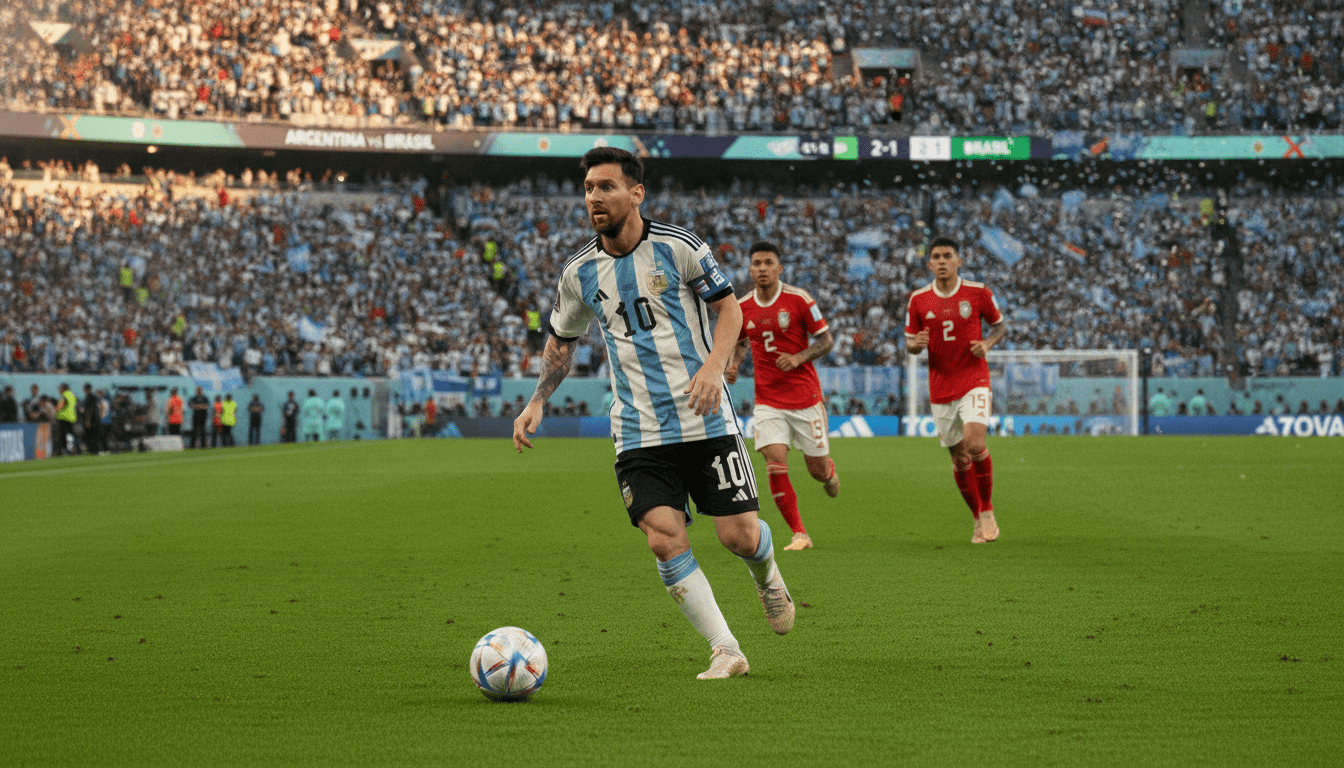
Messi and Ronaldo Steal the Show at the Midpoint of the 2026 World Cup
Fan attention shifts as Lionel Messi and Cristiano Ronaldo headline the 2026 World Cup, proving age has not dimmed their influence.
The 2026 World Cup has reached its midpoint and the tournament’s narrative is unexpectedly centered on familiar names. About half of the matches of this expanded global competition have been played, and Lionel Messi and Cristiano Ronaldo are again the defining figures on the pitch. Their performances have reframed debates about eras, style, and what it means to be the game’s greatest.
Messi and Ronaldo at the Heart of the Tournament
Both superstars have become focal points of the 2026 World Cup, drawing defenders and headlines in equal measure. Messi’s small, precise movements continue to shape games even when the surrounding tactics shift dramatically. Ronaldo remains a finishing focal point for Portugal, converting chances with the clinical instinct that has defined his career.
Their presence has altered how opponents prepare and how broadcasters frame matches, turning each appearance into an exercise in measuring legacy against contemporary context. Fans and pundits alike are watching not just for goals but for evidence of how individual brilliance adapts to modern football’s speed and structure.
Nostalgia for 2006–2014 Meets Current Reality
Many supporters trace a golden age of football to the 2006–2014 period, remembering playmakers who controlled tempo and attackers who produced classic moments. That era featured technicians and architects who often dictated matches through possession and subtle movement. Today’s debate frequently returns to whether that period represented football’s high point.
But the comparison is complicated: the game’s reference points have changed. Rule shifts, athletic conditioning, and tactical evolution have altered the canvas on which stars perform, making direct comparisons misleading rather than illuminating.
Tactical Shift: From Possession Ballet to Rapid Counters
Tactics at the 2026 World Cup reflect a broader shift away from patient possession toward faster transitions and aggressive pressing. Many teams now prioritize winning the ball high and moving forward quickly rather than constructing prolonged passing sequences. The result is a tournament with more end-to-end action and fewer long passages of untroubled possession.
This change has amplified certain player profiles while obscuring others; lone orchestrators who once thrived in pockets of space must now operate under relentless pressure. The pace has made football feel less elegant to some observers, but it has heightened tempo and unpredictability across matches.
How Individual Class Is Tested by Systemic Change
The question of whether any player matches the individual class of the past is complicated by the game’s evolution. Players like Zidane or Xavi enjoyed different spatial and temporal conditions that allowed them to exhibit extended sequences of control. Today’s framework compels even the most gifted to adapt to constant pressing and rapid recovery runs.
Yet some qualities remain timeless: spatial intelligence, decision-making under pressure, and the ability to influence outcomes persist regardless of formation. Messi’s capacity to puncture defenses with subtle motion and Ronaldo’s goal-scoring instincts demonstrate that extraordinary individual traits can transcend tactical eras.
Club and National Coaches Respond to the New Tempo
Coaches at this World Cup must reconcile club-level training with international structures, often choosing pragmatic strategies for short tournament windows. Many managers favor compact defensive shapes and quick vertical play to maximize limited preparation time. Such approaches are designed to exploit transitional moments rather than sustain long periods of control.
These tactical choices have reinforced the roles of fast attackers and athletic midfielders while reducing opportunities for players whose gifts lie in prolonged positional manipulation. Coaches therefore emphasize collective cohesion and directness when planning for knockout scenarios.
Fan Perception and the Cultural Frame of Greatness
Pop culture and collective memory play a significant role in how eras are judged, with retro fashions and highlight reels shaping perceptions. Supporters often remember the texture of past tournaments—the songs, kits, and iconic plays—through a lens that accentuates beauty and drama. That nostalgia fuels claims that football peaked in earlier years.
At the same time, present-day spectacles offer their own forms of excitement: blistering counters, athletic duels, and moments of improvisation that defy replication. The coexistence of reverence for the past and enthusiasm for the present underlines how greatness is often measured by feeling as much as by statistics.
The second half of the 2026 World Cup will test whether the current tactical paradigm allows room for more players to assert sustained individual dominance. Teams, coaches and stars will all face decisions about risk and control as they chase knockout success. The tournament’s remaining matches will help determine whether the modern game’s velocity enhances or diminishes the legacies of those who have already written their names into football history.
