
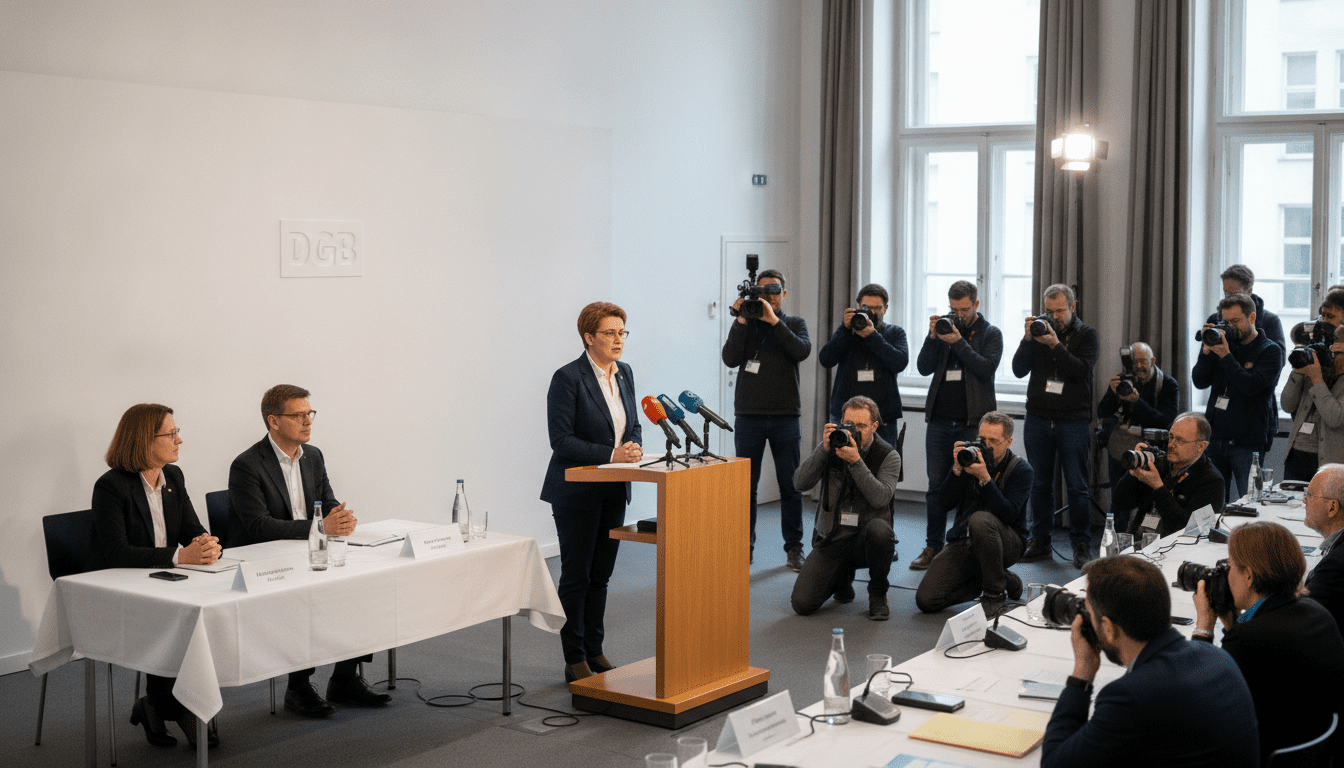
DGB pension plan challenges government commission with commitment to higher statutory pensions and compulsory workplace schemes
DGB pension plan backs higher statutory pensions and mandatory workplace schemes to secure 70-90% of net income, contesting the government’s capital-rente.
DGB presents alternative to government recommendations
The DGB pension plan was unveiled as a clear alternative to the federal government’s recently published commission report. The trade union federation says its package would raise the statutory pension level while adding a compulsory employer-funded workplace pension, aiming to protect retirees’ incomes without raising the pension age. The timing places the DGB proposal directly against the government commission’s 33 recommendations, which include a capital-funded supplement to the statutory system.
Main measures proposed by the DGB commission
The DGB commission recommends boosting the statutory pension level from the current 48 percent to 50 percent and then to 53 percent. It also calls for mandatory occupational pensions, with employers providing a minimum contribution equal to two percent of gross wages. Together, the DGB argues, these measures could secure between 70 and 90 percent of a worker’s last net income in retirement, depending on earnings and contributions.
How the DGB plan would be financed
Financing in the DGB pension plan would rely on slightly higher contribution rates and a larger federal subsidy to the statutory pension insurance. The proposal envisages a “demography subsidy” financed by taxes on high incomes, large private wealth and capital income. The DGB also proposes gradually widening coverage so that more groups—initially the self-employed and elected officials—pay into the statutory system as steps toward a broader employment-based insurance.
Differences with the government’s capital-rente approach
The government commission’s package differs in design and emphasis, centering on a capital-funded supplement to the pay-as-you-go pension system. That model would see employees and employers jointly adding two percent of gross wages to a capital-based pension reserve, with the intent of improving future pensions for younger cohorts. By contrast, the DGB rejects a core capital-rente under the statutory roof while leaving open the idea of a large tax-funded capital stock that could stabilize contribution pressures for the pay-as-you-go system.
Contested policy elements and political tensions
Several elements of the government plan are explicitly rejected by the DGB pension plan, notably the scheduled further increase of the statutory retirement age and the abolition of early retirement without deductions after 45 contribution years. DGB leadership praises selective goals in the government package, such as the long-term aim of securing 70 percent of net earnings, but objects to shifting burdens onto future retirees. The federation’s paper frames employers and higher earners as principal contributors to the additional costs, setting up potential conflict with business groups and parts of the governing coalition.
Public and procedural next steps
The DGB says the initial eleven-page concept is a first stage and will be followed by a more comprehensive closing report scheduled for the summer. For the governing CDU-SPD coalition, the move by the federation could act as a disruptive element in legislative negotiations over pension reform. Implementation of any reform will require parliamentary decisions and agreement on detail, including the exact size of contribution increases, the structure of employer mandates and the legal design for expanding statutory coverage.
The DGB pension plan places social insurance principles at the center of the debate and seeks to prioritize income replacement over market-based accumulation as Germany considers long-term pension sustainability.
