
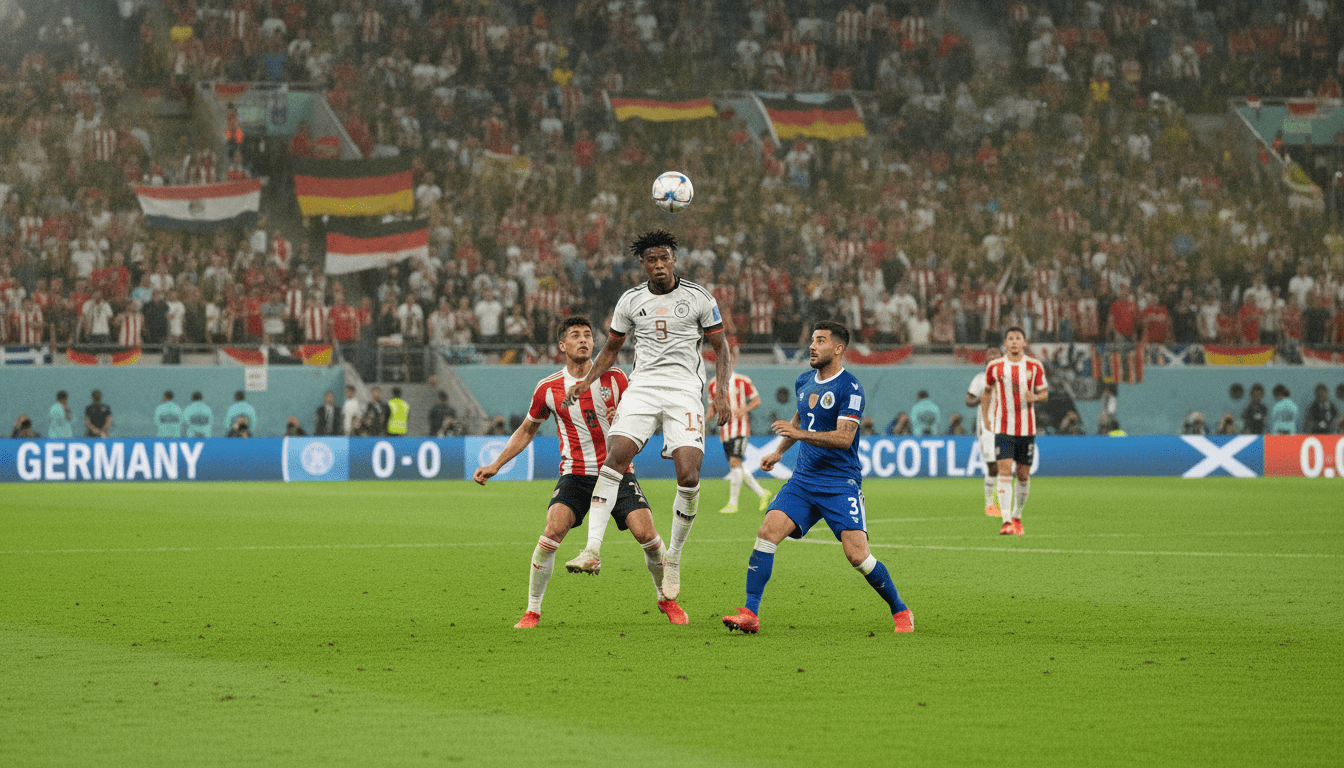
Germany’s World Cup round-of-16 opponent list narrows to eight potential teams
Germany’s World Cup opponent field tightens as eight third-place candidates remain for the round of 16, with Scotland, Paraguay and Australia among the likeliest options.
Germany’s World Cup opponent possibilities have been reduced sharply, shrinking from 15 to eight teams after a series of group-stage results. The German squad is guaranteed to meet a third-placed side from groups A, B, C, D or F in the round of 16, which will be played in Foxborough near Boston on Monday, June 29, 2026 at 22:30 CEST and broadcast by ARD and MagentaTV. That narrowing reshapes preparations for Julian Nagelsmann’s team as the final group fixtures conclude.
Scotland remains a theoretical opponent but sits on a knife-edge
Scotland finished third in Group C after a 0-3 defeat by Brazil and currently has three points with a 1:4 goal difference. That tally leaves the Scots dependent on finishing among the eight best third-placed teams, a position that is far from secure given their goal situation and the remaining fixtures. If Scotland holds one of those eight slots, it could be drawn against Germany in the first knockout round, but their path to qualification remains fragile.
Paraguay-Australia showdown will significantly affect Germany’s draw
A decisive match between Paraguay and Australia in Group D will play a major role in determining who Germany may face. Paraguay and Australia enter the contest level on points, with Paraguay holding a slightly inferior goal difference; Paraguay must win to overtake second place, while Australia can secure the higher spot with a draw. The outcome will also influence whether a D3 side, frequently projected as Germany’s opponent in many scenarios, is Paraguay or Australia.
Third-place ranking shows Bosnia-Herzegovina leading the pack
Among the current third-placed teams, Bosnia-Herzegovina sits top of the comparative table with four points and a 5:6 goal record, having already cemented one of the eight qualifying third spots. Several other third-placed nations follow closely, with Sweden, Croatia and South Korea occupying mid-table positions. Scotland, Paraguay and a handful of others remain in contention, but the comparative ranking is volatile until all groups finish their final matches.
Scenario math: Distribution heavily favors groups C and D for Germany’s opponent
Under the FIFA allocation method for third-placed teams there were up to 495 initial scenarios; after the completion of groups A, B and C that number narrowed to 246 remaining possibilities affecting Germany’s opponent. Within that reduced set, a team from Group D accounts for the largest share of outcomes, with 107 of 246 scenarios leading to a D3 opponent. Group C third-placed teams appear in 96 of the scenarios, while Group F contributes 27 possibilities, Group A 15 and Group B a single scenario at present.
Previously possible opponents have largely been removed
Several national teams that were earlier floated as potential opponents for Germany are no longer in contention after recent results. Nations such as Brazil, Morocco, Switzerland, Canada and South Africa advanced directly and therefore cannot be drawn as third-placed opponents. Conversely, Qatar and the Czech Republic have been eliminated from advancement entirely, trimming the pool of possible matchups further and concentrating attention on the remaining contenders.
Germany’s final group match holds little sporting significance for the hosts but matters for opponents
Germany have already secured first place in their group after wins over Curaçao (7-1) and Ivory Coast (2-1), which leaves their final group match against Ecuador on Thursday, June 25, 2026 at 22:00 CEST primarily as a contest for Ecuador’s qualification hopes. For Julian Nagelsmann’s side, the game carries limited competitive consequence, but it will affect seeding, form and potential opponent scenarios by influencing comparative third-place standings elsewhere in the tournament.
The narrowing field means Germany must now prepare for a range of tactical challenges rather than a single known opponent, balancing rest and rotation with the need to maintain momentum. As the final group matches conclude and the full bracket is confirmed, the precise identity of Germany’s World Cup round-of-16 opponent will become clear, setting up the first knockout test in Foxborough on June 29, 2026.
