
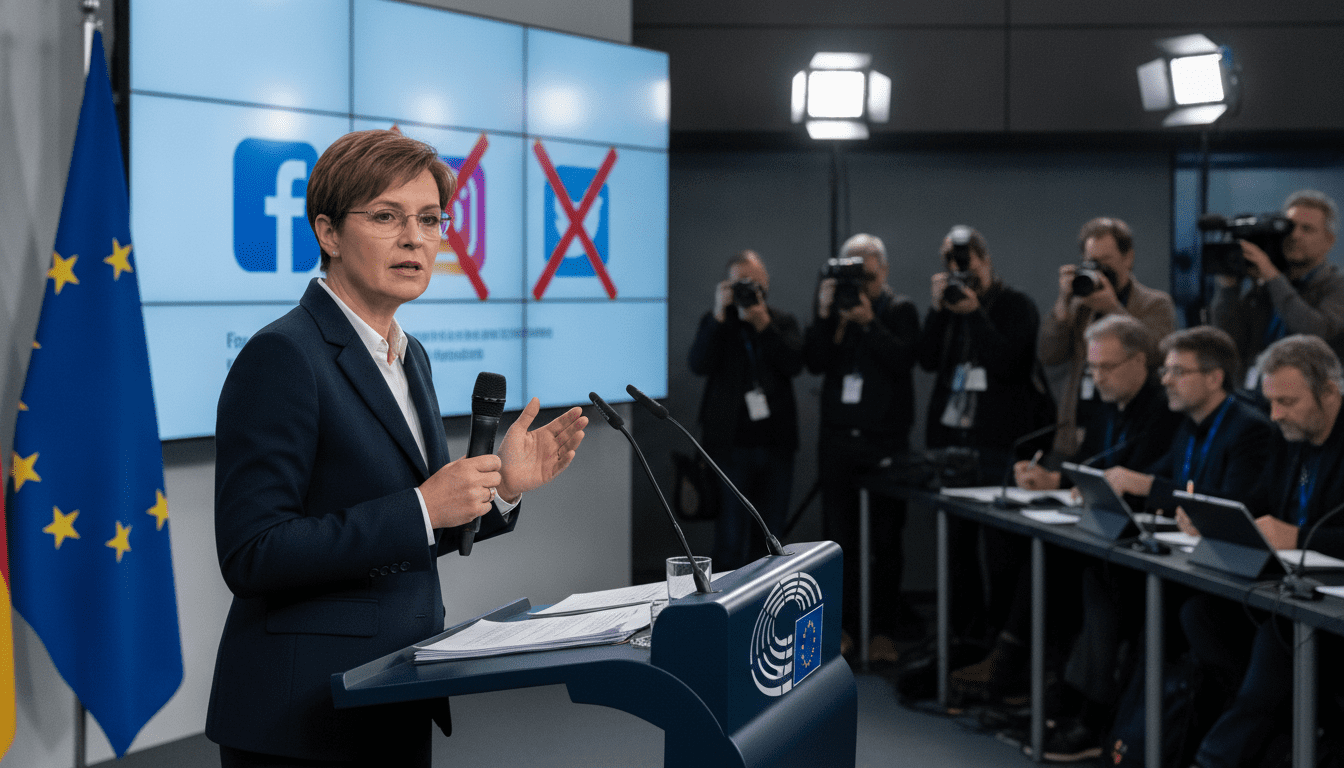
Germany’s family minister urges social media ban for children under 13 as EU weighs rules
Germany’s family minister proposes social media ban for children under 13, urging a Europe-wide approach as experts and industry debate age limits and enforcement.
Germany’s family minister has publicly called for a social media ban for children under 13, pressing for clearer rules and a coordinated European response. The proposal follows work by an expert commission appointed to study child and youth protection online, even though that panel stopped short of recommending a single age threshold. The minister said she hopes Brussels will take the lead and deliver harmonised proposals that make platforms accountable and parents better supported.
Prien’s proposal and political intent
Family Minister Anne Prien framed the proposal as a protection measure aimed at reducing early exposure to addictive design and harmful content. She argued that an absolute minimum age would simplify parental responsibilities and give schools and social services a clearer baseline for safeguarding. The minister prefers a Europe-wide solution to prevent cross-border loopholes and uneven enforcement among member states.
Expert commission stops short of a fixed age
The advisory commission tasked with assessing child and youth protection online produced a mixed set of recommendations and did not endorse a single age limit. Members highlighted trade-offs between protection, free expression and the diversity of family circumstances, leaving the decision on an exact threshold to policymakers. That divergence prompted the minister to press for political clarity so that legislation can follow a definitive standard.
European Commission timetable and regulatory prospects
Officials in Berlin say they expect the European Commission to publish regulatory proposals in September, with the aim of aligning national rules across the EU. Lawmakers in Germany will likely seek to coordinate domestic legislation with any Brussels text to avoid conflicts and fragmentation. A Europe-wide framework would give regulators common enforcement tools, but it could also extend the time before any national ban would take effect.
Responses from industry, child advocates and parties
Platform operators have cautioned against blanket bans, arguing that robust age-verification systems and parental controls may be more effective than prohibition. Child welfare organisations expressed guarded support for stronger protections but warned that enforcement must not drive young users to unregulated or underground services. Political groups showed early signs of alignment, yet critics including some civil liberties advocates emphasised the importance of digital literacy and targeted interventions over a one-size-fits-all ban.
Practical and technical hurdles for enforcement
Experts point to significant technical challenges in implementing a social media ban for children under 13, such as reliable age verification without creating privacy risks. There are concerns that strict verification processes could incentivise the use of forged credentials or push children toward encrypted or decentralised platforms beyond regulatory reach. Policymakers will need to balance verification, data minimisation and the administrative burden on smaller platforms.
Major transport and defence developments in Germany this week
Rail infrastructure and defence news added to a busy domestic agenda, with Deutsche Bahn announcing a postponement of the Stuttgart 21 opening to December 2031. Bahn chief executive Katarina Palla told the Bundestag transport committee that complex digital integration, incorrectly laid cables, an ageing technical building and power-supply shortcomings were principal causes of the delay. Separately, a nationwide rail stoppage late Tuesday was linked to a technical-component swap that rendered the primary train radio system inoperative, an incident now subject to formal investigation.
Corporate moves and parliamentary reforms
In parallel, Franco-German defence group KNDS signalled plans for a stock market listing set for mid-July, contingent on an agreement allocating 40 percent stakes to both Germany and France and valuing the group between €15 billion and €20 billion. Meanwhile, leaders of the Union and SPD parliamentary groups expressed broad backing for proposed pension reforms despite criticism from unions and business associations, with lawmakers indicating a preference for limited amendments to preserve the overall design.
The coming months are likely to see intensified debate in Berlin and Brussels over how best to protect children online while preserving access to digital services, and whether a legal minimum age can be both practical and effective. Lawmakers and regulators will need to reconcile competing demands — technical feasibility, privacy safeguards and social equity — as they prepare for proposals expected in September and subsequent national legislative action.
