
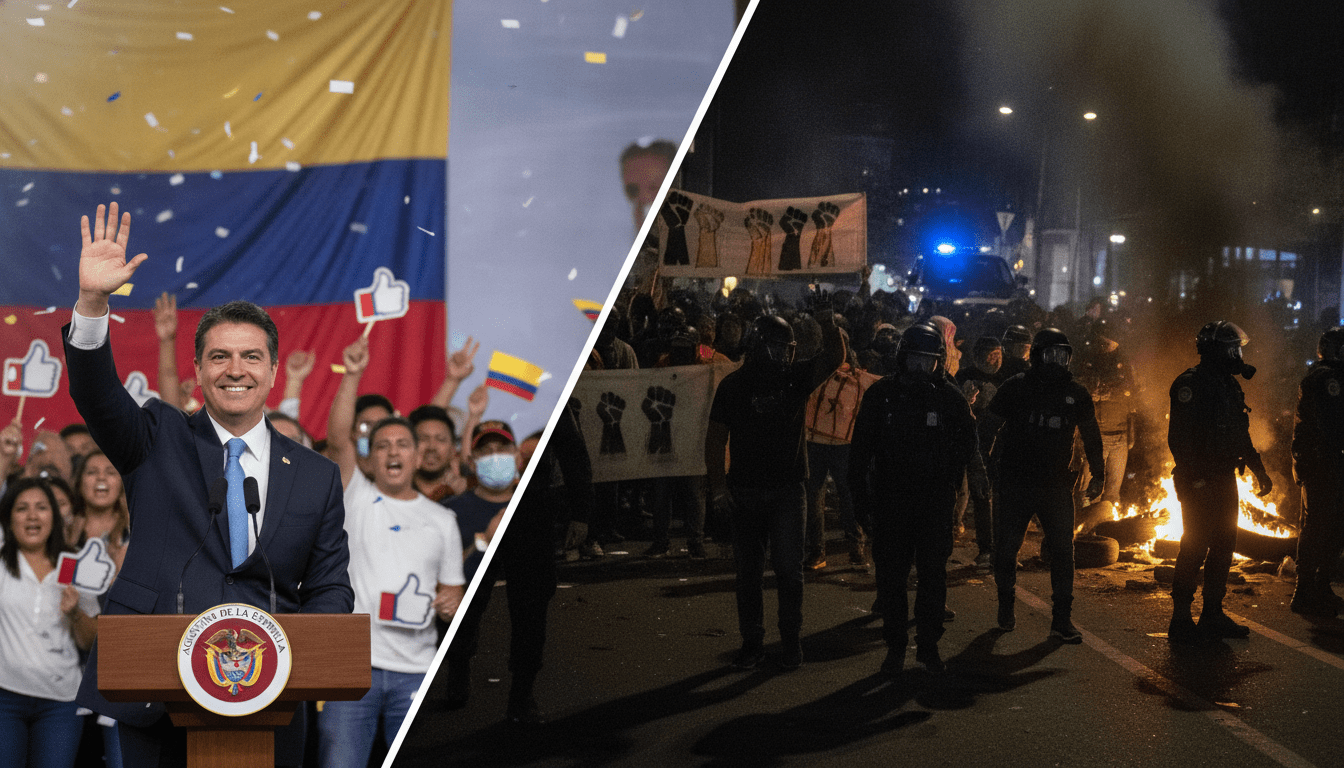
Colombia presidential election: Narrow lead for Abelardo de la Espriella sparks protests in Cali
Preliminary results in the Colombia presidential election show Abelardo de la Espriella narrowly ahead of Iván Cepeda as clashes erupted in Cali and authorities called for calm.
The Colombia presidential election entered a tense phase as preliminary tallies showed a razor-thin margin between right‑wing challenger Abelardo de la Espriella and leftist Iván Cepeda, prompting protests and isolated violence in the southwestern city of Cali. Local authorities reported property damage and injuries after demonstrators clashed with police, while national officials urged restraint until electoral bodies make a formal declaration.
Protests Erupt in Cali After Voting Night
Authorities in Cali said protesters damaged a public bus, several surveillance cameras and an ATM during demonstrations that followed the night’s count. Police reported four officers injured and two demonstrators detained as confrontations escalated after US flags were burned, an action that appeared to inflame tensions on the streets.
City officials described the unrest as episodic and localized, emphasizing that most polling stations and counting centers remained secure. Officials called for calm and warned that further clashes could undermine public confidence in the post‑election process.
Preliminary Count Shows Narrow Margin
With 99.9 percent of ballots counted, the national electoral authority’s unpublished tallies circulating in official briefings showed de la Espriella at roughly 49.7 percent and Cepeda at about 48.7 percent. No winner had been formally declared by the electoral council at the time authorities urged patience and legal verification of remaining votes and challenges.
De la Espriella, a businessman and lawyer who had not previously held public office, addressed supporters in Barranquilla and declared the start of a “new era,” pledging to be a president for all Colombians. International reactions included congratulations from high‑profile foreign backers, underscoring the election’s geopolitical attention.
De la Espriella’s Security and Economic Agenda
De la Espriella has campaigned on a hardline security platform, promising aggressive measures against armed groups he says are tied to the drug trade. His proposals include the use of military force, including possible airstrikes against guerrilla factions implicated in narcotics trafficking, and construction of large, high‑security prisons to combat organized crime.
On economic policy, he has advocated deregulation and pro‑business measures he argues will stimulate investment and growth. Critics warn that rapid deregulation coupled with a militarized security strategy risks deepening social divisions and raising human rights concerns.
Campaign Violence Marked the Run‑off Race
The run‑off campaign was shadowed by a string of violent incidents, including car bombs and drone attacks that targeted political figures and infrastructure. In June 2025, the assassination of a prominent right‑wing presidential candidate, Miguel Uribe, drew international condemnation and highlighted the volatile environment surrounding the election; the shooter in that case was a minor, underscoring security and social challenges.
Analysts said the pattern of violence contributed to heightened public anxiety and polarized campaigning, complicating efforts by electoral authorities to guarantee a calm transfer of power regardless of the outcome. Observers also noted the strain such instability places on Colombia’s institutions and on the capacity of law enforcement to protect civilians during politically charged moments.
Political Leaders Urge Legal Process and Restraint
Outgoing President Gustavo Petro, a leftist who cannot seek re‑election, appealed for calm and respect for the legal procedures that govern the declaration of a winner. Petro emphasized that the official result must come from the electoral tribunal and that all parties are obliged to accept the verdict delivered through the legal process.
Iván Cepeda, who has led calls for a peaceful response to the preliminary counts, asked supporters to refrain from violence while reserving the right to pursue legal challenges if irregularities are found. Electoral authorities said they will process any formal complaints and verify outstanding tallies before issuing an official certification.
Implications for Colombia’s International Relations
A prospective shift from a left‑leaning government to a right‑wing administration could mark a significant geopolitical turn for Colombia, a country long aligned with the United States in the region. Relations between Bogotá and Washington deteriorated during the Petro presidency over a series of incidents, including US military actions against suspected drug smuggling that resulted in Colombian casualties, and the next administration’s posture is likely to reshape cooperation on security and counternarcotics operations.
Foreign governments and diplomatic missions were monitoring developments closely and urged all actors to prioritize legal channels and peaceful conduct. International observers warned that abrupt policy shifts, especially in security operations, could have regional effects and complicate existing peace and human rights commitments.
The immediate focus now rests on the electoral authority’s formal review and certification of results, along with the handling of any legal challenges or recounts that may follow. As Colombia awaits an official outcome, leaders on both sides have signaled a mix of acceptance of due process and readiness to contest the result through institutional means if necessary.
