
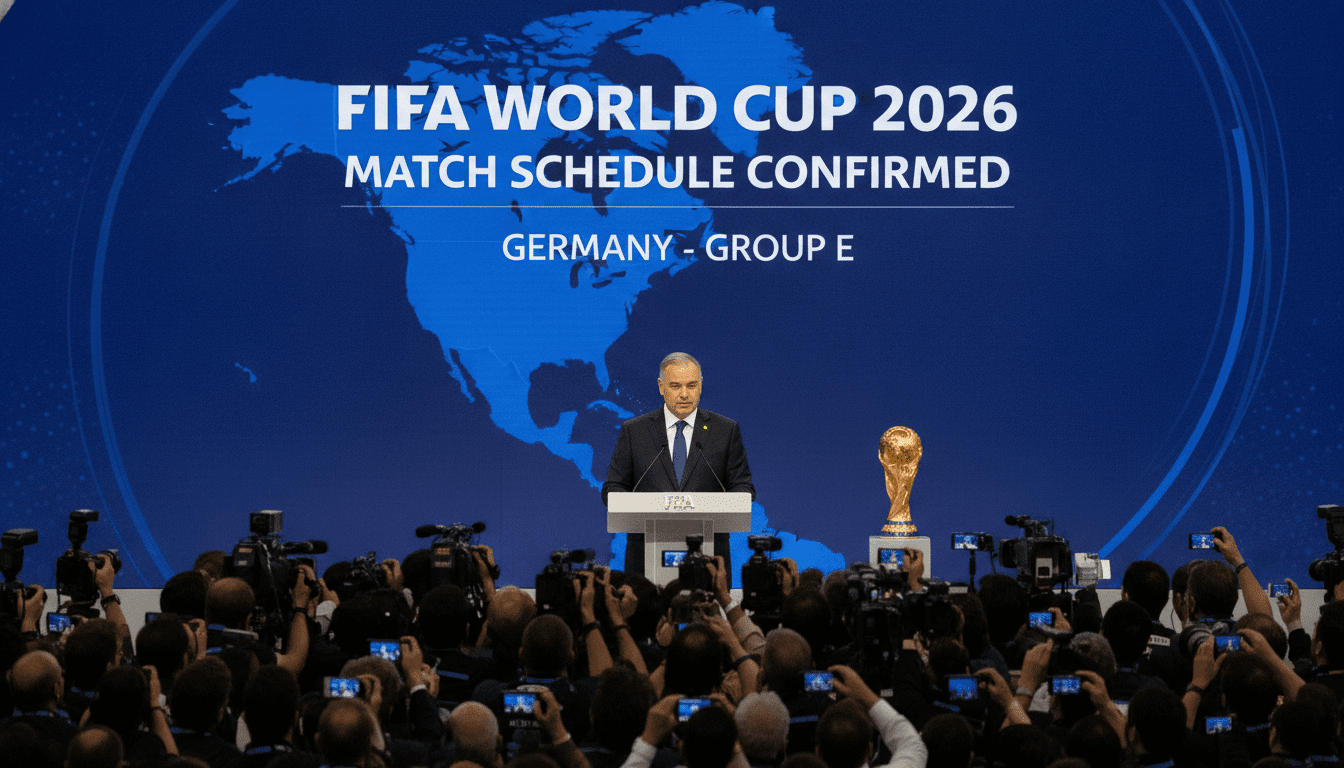
FIFA World Cup 2026: Groups, full schedule, TV coverage and Germany’s path
FIFA World Cup 2026 group draw and match schedule summary, Germany in Group E with Ecuador, Ivory Coast and Curaçao; full fixture list, venues and broadcast details.
The FIFA World Cup 2026 kicked off on June 11 and runs through July 19, featuring a 48-team format and 104 matches across the United States, Canada and Mexico. Germany has been drawn into Group E alongside Ecuador, the Ivory Coast and Curaçao, with all three group matches scheduled for broadcast windows tailored to Central European Summer Time (MESZ). The expanded tournament begins with 12 groups of four teams and advances into a 32-team knockout phase that will decide the champion in New York on July 19.
Group composition and Germany’s opponents
Germany enters the competition in Group E, drawn with Ecuador, Ivory Coast and Curaçao for the group stage. The grouping sets up a varied set of tactical challenges, pitting the DFB side against South American flair, West African physicality and a Caribbean underdog.
Across the 12 pools the draw also placed traditional powers such as Brazil, Argentina, France and Portugal into distinct groups, while emerging teams and playoff qualifiers fill out a broader global representation. The expanded field means more nations gain World Cup exposure, increasing group-stage stakes and unpredictability.
Match schedule, time zones and match windows
The group stage runs from June 11 to June 27, with the round of 32 scheduled between June 28 and July 3 and the final set for July 19. Match times for European viewers are listed in Central European Summer Time (MESZ), with many fixtures scheduled late at night or in the early hours to align with North American local kickoffs.
Organizers mapped the calendar to reduce overlap and to concentrate marquee fixtures on weekends and prime viewing windows in Europe. The knockout rounds proceed from the round of 32 to the round of 16 (July 4–7), quarter-finals (July 9–11), semi-finals (July 14–15) and the final on July 19.
Venues, regional grouping and travel planning
Matches will be staged in 16 cities across the three hosts: 13 fixtures each in Canada and Mexico and 78 fixtures across the United States. Canadian venues include Toronto and Vancouver, while Mexican matches are set for Monterrey, Mexico City and Guadalajara. U.S. host cities range from New York and Los Angeles to Dallas, Houston and Seattle.
Organizers grouped stadiums into eastern, central and western clusters to limit travel for teams and officials. The regional plan also defines time-zone offsets for European broadcasters: roughly minus six hours for the eastern cluster, minus seven for the central cluster and minus nine for the western venues relative to MESZ.
Broadcast arrangements for German viewers
All tournament games are carried by MagentaTV in Germany, with public broadcasters ARD and ZDF each scheduled to air a selection of 30 matches. Germany’s opening match against Curaçao and the third group game against Ecuador are slated for ARD, while the second group fixture against the Ivory Coast will be shown on ZDF.
The mix of pay and public broadcasters aims to give broad access to marquee matches while preserving comprehensive live coverage across platforms. Viewers can expect varied programming windows, with ARD and ZDF prioritizing key German fixtures and weekend knockout ties.
Knockout bracket structure and key fixtures
After the group stage the tournament moves into a new knockout structure that begins with a round of 32 and proceeds to the final over three weeks. The round of 32 plays out in venues across the three countries and leads into an eight-match round of 16 schedule, creating a compressed sequence of high-stakes ties.
Quarter-finals are scheduled between July 9 and 11, followed by semi-finals on July 14 and 15. The third-place match is set in Miami and the final will be contested in New York on July 19, capping a 39-day tournament that blends expanded participation with a traditional knockout climax.
Germany’s form, qualifying run and pre-tournament results
Germany arrives in the tournament following a strong run of friendlies and qualifying results under coach Julian Nagelsmann. In warm-up fixtures the DFB team recorded wins in Basel, Stuttgart and Chicago and entered the finals with momentum from a series of qualifying victories that secured top spot in their group.
The qualifying campaign featured mixed results early on but finished emphatically, including multiple multi-goal victories that reinforced Germany’s depth and goal-scoring options. That form has heightened expectations at home and sets a framework for tactical decisions once group play begins.
The expanded FIFA World Cup 2026 alters traditional tournament math while offering new matchups and broadcast challenges for European audiences. Germany’s draw presents a mix of styles and logistical considerations, and fixtures across North America will test squad rotation, travel management and match-day preparation as the competition moves toward its July 19 finale.
