
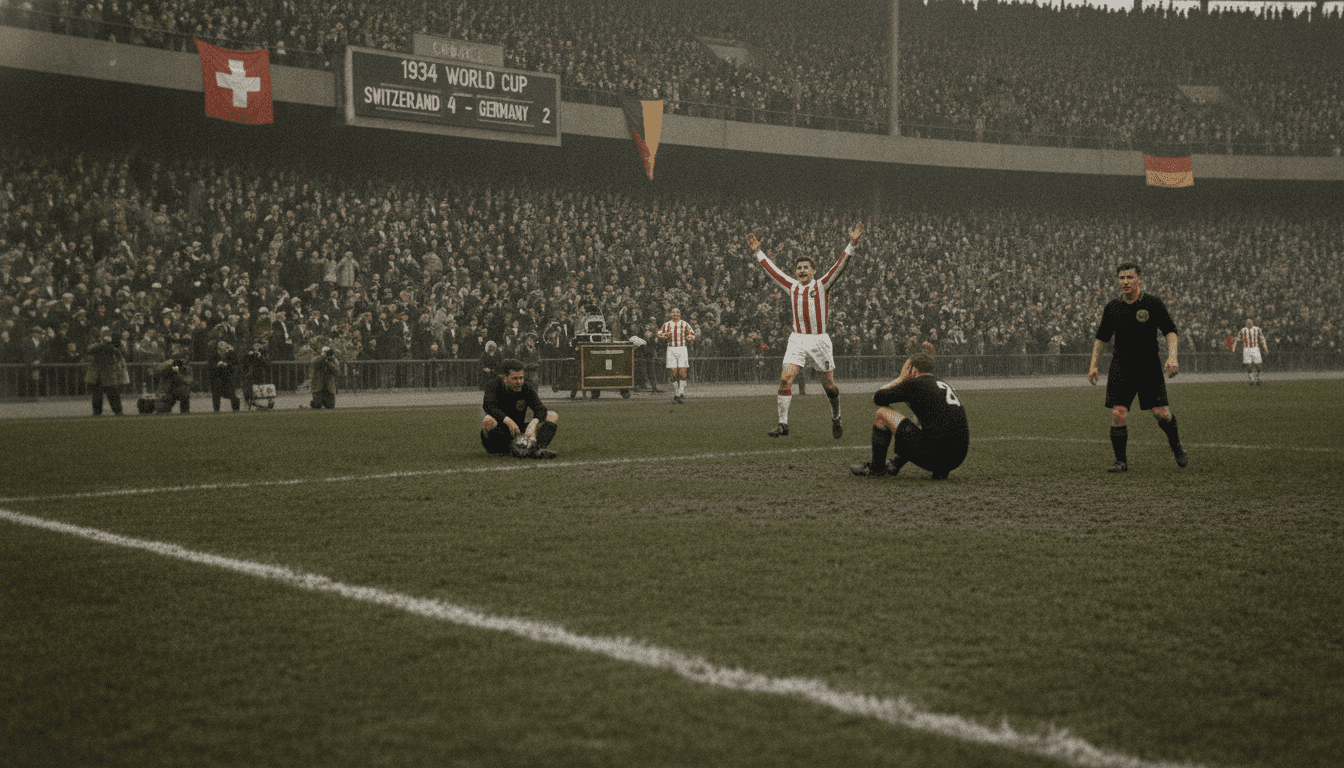
Switzerland’s 4-2 Win Over Germany in 1938: Rappan’s Tactical Breakthrough at Parc des Princes
Switzerland’s 4-2 win over Germany in 1938 showcased Karl Rappan’s ‘Swiss Riegel’ at Parc des Princes and reshaped tactical thinking in European football.
The Swiss national team delivered a startling victory over Germany in a replayed World Cup tie at Parc des Princes, overcoming an early deficit and demonstrating a tactical maturity that surprised observers. Switzerland’s 4-2 win over Germany came after an initial 1-1 draw and featured decisive moments, a dramatic injury, and a series of well-executed attacking moves that exposed the limits of the German side. The result has endured as one of the most significant matches in Swiss football history and as an early example of system-driven success in the international game.
Karl Rappan’s tactical blueprint
Karl Rappan had introduced a defensive system that prioritized structure and situational superiority in ball proximity. Known later as the “Swiss Riegel,” his setup used a three-man backline with a dedicated cover player and a preceding defensive midfielder, allowing positions to shift dynamically to create numerical advantages around the ball. That approach made Switzerland far more than a reactive unit; it permitted rapid transitions and disciplined pressing that unsettled opponents used to more rigid formations.
Rappan’s method represented a departure from the era’s standard tactics and gave the Swiss both defensive solidity and a framework for swift counterattacks. Opposing teams found it difficult to create clear chances because the Swiss players moved as a coherent block, closing passing lanes and forcing errors. On the day of the replay, those tactical advantages translated into sustained periods of control and the space for creative attackers to operate.
Early drama and momentum shifts
The replay did not begin in Switzerland’s favor. After an early exchange of goals that left the visitors ahead at one point, the scoreboard in the Prinzenpark read uncomfortably for Swiss supporters. Yet the side regrouped and began to assert itself as the game progressed. A key equalizer before halftime swung momentum back in Switzerland’s direction and set the stage for a decisive second half.
The Swiss attacking unit combined discipline with flair, probing the German defense and exploiting the gaps created by Rappan’s system. Their approach blended technical skill with tactical awareness, and the team’s ability to manufacture chances under pressure proved decisive as the match wore on. That shift in dynamics underlined the notion that the result was not merely the product of off-field factors but of a clearly superior match plan.
Injury, courage and a defining strike
The game featured a dramatic injury that might have derailed the Swiss. One of their forwards suffered a severe head wound in a collision and left the field temporarily while the wound was attended to. Even after returning with a prominent bandage, the player continued to contribute to the team’s momentum, a testament to the squad’s resilience. The incident galvanized the side and seemed to stiffen their collective resolve.
Amid that charged atmosphere, a composed and skillful finish from a young Swiss forward produced one of the tournament’s most memorable goals. Executed as a delicate lob over the goalkeeper and two defenders, the strike combined technique and nerve in equal measure. It landed Switzerland ahead and quieted the volatile crowd, turning the balance irreversibly toward the visitors.
Abegglen’s decisive contribution
André Abegglen emerged as the match-winner with a close burst of finishing in the decisive phase of the contest. His pair of goals within minutes created a gap that Germany could not bridge, marking him as the pivotal figure in the replay. Abegglen’s runs and sharpness in the penalty area exploited the small openings Switzerland created through coordinated buildup play.
His performance underscored the importance of having clinical finishers to complement a robust tactical setup. While the Swiss system created opportunities, Abegglen’s instincts and execution turned those openings into match-defining moments. The combination of system and individual quality is what made the victory both convincing and historically significant.
Aftermath: immediate fatigue and long-term legacy
The triumph carried a heavy short-term cost. Switzerland’s reinvigorated side had to return to the field just days later against Hungary, a rested opponent that dealt them a 2-0 defeat. The rapid turnaround highlighted the physical toll of the replay and the scheduling realities of the tournament. Nevertheless, the 4-2 victory over Germany remained the defining achievement of that Swiss squad’s tournament.
In the longer view, the match became a reference point for the effectiveness of Rappan’s ideas and for the potential of tactical innovation to change international results. Swiss coaches and analysts would point to the game as evidence that disciplined, system-oriented football could level the playing field against technically gifted or politically favored sides. The match also entered Swiss cultural memory as one of the national team’s greatest performances.
Germany’s players acknowledged the defeat with sportsmanlike conduct, and the German coach recorded a private note that hinted at uncertainty about the national team’s immediate future. For Switzerland, the victory confirmed a moment of tactical modernity and produced memorable individual performances that have been retold in football histories ever since.
The match remains a study in how preparation, system design and individual resolve can combine to overturn expectations in a high-stakes international fixture.
