
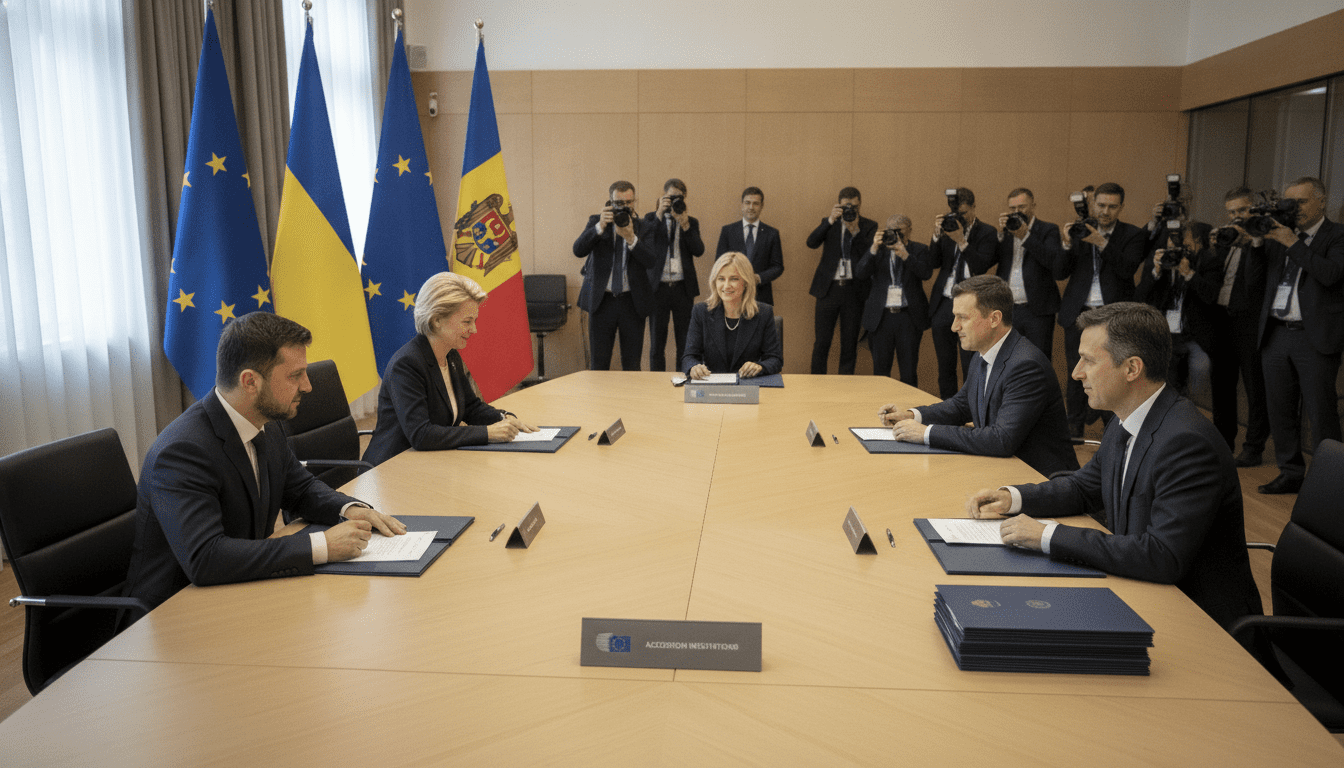
EU accession talks advance as ministers open rule-of-law cluster for Ukraine and Moldova
EU accession talks progress as ministers open the rule-of-law cluster for Ukraine and Moldova after Hungary lifts veto; sanctions and funding disputes persist.
Ministers open rule-of-law cluster for Ukraine and Moldova
On Monday, June 15, 2026, EU foreign ministers meeting in Luxembourg formally opened the first thematic cluster on fundamental issues and the rule of law for Ukraine and Moldova, marking the start of concrete accession negotiations. The move — hailed by the European Commissioner in charge of enlargement as a “Megamonday for the enlargement process” — begins substantive talks on judicial reform and core EU standards.
The rule-of-law cluster bundles five chapters, covering justice and fundamental rights, internal security cooperation, public procurement, statistics and financial control. By convention, this cluster must be opened first and is typically the last to be closed in accession negotiations.
Hungary withdraws veto after minority guarantees agreed
The deadlock that had stalled progress for two years ended after Hungary’s new government reached an agreement with Kyiv on protections for Hungary’s minority in Transcarpathia. Budapest signalled its approval on Friday, June 12, 2026, following a bilateral understanding on language use, education, public administration and cultural expression.
Hungarian Foreign Minister Anita Orbán, who is not related to Prime Minister Viktor Orbán, said the commitments were incorporated into an EU action plan on minority rights and are now part of the accession track. Her statement framed the decision as a return to cooperative EU diplomacy after months of bilateral obstruction.
Remaining clusters could follow in July but member states divided
The European Commission and several capitals expressed hope that the five remaining thematic clusters — internal market, competitiveness, the Green Agenda, agriculture and external relations — could be opened as early as July. Commissioner Marta Kos signalled that progress on the rule-of-law cluster paves the way for rapid movement on other dossiers.
However, diplomats caution that unanimity remains uncertain. While Germany has offered to lead the opening of additional clusters, France and the Netherlands are reported to be hesitant, creating a potential bottleneck that could delay the wider negotiation timetable.
New sanctions and contention over oil price cap
Alongside enlargement business, ministers agreed further sanctions targeting Russia for its invasion of Ukraine, adding individuals, organisations and vessels tied to oil embargo circumvention. The package includes listings of 34 persons, 47 entities and 54 ships believed to be part of a so-called shadow fleet.
A major point of contention concerned the oil price cap, currently set at $44 per barrel since February. The Commission proposed measures to freeze the cap until January, despite market pressures that would normally push the cap higher; the market price for Russian Ural oil has risen to roughly $72 a barrel, driven in part by tensions around the Strait of Hormuz.
Proposal to bar former Russian service members from EU faces legal tests
Ministers also debated a Commission proposal to deny entry to people who have served in the Russian armed forces since the start of the war in early 2022. Estonian Foreign Minister Margus Tsahkna, who tabled the idea, estimated it could affect at least 600,000 individuals, but implementation poses practical and legal challenges.
Baltic states have uploaded only a small number of names to the Schengen Information System, and officials described the task of identifying and vetting potential entrants as onerous. One option under consideration would require visa applicants to declare past military service, with false statements leading to automatic disqualification; another would ask applicants to supply military discharge papers or certificates.
European Peace Facility split over compensation and weapons funding
The ministers reached a compromise on the use of funds from the European Peace Facility that had been frozen by Hungary’s prior veto. Budapest’s withdrawal of that veto reopened debate on how to divide the facility’s €6.6 billion envelope between compensation for countries that supplied arms to Ukraine and fresh weapons deliveries.
Estonia’s foreign affairs chief Kaja Kallas pushed for the entire sum to be invested in new weaponry for Kyiv, but member states could not agree. The provisional arrangement anticipates roughly €1 billion for new arms, €900 million for the EU’s training mission for Ukraine (EUMAM) and about €4.5 billion earmarked for compensation claims, with ongoing talks to determine the reference period for eligible deliveries.
The distribution formula will have important consequences for national budgets and for suppliers that fronted ammunition and hardware to Ukraine at speed. If the compensation period is limited to the time before Hungary’s veto in August 2024, reimbursements would be substantially higher than if the period runs to the present day.
EU accession talks for Ukraine and Moldova have moved from formal technical review to full negotiation, but the path ahead will require both internal consensus and continued diplomatic management of contentious security and budgetary issues.
