
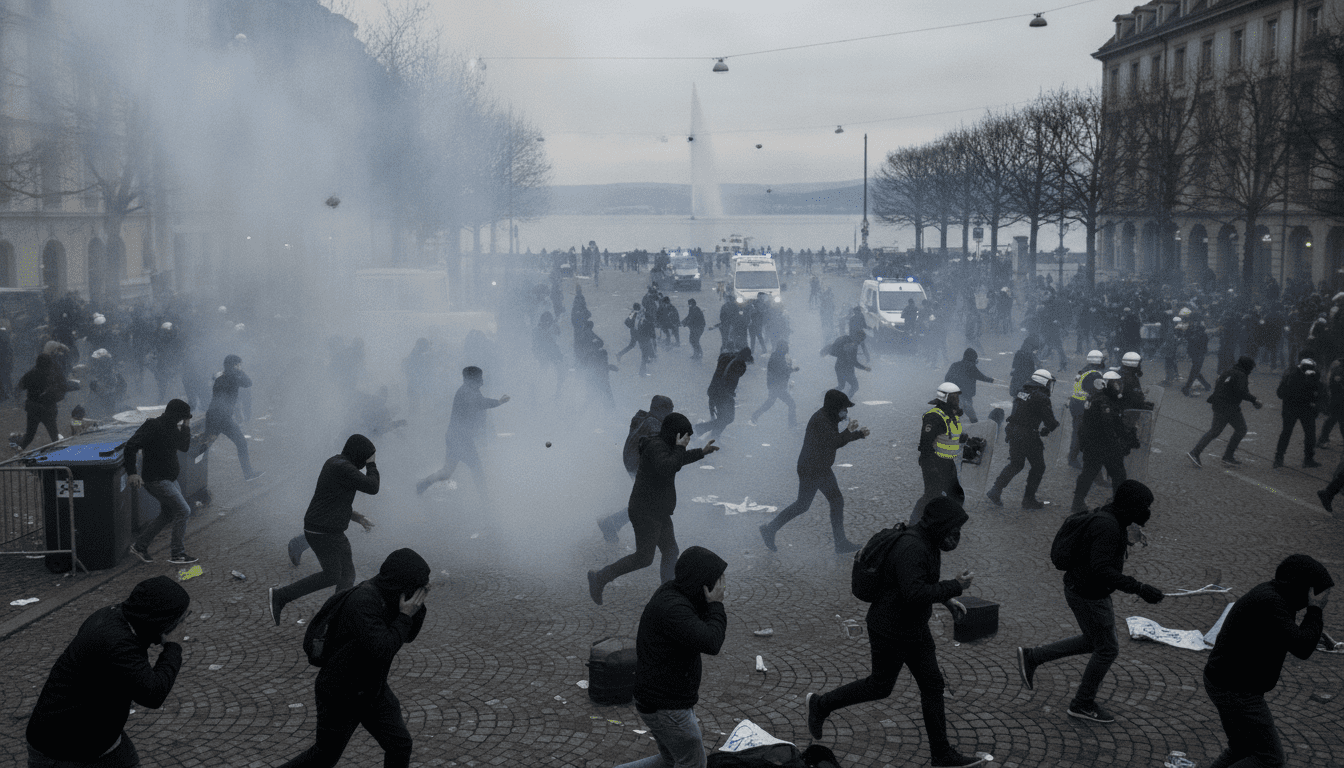
G7 protest in Geneva turns violent as masked demonstrators smash windows and set fires
Masked clashes mar G7 protest in Geneva: windows smashed, vehicles and bins set ablaze, police used tear gas. Summit begins Monday, June 15, 2026, in Évian.
The G7 protest in Geneva escalated into violence on Sunday, June 14, 2026, as masked groups smashed shop windows, set a car and rubbish containers on fire, and clashed with police who deployed tear gas. Organizers had registered the demonstration in Geneva after French authorities declined to permit protests near the summit site in Évian, where leaders are due to meet on Monday. Authorities and organizers offered differing estimates of crowd size amid widespread property damage across the city center.
Violence Erupts in Central Geneva
Masked demonstrators tore paving stones from the ground, ripped plywood from storefronts and smashed glass at retail premises and public transport shelters. Flames from a car and burning bins sent plumes of smoke into the evening sky, and several entrances to United Nations buildings were reported damaged by thrown objects.
Police said the permitted march included at least 20,000 participants while organizers put numbers in the tens of thousands, and a few hundred individuals in black clothing formed a disruptive bloc. The unrest transformed a largely peaceful demonstration into scenes of smash-and-grab vandalism and targeted attacks on urban infrastructure.
Police Response and Crowd Controls
Geneva police, who initially maintained a background presence, moved in to contain the disturbances and deployed tear gas to disperse groups. Law enforcement sealed key access points, including the principal bridge over the Rhône and routes to major shopping streets, to prevent the violence from spreading into denser commercial zones.
The canton’s policing operation involved thousands of officers, with reinforcement called in from across the country in anticipation of trouble. Authorities also conducted checks of vehicles and identity controls in multiple locations as part of an effort to restore public order and identify those responsible for the damage.
Organized Coalition and Demonstrators’ Demands
The march was organized by a coalition of roughly 60 groups under the “No G7” banner, uniting a range of activists including feminist collectives, trade unions, Kurdish groups and a self-described “revolutionary block.” The manifesto distributed by the coalition criticized the G7 as an “illegitimate and outdated” institution and outlined a broad agenda of social and political demands.
Among demands publicized by the coalition were calls to oppose U.S. military bases on European soil, raise minimum wages, secure free contraception, expand labor mobility across borders and remove gender markers from official identity documents. Organizers framed the Geneva demonstration as a venue to amplify those positions in the run-up to the summit.
2003 Unrest Still Shapes Geneva’s Approach
City and cantonal authorities said memories of destructive riots during a 2003 anti-G8 protest remain a deep-rooted concern for local policing strategies and business owners. In the days before Sunday’s march many shopkeepers and hoteliers boarded up windows with plywood in a precautionary move echoing preparations made more than two decades ago.
Monica Bonfanti, the cantonal police chief, described the legacy of 2003 as a “trauma” that influenced the scale and posture of security deployments this weekend. That institutional memory, officials said, informed decisions to stage large police contingents across the city ahead of and during the demonstration.
Damage, Investigations and Security Ahead of Évian Summit
Municipal and commercial authorities began initial damage assessments on Sunday night, cataloguing smashed windows, burned vehicles and vandalized public fixtures. City officials said investigations into individuals and groups involved in the violent episodes would follow once immediate public-safety concerns were addressed.
With the G7 summit scheduled to open in Évian on Monday, June 15, 2026, security forces in the region remained on heightened alert and diplomatic missions reinforced precautions around their premises. French authorities’ decision to bar protests near the summit site had pushed demonstrators to Geneva, where municipal officials had permitted a march but sought to balance the right to protest with the imperative to protect public order.
The unrest in Geneva underscores the frictions that large international summits can provoke between security planners and protest coalitions, and authorities say inquiries will continue into the organizers’ coordination with law enforcement and the actions of violent subgroups.
