
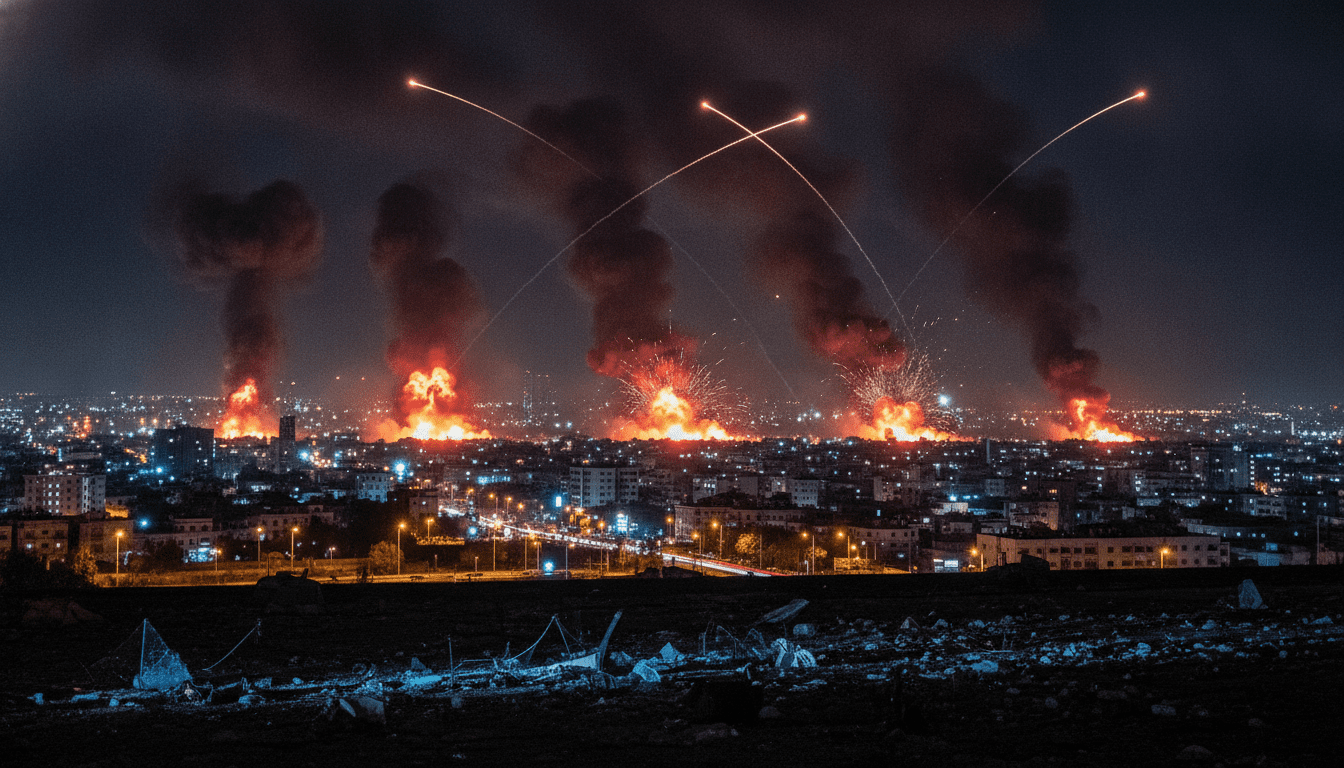
Israeli air strikes on Beirut suburbs follow Hezbollah drone attacks on northern Israel
Israeli air strikes on Beirut suburbs hit Hezbollah targets in response to explosive drone attacks on northern Israel, Israeli officials said, as cross-border tensions spiked. The strikes, aimed at the Dahieh district south of Beirut, come after the Israeli military reported two impacts on its territory near the Lebanon border with no injuries.
Israeli leaders frame strikes as response to drone attacks
Israel’s prime minister and defense minister issued a joint statement saying the air strikes targeted “terror” infrastructure in the southern Beirut suburbs known as Dahieh. The statement linked the operation directly to what Israeli forces described as renewed attacks by Hezbollah on northern Israeli communities.
Officials emphasized that the action was carried out to degrade the group’s ability to launch further drone and explosive raids, framing the strikes as a defensive measure in the context of ongoing hostilities along the northern frontier. The government described the operation as limited and focused on military objectives inside the Beirut suburbs.
Hezbollah’s use of explosive drones reported by Israeli military
The Israeli military said Hezbollah had launched several explosive-laden drones into northern Israel, marking another episode in a series of cross-border exchanges. Two strikes were recorded on Israeli soil near the Lebanese border, with no casualties reported according to military sources.
Hezbollah has increasingly relied on unmanned aerial systems in recent confrontations, Israeli officials contend, presenting a growing challenge for air defenses and border communities. The military statement did not provide detailed damage assessments for the Lebanese side, and independent verification of the drone attacks was not immediately available.
Military operations focused on Dahieh, south Beirut suburb
The strikes were reported to have concentrated on the Dahieh area, a densely populated southern suburb of Beirut that Israeli officials say houses Hezbollah infrastructure. Dahieh has previously been described by Israeli authorities as a staging area for the militia’s capabilities, and it has been struck during earlier rounds of conflict.
There was no immediate confirmation from Lebanese authorities on casualties or the extent of damage inside Dahieh, and civilian reports from the area were limited in the hours following the strikes. Humanitarian and civilian risk is a central concern in densely populated suburbs where military targets and residential zones are often intermingled.
Border impacts and security situation in northern Israel
Israeli forces reported two impacts on their territory near the Lebanon border, attributing them to the recent barrage of explosive drones. Local authorities said there were no injuries, and military units maintained heightened alert along the frontier following the incidents.
Communities along the northern border have faced repeated disruptions and the threat of cross-border fire in the current phase of tensions, with residents routinely told to seek shelter during alerts. Israel’s air defense and surveillance systems have been engaged to track low-altitude threats, and commanders said they remain prepared for further attempts to strike across the frontier.
Escalation risks and the pattern of tit-for-tat exchanges
Analysts and officials familiar with the region caution that such strikes raise the risk of wider escalation, as tit-for-tat attacks on both sides can quickly broaden into larger confrontations. Each side’s public statements framed the operations as limited responses, but the potential for miscalculation remains a persistent danger.
Past cycles of exchanges have shown how localized incidents can draw in additional military assets and provoke broader mobilization, complicating diplomatic efforts to contain violence. Military planners on both sides appear to be calibrating actions to achieve tactical aims while attempting to avoid full-scale war, though that balance is fragile.
Diplomatic attention and calls for restraint expected
Regional and international capitals routinely monitor outbreaks of cross-border violence and often call for restraint to prevent a spillover into a wider conflict. Diplomatic actors are likely to press both sides for de-escalation and urge measures to protect civilians in contested areas.
Any sustained increase in strikes or retaliatory measures could prompt renewed emergency consultations at international fora and intensified mediation efforts, as neighboring states and global powers assess risks to regional stability. For now, diplomatic channels remain a key avenue for lowering temperatures and preventing further escalation.
The incidents underscore the fragile security environment along the Israel-Lebanon border, where advances in weaponry and tactics such as explosive drones complicate traditional deterrence and defense calculations. Further exchanges remain a distinct possibility as both sides assess the effects of the latest strikes and plan their next steps.
