
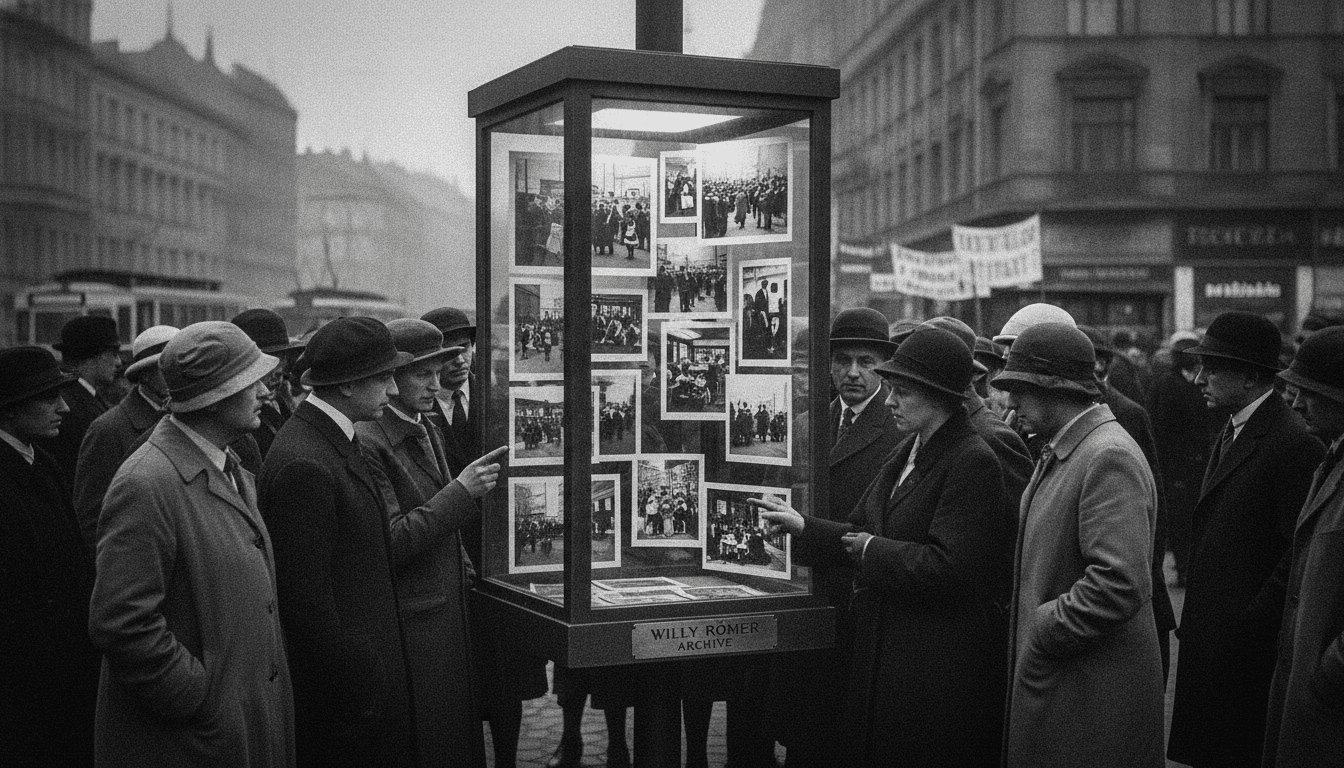
Willy Römer: The Photographer Who Documented Weimar Berlin
Willy Römer: a portrait of the press photographer who recorded Weimar Berlin’s streets, uprisings and ruins, and whose archive reshaped the city’s memory.
Willy Römer emerged from Berlin’s early press‑photography scene to become one of the most important visual chroniclers of Weimar Germany. His camera recorded ordinary life, political upheaval and the physical destruction of the city, creating a photographic legacy that only found broad public attention decades after his work was made. The story of his apprenticeship, frontline pictures from the First World War, arresting images of the 1918–19 revolutions, and the fate of his archive under National Socialism shows how photojournalism both shapes and survives history. This profile traces Römer’s career and the posthumous rescue of his collection, underlining why his images remain central to understanding Berlin in the twentieth century.
From Apprentice to Press Photographer in Pre‑War Berlin
Willy Römer was born in Berlin on 31 December 1887 and began learning photography as a teenager, joining the newly formed Berliner Illustrationsgesellschaft around 1903. That agency, founded at the turn of the century, was at the forefront of a nascent press‑photography industry that transformed newspapers by publishing images alongside news text for mass readers. Under the mentorship of figures such as Karl Delius, the young Römer gained technical skill and a professional attitude toward documenting public life. Even in these early years he photographed city streets, seasonal scenes and everyday workers, establishing the human‑centered approach that would define his later reportage.
His apprenticeship coincided with significant technological advances in cameras and light‑sensitive plates, which made street and urban photography both more practical and more in demand. Römer learned to handle heavy plate cameras and developed an eye for composition that balanced documentary exactness with empathetic framing. He and peers such as Leopold Ahrendts and Hermann Rückwardt helped set the standard for press imagery in Berlin, moving the photograph from mere “illustration” to a distinct journalistic profession. By the late 1900s he was already gaining assignments that took him beyond Berlin to Paris and other European centers, expanding his subject matter and professional network.
On the Eastern Front and Beyond: Römer’s War Years
When the First World War began, Römer was conscripted into the German infantry and took his camera with him, continuing to photograph even under the constraints of military life. He worked with bulky 13 × 18 plate cameras and, when circumstances allowed, recorded scenes of civilian life behind the front lines in places such as Lida and the Suwałki region, producing a set of images that balance the war’s disruptions with moments of daily routine. These photographs reveal a photojournalist who sought the human story amid conflict, documenting market activity, peasant life and local customs as well as military subjects. His wartime work provided a body of negatives that later helped establish his reputation as a photographer who went beyond staged or purely propagandistic imagery.
After returning to Berlin, Römer quickly turned his lens to the dramatic political and social ruptures unfolding at home as the war ended. He photographed returning troops, street demonstrations, and the chaotic days surrounding the abdication of the Kaiser, supplying a visual record of a city in upheaval. Those images were circulated widely and helped make Römer one of the principal German press photographers of the immediate postwar years. His capacity to work in tense and dangerous circumstances—on battlefields and in revolutionary streets—cemented his status as a chronicler of history in the making.
Capturing Revolution: Berlin’s Turmoil in 1918–1919
Römer produced an extensive photographic record of the revolutionary weeks and months in Berlin from late 1918 into 1919, covering clashes in December, the Spartacist uprising in January 1919, and the March battles that followed. He made hundreds of images during this period, some of which documented key moments close to the leaders and victims of the upheaval, including some of the last photographs of Karl Liebknecht and Rosa Luxemburg before their murders. His work from these weeks is among the most valuable visual testimony of the revolutionary period, showing both the mass mobilizations in the streets and the smaller human scenes that accompanied political violence.
The photographs Römer produced during the revolution did more than record events; they shaped contemporary and later understandings of the conflict by providing vivid, immediate evidence of what transpired. Newspapers and image agencies circulated many of his shots, amplifying their impact and ensuring they were seen across Germany and abroad. For a press photographer, the combination of rapid response and careful composition allowed Römer’s images to communicate complex social and political dynamics clearly to a broad audience. The legacy of those pictures is inseparable from the public memory of Weimar’s turbulent birth.
Photothek and the Business of Weimar Photojournalism
In the postwar years Römer and his colleague Walter Bernstein established Photothek, a picture agency that capitalized on the growing market for press images during the Weimar Republic. Photothek employed photographers, lab technicians and clerical staff and built an archive that supplied newspapers, magazines and publishers with documentary photographs of politics, society and culture. Römer continued to cover major events—political rallies, strikes, market scenes and portraits of public figures—while also keeping a steady interest in the everyday life of Berliners outside the spotlight. The agency’s success in the 1920s reflected both Römer’s photographic range and the expanding appetite of print media for immediate, authoritative visuals.
Römer’s personal life during this period mirrored the fragility and mobility of creative professionals in Weimar Germany; he married Charlotte Michel in 1922 and the couple raised a daughter, Ursula, while juggling the practical demands of running a picture agency. Photothek’s portfolio ranged from political reportage to street photography, and its outputs contributed to the visual culture of the era by documenting both elites and ordinary citizens. The business dimensions of press photography—negative preservation, captioning, and the sale of prints—were as important to Römer as the act of taking photographs. Photothek’s holdings, later described as historically significant, became the foundation for the archive that would survive both economic vicissitudes and political persecution.
From Forced Sale to Archival Rescue: Römer’s Later Life
The rise of National Socialism in 1933 abruptly altered the fortunes of Photothek and its founders when the regime denounced and dismantled media outlets viewed as politically or racially undesirable. Photothek was targeted because Walter Bernstein was of Jewish descent, and the agency’s staff were dismissed as the company was forced into bankruptcy and its assets divided. Römer retained a portion of the negatives, but the split brought financial hardship and professional marginalization, a fate shared by many photographers and media professionals under the early Nazi regime. Attempts to continue independently were unsuccessful, and the personal and economic consequences were severe for both partners.
During the later 1930s and into the Second World War, Römer’s photographic activity diminished and then shifted under duress; in 1942 he was drafted to work for the Ostdeutscher Beobachter in Posen and joined the NSDAP that same year, a step that historians note has to be read in the context of survival and limited choices under the dictatorship. The photographs attributed to him in that phase tend to show the formal imagery expected by propagandistic editors rather than the intimate civic portraiture that marked his earlier career. After 1945, Römer returned to a devastated Berlin and photographed ruins and reconstruction, aiming at both documentary value and the practical need to sell images to occupying forces and publishers.
In the postwar decades Römer devoted himself to organizing and preserving the thousands of glass negatives and contact prints he retained, working in a modest darkroom and compiling detailed captioned binders. He produced new prints and established an ordered archive of his life’s work, but recognition came slowly and economic reward remained limited. After his death on 26 October 1979, his family struggled to find an institutional buyer until cultural historian Diethart Kerbs purchased the collection and later worked to ensure its cataloguing and public exposure. Kerbs’s initiative and later exhibitions were decisive in bringing Römer’s images back into public view.
Legacy, exhibition and institutional stewardship
The rediscovery and exhibition of Römer’s archive in the early 2000s transformed his posthumous reputation and demonstrated the archival value of press photography for historical research. A major exhibition in 2004 at Berlin’s German Historical Museum presented a broad selection of his street, political and wartime photographs, prompting renewed media interest and scholarly reassessment. That show helped propel the archive into institutional care; in 2009 parts of the collection passed to the Bildarchiv Preußischer Kulturbesitz, which has since managed preservation and access. The transfer to a major public repository ensured that researchers, curators and the public would be able to study and display Römer’s work within the wider context of twentieth‑century visual culture.
Römer’s imagery is now used by historians to illustrate discussions of urban life, class, political conflict and the material consequences of war and dictatorship. His pictures have been published in thematic booklets and commissioned publications and are referenced in exhibitions that examine Berlin’s transformation from imperial capital to war‑scarred metropolis to divided and rebuilt city. The survival of his negatives and the care taken in their cataloguing allow contemporary audiences to see the city through a sustained eyewitness perspective. For archivists and cultural institutions, the story of Römer’s archive is also a reminder of the fragility of visual records and the importance of timely institutional intervention.
Willy Römer’s photographs remain compelling because they combine a consistently human focus with reportage consistently rooted in place and time. He did not merely stage events for dramatic effect; he recorded markets, playgrounds, demonstrations and ruins with attention to gesture, light and circumstance, producing images that continue to speak across generations. The gradual recovery of his reputation—thanks to private preservation, academic interest and museum exhibitions—has placed him among the key photographers whose work helps define the visual narrative of Weimar Berlin. His archive offers both researchers and the wider public a concentrated resource for understanding how images shaped and reflected political and social change in twentieth‑century Germany.
Even where his career was interrupted or compromised by political pressures, Römer’s body of work provides vital documentary evidence: from pre‑war urban life to wartime front scenes, from revolutionary streets to the physical devastation after 1945. The photographs preserve moments that would otherwise exist only in textual records, giving form and texture to historical events and social conditions. As Berlin continues to reinterpret and display its past, Römer’s images will remain a touchstone for curators and historians seeking to connect contemporary visitors with the lived realities of earlier decades.
The archive’s institutional home today ensures that Willy Römer’s photographs are conserved, described and made available for exhibitions and scholarship, allowing them to inform new interpretations of Weimar society and the city’s contested twentieth‑century history.
