
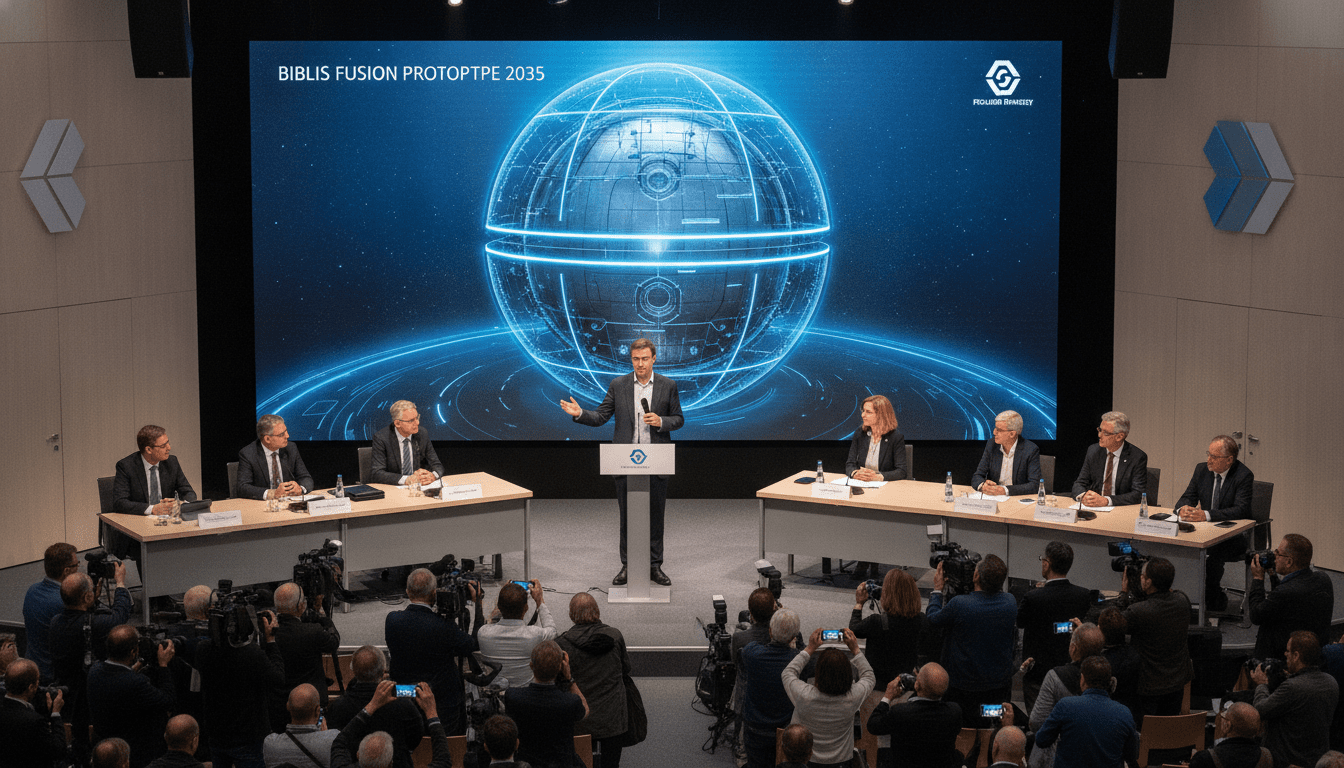
Focused Energy Raises €240 Million, Plans Laser Fusion Power Plant at Biblis
Focused Energy has secured €240 million in new funding to accelerate development of a laser-based fusion power plant at the former Biblis nuclear site, positioning fusion power at the center of Germany’s long-term energy strategy.
Funding Boost and Biblis Strategy
Focused Energy announced a fresh €240 million capital injection this month, elevating it to one of Europe’s most valuable fusion startups.
The company intends to repurpose the decommissioned Biblis site in Hesse as a research and development campus and eventual location for a first-generation fusion prototype.
Company executives say the shutdown of Germany’s older nuclear reactors creates an operational advantage by offering ready infrastructure and grid connections.
They emphasize that major industrial partners will be required to turn the concept into a working power plant, citing RWE, Siemens Energy and laser manufacturer Trumpf as potential collaborators.
How Laser Fusion Would Produce Electricity
Focused Energy’s approach uses intense laser pulses to compress and heat tiny fuel capsules until light nuclei fuse, briefly releasing energy.
That energy would be captured as heat, used to produce steam, and then drive turbines and generators in a conventional thermal cycle.
The planned fuel mix is deuterium–tritium, with deuterium extractable from water and tritium producible from lithium, meaning only trace quantities of raw materials would be needed.
Company scientists highlight that, unlike fission reactors, fusion does not rely on a self-sustaining chain reaction, reducing long-lived radioactive waste and inherent runaway risks.
Projected Costs and the Financing Gap
Focused Energy estimates roughly €1–2 billion is needed to develop its so-called fusion motor, with the first prototype plant projected to cost about €7–8 billion.
The startup says those sums are achievable only with a consortium of large industrial partners and public support to absorb early-stage risks.
Executives argue that state assistance is warranted to leverage private capital, pointing to precedent in other energy transitions where public funds de-risked large technology pushes.
They also expect component costs—most notably high-power lasers—to fall substantially with industrial-scale production, lowering later operating costs.
Timeline: Prototype by 2035, Commercial Scale in the 2030s–2040s
Focused Energy targets a 100–200 megawatt prototype in operation by 2035, describing that installation as a proof-of-concept rather than a commercial plant.
A commercial, gigawatt-scale fusion power station is envisaged in the second half of the 2030s or into the 2040s, subject to successful scale-up and partner commitments.
Company representatives caution that fusion will not be a near-term fix for Germany’s legally mandated 2045 climate neutrality date, but position it as a long-term, large-scale solution.
They liken the technology’s current stage to early aviation in 1903—demonstrated potential but decades required to reach mass deployment.
Cost of Electricity and Market Expectations
Focused Energy projects a long-term delivered electricity cost from fusion at about €0.05 per kilowatt-hour once technologies mature and supply chains scale.
For the initial prototype plants, expected generation costs are higher—roughly €0.10–0.20 per kilowatt-hour—driven by prototype capital intensity and expensive early-stage laser systems.
Economies of scale and serial production of lasers and plant components are cited as the path to bringing the cost down to competitive levels against conventional and renewable baseload options.
The company argues that steady, low-marginal-cost fusion power could complement intermittent wind and solar generation and enable energy-intensive carbon removal applications.
Technology Positioning and International Competition
Focused Energy champions inertial confinement using lasers and contends the method has demonstrated net fusion events in laboratory settings, placing the firm ahead of some magnetically confined efforts.
But it acknowledges that a final judgment on which fusion approach will dominate will only be possible after multiple technologies are operated at commercial scale over time.
The company estimates there are roughly 53 fusion startups worldwide, and believes only a handful will succeed in building sustainable power plants.
Officials warn Europe risks becoming a passive observer unless it invests decisively to retain industrial value from a future fusion supply chain.
Germany faces a policy balancing act: continue rapid deployment of renewables while funding long-horizon research into fusion power.
Focused Energy’s leaders urge flexible climate policy that protects industry competitiveness without abandoning decarbonization goals.
Focused Energy stresses that fusion is not a short-term silver bullet for 2045 targets, but a transformative technology for the latter half of the century that could deliver vast amounts of clean, low-resource electricity if technical and industrial challenges are resolved.
