
Social partner dialogue exposes deep rifts over Germany’s reform agenda
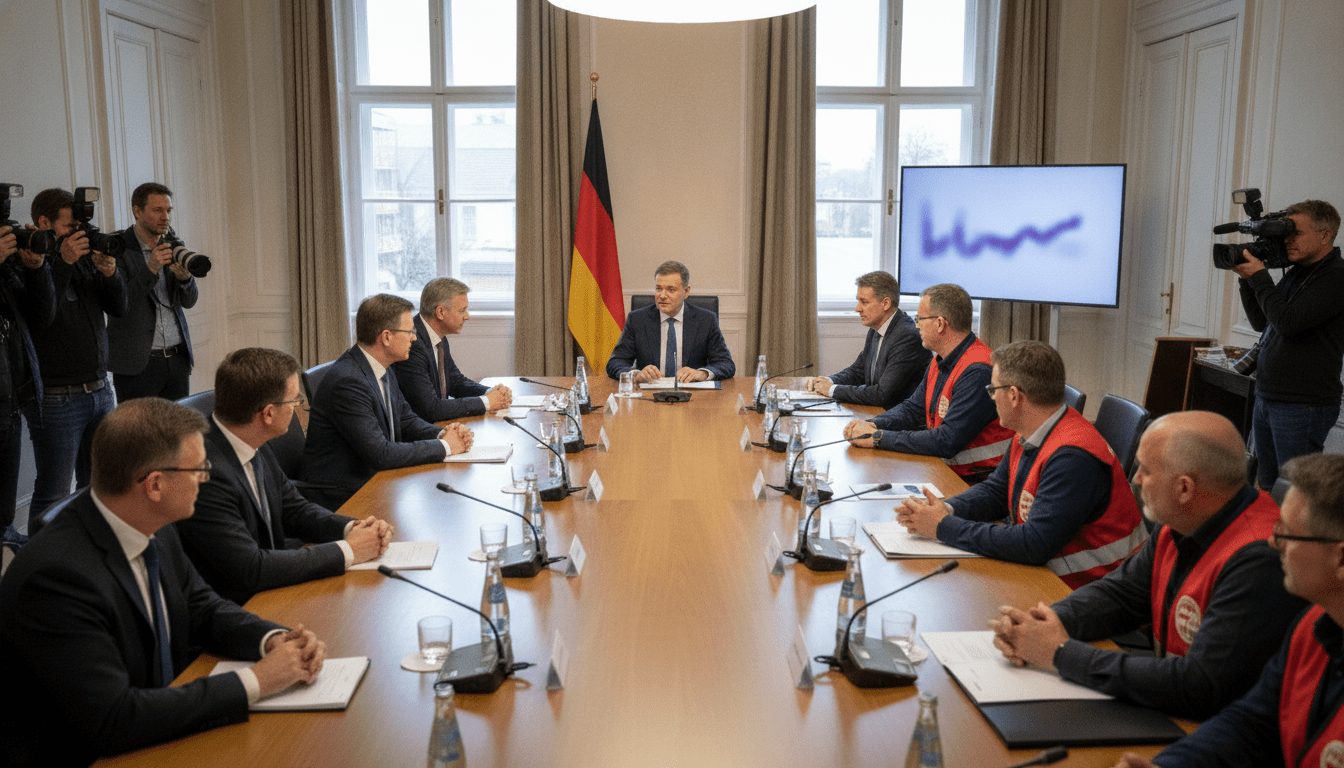
Social partner dialogue in Berlin on June 10, 2026 pits government, unions and employers against each other over reform demands amid sharp industrial job losses.
Germany’s social partner dialogue on Wednesday evening, June 10, 2026, brought the federal government, leading employers and union heads together for a three‑hour meeting intended to signal consensus on urgent reforms. The Chancellery convened the roundtable from 19:00 to 22:00 to hear competing proposals as ministers prepare to unveil reform packages in the coming weeks. The session unfolded against stark economic indicators and deep disagreements over the size and shape of changes many say are needed.
Participants and government objectives
The meeting assembled eight representatives: four from major trade unions and four from employer associations, a composition chosen to present balanced voices. On the labour side were the heads of the DGB and the unions Ver.di, IG Metall and IGBCE. Employer representatives came from the BDA, BDI, DIHK and the ZDH.
Government sources said the aim was to produce “a signal of fundamental consensus on the need for reform” and to project unity ahead of legislative proposals. Organizers framed the exchange as a way to gauge common ground rather than to clinch agreements in a single session.
Economic backdrop and urgent figures
The dialogue took place amid a pronounced industrial slowdown: the economy lost some 124,000 industrial jobs last year, according to figures cited by participants. Industry groups also reported an unexpected, steep fall in orders — described internally as roughly double the decline they had forecast.
Industry leaders argued these trends require rapid adjustments to keep production and investment in Germany. They pointed to large differences in labour costs across borders, arguing competitiveness pressures are forcing companies to seek relief.
Employer proposals and rationale
Employer associations arrived with concrete proposals that they said would restore competitiveness and preserve jobs. Their demands included greater flexibility in working time—moving toward a maximum weekly working time rather than a rigid eight‑hour day—introduction of an unpaid first sick day, reductions in non‑wage labour costs and a loosening of dismissal protections.
While employer spokespeople emphasized they did not seek to dismantle the social system, they framed the measures as necessary to stop what some called an “economic downward spiral.” In private briefings they warned that without cost relief, further job cuts and offshoring would continue.
Union resistance and named red lines
Union leaders pushed back, warning that many employer proposals would erode protections won over decades. They highlighted concrete calculations designed to show the human impact of the suggested changes: for example, a care worker with two children could face a loss of roughly €460 gross a year under a scenario of reduced sick pay and could be exposed to much longer shifts.
Unions publicly set out several “red lines” they would not accept, including limitations on the right to strike, weakening of dismissal protections, raising the statutory retirement age and measures that would permit employers to extend daily working hours by unilateral direction. Prominent union figures signalled limited room for compromise on those points.
Politics, timing and the limits of one meeting
The Chancellery had asked both sides to submit joint ideas in advance around five thematic blocks — from general reform needs to taxation, social insurance, the labour market and bureaucracy reduction. Several employer groups complained the consolidated submission arrived late, complicating efforts to find a unified position before the meeting.
Officials acknowledged the session was as much political theatre as policy discussion: a successful outcome could bolster the government’s fragile reform narrative, while a public breakdown would underscore the difficulties the coalition faces in delivering change. Participants warned that a single three‑hour meeting could not bridge fundamentally opposing visions.
The roundtable concluded without any formal agreement, leaving unresolved whether the encounter will be remembered as the start of a pragmatic pact or as a prelude to sharper public confrontation. The government will use the input as it finalises its legislative timeline, but substantial negotiation remains ahead.
Public attention now turns to the reform packages the coalition plans to present in the coming weeks, and to whether social partners will be able to narrow differences sufficiently to produce durable compromises. The stakes are high: policymakers must balance competitiveness, social protection and political feasibility as Germany seeks to arrest industrial decline and stabilise its labour market.
