
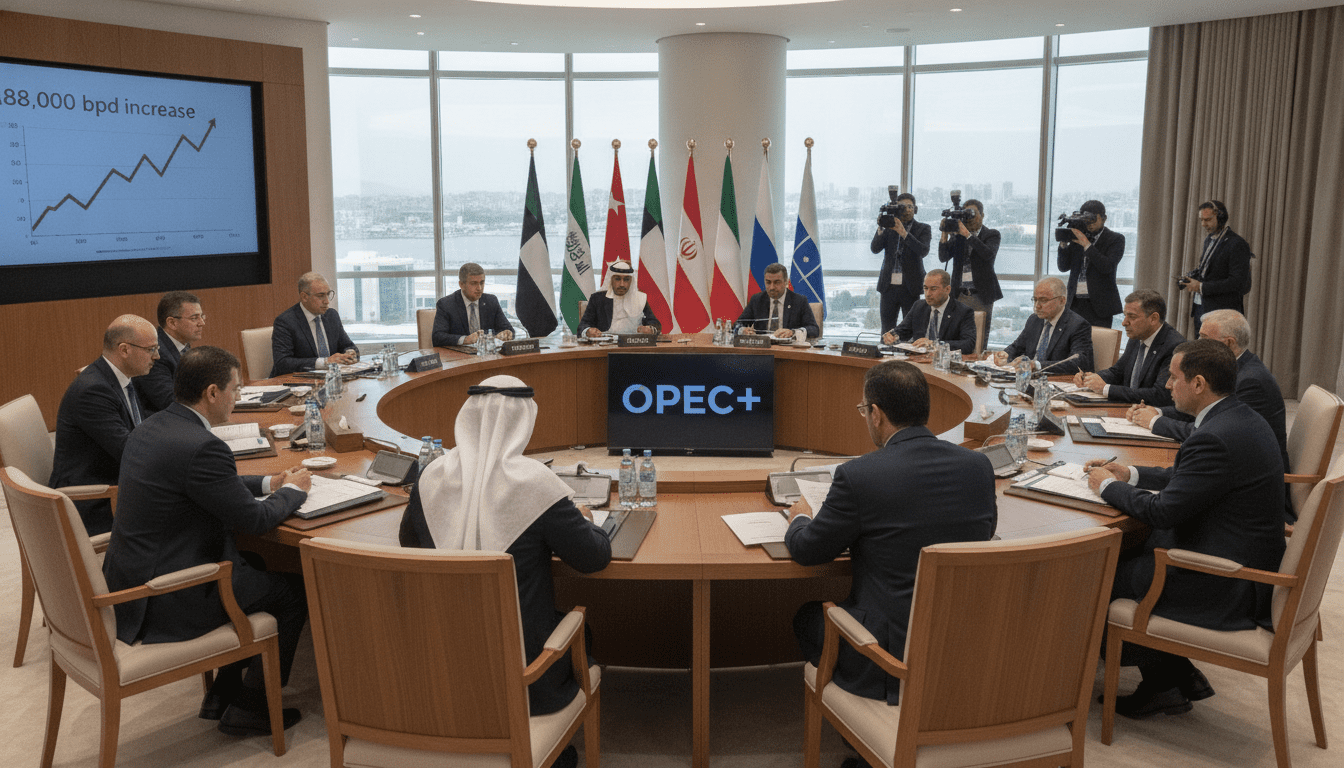
Opec+ raises production targets by 188,000 bpd in fourth monthly increase
OPEC+ raises production targets by 188,000 barrels per day from July as group says move will stabilise markets amid high prices and a Strait of Hormuz blockade.
Opec+ on Monday agreed to raise its collective production targets by roughly 188,000 barrels per day from July, marking the fourth consecutive monthly increase and bringing total adjustments since April to nearly 600,000 barrels per day. The move, announced by the seven core members of the expanded group, was described as an attempt to stabilise the oil market while preserving flexibility amid historically high prices. Officials framed the increase as cautious and deliberate, even as analysts questioned its practical effect while shipping constraints persist.
Details of the July quota increase
The seven core Opec+ members—Saudi Arabia, Iraq, Kuwait, Algeria, Kazakhstan, Russia and Oman—consented to the modest uplift in quotas, which takes effect in July. Officials said the step reflects a calibrated approach intended to respond to market conditions without triggering sudden price swings.
This is the fourth time in four months that the group has raised its targets, and combined adjustments since April amount to almost 600,000 barrels per day, underscoring a gradual loosening of supply policy. Ministers emphasised in their statement that the aim is to stabilise supply and demand fundamentals while keeping options open for future action.
Supply increase seen as political signal by analysts
Several market analysts cautioned that the announced increase is more symbolic than substantive given current constraints on physical shipments. Jorge Leon, an analyst at Rystad Energy, said the 188,000-barrel-per-day adjustment looks “like a political signal rather than a genuine supply expansion,” because quotas do not translate into barrels if logistical channels remain disrupted.
Traders and analysts have repeatedly pointed out that the oil market today is constrained less by declared quotas and more by the ability to move crude to purchasers, a point that many view as central to interpreting Opec+ policy moves.
Strait of Hormuz blockade limits exports
A continuing blockade of the Strait of Hormuz has sharply curtailed the ability of some producers to ship crude, creating a bottleneck that undermines the impact of quota increases. Since late February, several key producers have been unable to deliver full volumes to customers because vessels cannot transit the narrow, strategically vital waterway.
The blockade has therefore turned nominal production capacity into theoretical rather than realised supply, complicating the global market’s response to Opec+ announcements and heightening uncertainty among consumers and refiners.
Operational disruptions and wider membership changes
The crisis has been compounded by recent membership shifts: the United Arab Emirates formally left Opec in April after nearly six decades of participation, a development that has reshaped the organisation’s internal dynamics. Combined with combat-related disruptions in the broader Middle East region, operational constraints have limited actual crude flows even as quotas are adjusted upward.
Saudi Arabia and other large producers have reported difficulties keeping supply commitments fully met to customers since late February, reflecting the gap between production capability and export capacity in a period of heightened geopolitical tension.
Market risks and potential for rapid reversal
Analysts warn that if the Strait of Hormuz reopens and shipments resume at scale, the market could pivot quickly from supply anxiety to oversupply, amplifying downward pressure on prices. Jorge Leon and other market watchers noted that reopening could transform the current premium for security of supply into an acute risk of excess barrels chasing available storage and refining capacity.
Opec+ ministers acknowledged that uncertainty in shipping and demand dynamics necessitates a cautious stance, saying they would monitor conditions closely and retain the flexibility to adjust quotas again if needed.
Price implications and policy motives
Ministers justified the increases as measures to stabilise markets, but they also cited an opportunity to benefit from persistently high oil prices. The stated rationale combined economic pragmatism with a strategic posture intended to avoid abrupt price volatility.
For consumers and downstream buyers, the practical effect is likely to remain muted in the near term unless shipping constraints ease, meaning price relief could be limited even with higher nominal quotas. Market participants will be watching actual tanker movements and storage levels more closely than headline quota figures.
Opec+’s incremental quota rises underscore the tension between declared supply policy and on-the-ground transport realities, leaving traders, refiners and policymakers dependent on developments in the Strait of Hormuz to determine whether the moves will translate into more oil reaching global markets or remain largely symbolic.
