
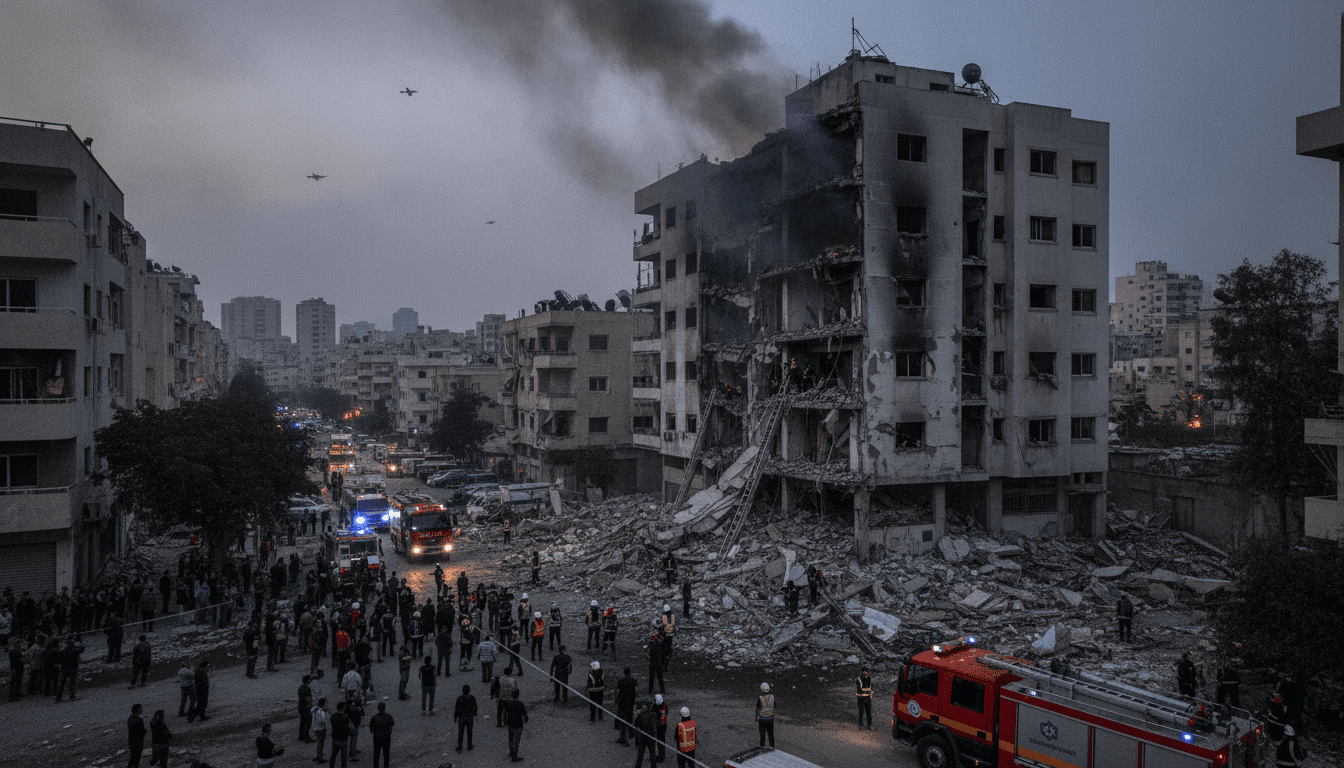
Israel bombs Beirut as multiple blasts rock Dahieh suburb
Israel bombs Beirut: at least three blasts hit Dahieh; Israeli military says it struck a ‘terrorist’ HQ after Hezbollah fired toward Israel. Casualties unknown.
Israel bombed areas of Beirut on Sunday, with at least three explosions heard in the Lebanese capital and witnesses reporting damage to a multi-storey building in the southern suburb of Dahieh. The strikes, which the Israeli military said targeted “terrorist” headquarters, came after Israeli leaders said they were responding to fire from Hezbollah toward Israeli territory. The exchange represents a significant escalation in cross-border tensions and raised concerns about a wider confrontation between Israel and Lebanese armed factions.
Explosions heard across the city
Witnesses in Beirut described multiple blasts and a surge of activity in the southern suburbs soon after the strikes began. At least three detonations were reported, and residents said a multi-storey building in Dahieh sustained visible damage, according to on-the-ground accounts. Television footage broadcast by local outlets showed smoke rising over parts of the city as emergency services moved toward affected neighborhoods.
Dahieh identified as the strike zone
The Israeli military said its operations were concentrated in the Dahieh area, a densely populated suburb of Beirut located south of the city center. Dahieh has long been associated with Hezbollah’s political and military presence, and Israeli officials described the targets as “terrorist” infrastructure. The military statement framed the action as a precision strike on what it identified as command facilities, though detailed evidence and independent verification of the exact targets were not immediately available.
Israeli leadership cites Hezbollah fire
Prime Minister Benjamin Netanyahu and Defence Minister Israel Katz issued a joint statement saying the strikes were a direct response to Hezbollah firing toward Israeli territory. Israeli officials characterized the operation as a necessary act of self-defence, framing it within an ongoing pattern of exchanges along the Israel-Lebanon frontier. Government sources emphasized the aim to degrade capabilities that threaten Israeli communities across the border.
Damage reports and casualty status
Local witnesses reported structural damage to at least one multi-storey residential or commercial building in Dahieh, with debris visible in surrounding streets. There was no immediate, independently verified information about fatalities or injuries; Lebanese authorities had not released a comprehensive toll at the time of initial reports. Hospitals in Beirut reported being on alert and mobilizing emergency teams, according to local media, while humanitarian groups signalled concern for civilians in densely populated suburbs.
Risk of wider escalation in the region
Analysts warned that strikes in Beirut’s southern suburbs risk expanding the scope of hostilities beyond isolated cross-border skirmishes. Dahieh’s urban density and its mix of civilian and military infrastructure raise the risk of collateral damage when military operations occur there. Observers noted that further exchanges between Israeli forces and Hezbollah could draw in additional regional actors and complicate diplomatic efforts to stabilise the front.
Calls for restraint and international concern
Diplomatic sources and international bodies have historically urged restraint during flare-ups along the Israel-Lebanon border, citing the potential for rapid escalation and humanitarian consequences. Global capitals typically reiterate support for de-escalation and for international mechanisms aimed at preventing full-scale conflict. At the same time, governments emphasise the need for accurate information and independent verification as events unfold amid competing claims from the parties involved.
The strikes in Beirut on Sunday underscore a sharp rise in tensions between Israel and Lebanese armed groups, with Israeli leaders framing the action as retaliation for cross-border fire and Lebanese witnesses reporting significant explosions in the Dahieh suburb. As emergency responders and local residents assess damage, the immediate humanitarian impact remains unclear while diplomats and analysts watch for signs of further escalation.
