
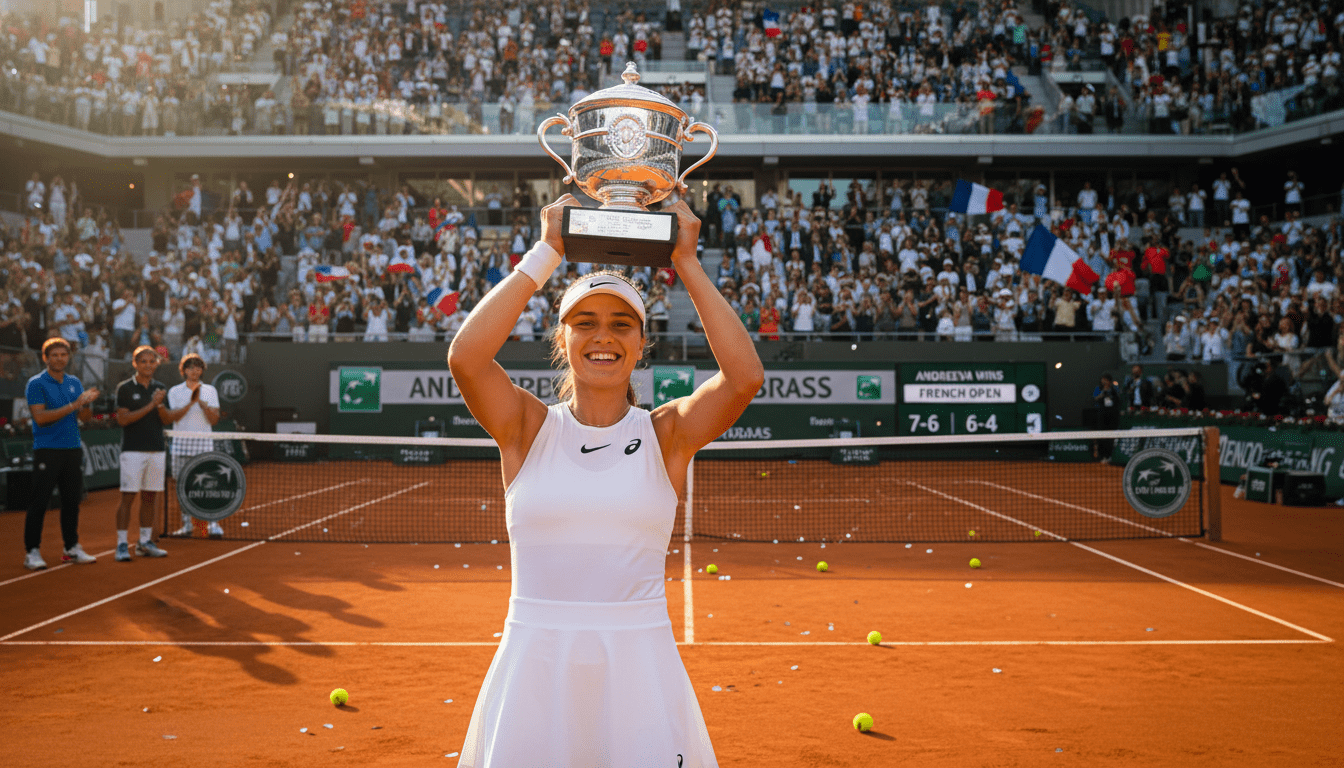
Mirra Andrejewa wins French Open title, becoming youngest Roland Garros singles champion since Monica Seles
Mirra Andrejewa wins her first French Open title, beating qualifier Maja Chwalinska 6-3, 6-2 to become the youngest Roland Garros champion since Monica Seles.
Mirra Andrejewa sealed the women’s singles title at Roland Garros with a 6-3, 6-2 victory over Polish qualifier Maja Chwalinska on Saturday. The 19-year-old collected €2.8 million, 2,000 ranking points and moved up to world No. 6 after an 82-minute final on Court Philippe-Chatrier. Andrejewa’s triumph makes her the youngest champion at the French Open since Monica Seles in 1992, and marks the first Grand Slam trophy of her professional career.
Victory on Court Philippe-Chatrier
Andrejewa converted her first match point and dropped to her knees as the crowd rose to applaud the new champion. The straight-sets win reflected a match in which the Russian displayed greater power from the baseline and a more penetrating first serve throughout the afternoon. Chwalinska pushed early but could not sustain the level required to unsettle Andrejewa over the course of the match.
The prize money and ranking boost underscore the scale of the breakthrough for Andrejewa, whose win was backed by a run of strong results on clay and hard courts. Tournament conditions — notably gusting wind — tested both players, but Andrejewa adapted more effectively as the match progressed.
Historic milestone and ranking impact
At 19 years and 39 days, Andrejewa becomes the youngest Roland Garros singles champion in more than three decades. The 2,000 ranking points awarded for the title propelled her two places up the WTA rankings to No. 6, a position that reflects her rapid ascension in the women’s game. The €2.8 million winner’s cheque is the largest prize of her career to date and cements her standing among the sport’s emerging elite.
The result also places Andrejewa firmly among the players expected to shape the remainder of the season, with the automatic seeding and ranking protection that come from a Grand Slam victory. Her age and form suggest the potential for sustained presence at the top of the tour.
Chwalinska’s remarkable run as a qualifier
Maja Chwalinska left Paris with much to celebrate despite the defeat, having started the fortnight in qualifying and reached the final against all expectations. The 24-year-old earned €1.4 million, a significant increase on her previous career earnings, and climbed into the top 25 — a leap that will grant her direct entry to main draws across the WTA calendar. Her nine match wins at Roland Garros were the most of any woman in this year’s tournament.
Chwalinska’s run underlined the depth on the WTA Tour and the opportunities offered by the Grand Slams for low-ranked players to make dramatic progress. Her performance on the sport’s biggest stage will likely change both her schedule and expectations for the months ahead.
Turning points and match dynamics
The final opened with both players losing their first two service games as gusty wind complicated ball tosses and timing. Chwalinska initially seized the initiative and led 3-2, buoyed by a vocal contingent of supporters in the stands. But Andrejewa’s superior serve velocity and heavier groundstrokes began to dictate rallies, and the momentum shifted in her favour.
Chwalinska had a late window in the second set at 0-2 when she generated three consecutive break opportunities, but she could not convert any of them. That sequence proved pivotal; Andrejewa tightened her game thereafter and closed out the match with the authority of a player convinced of her advantage on clay.
Andrejewa’s clay-court pedigree
Andrejewa’s comfort on clay has been evident across recent seasons, with deep runs in Paris in previous years and titles at high-level tournaments that signalled her rise. Her combination of aggressive serving and heavy, angled groundstrokes translates well to slow courts, and she repeatedly used those weapons to move opponents behind the baseline. The champion credited the atmosphere, the surface and the tournament’s familiar routines for helping her focus.
Her mother, present throughout the fortnight, has remained a constant in Andrejewa’s support system, and the player has spoken often about the emotional ease she finds at Roland Garros. The victory adds a major title to a résumé that already includes significant tour-level trophies.
Immediate implications for the season
The Grand Slam win will reshape Andrejewa’s calendar, seeding and media profile for the rest of the year. As a freshly crowned major champion, she will carry both heightened expectations and increased scrutiny into upcoming tournaments. Sponsors and tournament directors typically respond to such breakthroughs with additional opportunities, and her improved ranking guarantees easier entry into elite events.
For Chwalinska, the financial windfall and ranking rise provide resources and entry access that can accelerate her development and support a fuller schedule at higher-tier events. Both finalists emerge from Paris with momentum and new career parameters to navigate.
Mirra Andrejewa’s Paris triumph completes a rapid rise from promising teenager to Grand Slam champion, and she is certain to return to Roland Garros next year as the defending champion.
