
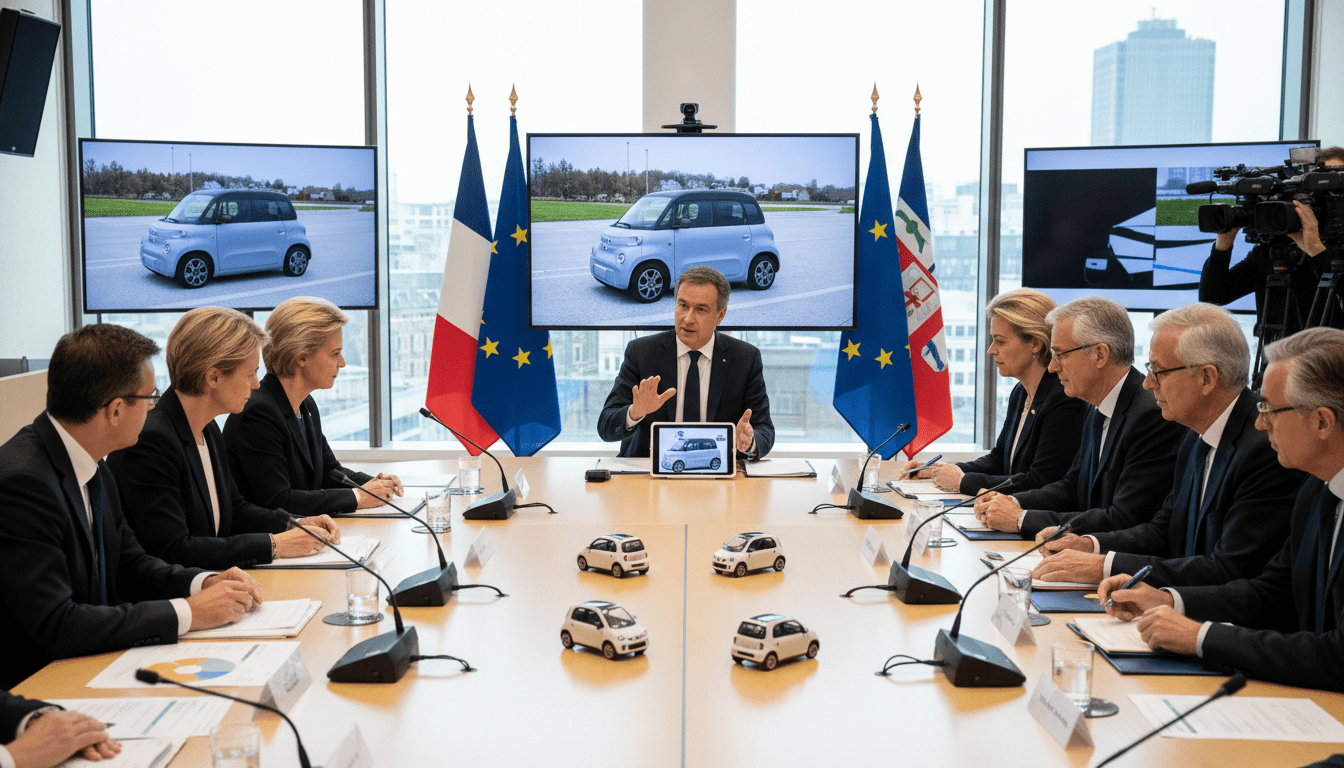
EU debate over small electric cars sparks industry rift between France and Germany
EU debate over small electric cars intensifies as France pushes special CO₂ rules favoring Renault and Stellantis, prompting opposition from German automakers.
A dispute in Brussels over special treatment for small electric cars has widened into a broader political and industrial conflict between French interests and major German manufacturers. The French-backed proposal would give a preferential weighting to electric microcars and subcompact models in fleet CO₂ calculations, a change that would directly benefit Renault and several Stellantis brands. German automakers and industry groups warn the move could distort competition, threaten jobs tied to larger models and prompt retaliatory trade measures. The proposal is reported to be under consideration within the European Commission, setting up a contentious debate in the weeks ahead.
How the proposed CO₂ calculation change would work
Under the French proposal, qualifying small electric cars would be counted with a multiplier when manufacturers calculate average fleet emissions. The suggested factor of 1.2 means each counted small EV would be treated as 20 percent more effective in reducing a maker’s fleet average. Eligibility would hinge on a simple dimensional threshold — vehicles no longer than 4.20 metres — which would capture a broad swath of subcompact models.
Proponents argue the mechanism would accelerate the availability of affordable electric cars for urban buyers and help decarbonize city transport. Critics counter that a blanket multiplier keyed to length would create arbitrary regulatory advantages and could be gamed to favour specific models and manufacturers.
Renault and Stellantis emerge as primary gainers
Industry observers say Renault stands to gain most from any carve-out for small electric cars, in part because the French state holds a significant stake in the company. New Renault models intentionally sized below or near the proposed threshold, such as recent small electric launches, would immediately qualify for the multiplier benefit if the rule is adopted.
Stellantis, which houses numerous French marques including Peugeot and Citroën, is viewed as a secondary beneficiary given its portfolio of city-oriented electric models. For both groups, regulatory relief on fleet emissions would translate into easier compliance and a competitive edge in European sales of low-cost EVs.
ACEA frames the change as industrial policy to preserve small-car production
The Association of European Automakers (ACEA) has formally supported measures aimed at safeguarding the production of affordable small cars in Europe. ACEA officials argue that targeted incentives would maintain industrial capacity, protect regional jobs and broaden access to electric mobility where charging infrastructure and consumer purchasing power vary widely.
In written responses and position papers, the trade body has also voiced support for prioritising “Made in Europe” vehicles when considering favorable treatment, linking the proposal to wider objectives on competitiveness and supply-chain resilience.
German automakers and unions raise alarm over market distortion
Representatives of Germany’s major carmakers and associated unions have warned that the proposed rules would favor one segment of the industry while penalising manufacturers of larger and luxury vehicles. Volkswagen, BMW and Mercedes-Benz make a substantial portion of their profits from larger cars and SUVs, which would not qualify for the proposed multiplier and could face higher effective compliance costs.
Beyond immediate commercial concerns, German industry sources say the change risks creating distortions in city access rules, parking fees and taxation if member states begin to legislate differential treatment for newly defined vehicle categories. There is also apprehension that measures favouring domestic or regional production could provoke retaliatory barriers from trading partners.
Political tensions in Brussels and national capitals
The initiative has highlighted cleavages among EU institutions and member states, with France pushing hard for measures that align with national industrial strategy. The matter has reportedly drawn attention at the political level in Brussels, where some commissioners are seen as sympathetic to arguments for social and territorial cohesion in mobility policy, while others emphasise market neutrality.
German politicians and business lobbyists are pressing for adjustments that would avoid singling out vehicle sizes or makers, arguing that climate and industrial goals should be pursued through technology-neutral standards and investment in charging infrastructure. The dispute has placed pressure on EU mediators to broker a compromise that balances decarbonisation, competitiveness and fairness.
Possible regulatory and market consequences
If formally adopted, a length-based classification and multiplier could encourage focused product line-ups aimed at exploiting the new rules, with knock-on effects for design, procurement and investment decisions. Manufacturers could accelerate development of subcompact EVs to improve fleet averages, while slowing or reshaping plans for larger electrified models that remain core to export markets.
The measure could also shift the political economy of EU trade policy, reinforcing calls for preferential treatment of European-built electric vehicles and potentially complicating relations with external suppliers and trading partners. Consumer impacts would depend on whether regulatory relief actually leads to lower retail prices and wider availability of small electric cars across member states.
The proposal now faces negotiation in Brussels and scrutiny from national capitals, industry associations and transport policymakers. Stakeholders on both sides say they prefer a market-based transition to electric mobility, but fundamental disagreements remain about whether targeted relief for small electric cars is an effective or fair instrument to achieve that goal.
