
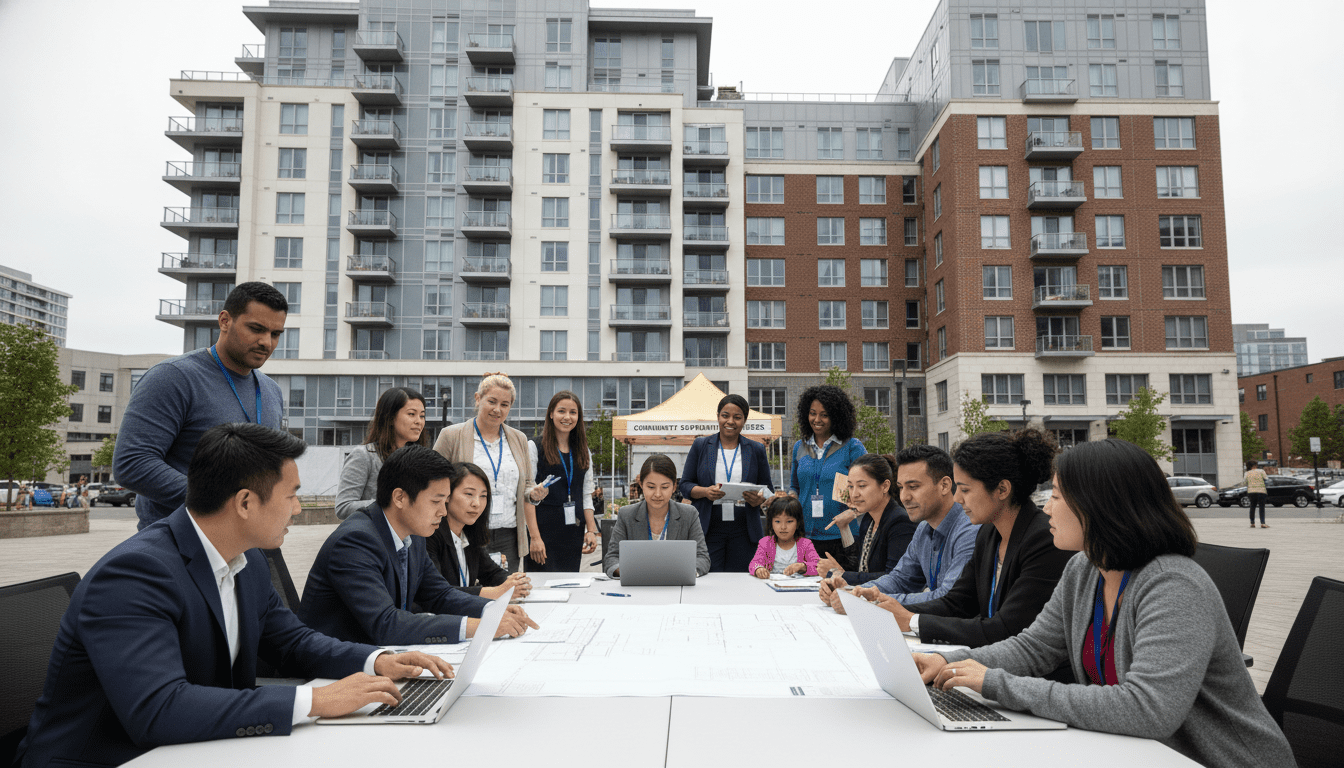
Social Mixing in Housing: Why Integration Fails Without Active Management
Social mixing in housing often fails when planning ignores management, equal design and support services. Experts warn integration must be actively organized.
Social mixing has been a guiding principle for urban development for years, but it is increasingly clear that simply placing diverse households side by side does not produce lasting integration. Planners and developers who assume proximity equals cohesion overlook deep differences in expectations, needs and life trajectories. The debate now centers on how to translate the ideal of mixed neighborhoods into durable social practice.
Mixing Alone Does Not Guarantee Integration
Spatial proximity is often treated as a policy panacea, yet evidence from recent projects shows that co-location is only the first step. When mixed tenures or income groups are assembled without complementary measures, relationships between residents tend to remain superficial rather than cooperative.
Neighborhood managers and local mediators can mitigate conflicts, but they cannot repair conceptual flaws in planning after the fact. Long-term success requires that integration be built into the project’s design, allocation and governance from the outset.
Differing Expectations and Everyday Tensions
Residents from higher-income households frequently demand different services and amenity standards than lower-income neighbors, and these divergent expectations quickly surface in everyday life. Disputes over shared areas, maintenance levels or perceived safety can erode trust and turn intended mixing into a persistent “side-by-side” arrangement.
Visible separations within buildings or across blocks—separate entrances, different finishes, or restricted common spaces—reinforce social hierarchies and signal inequality. Such design choices create a tacit segregation that undermines the public objective of cohesive, mixed communities.
Challenges of Including Vulnerable Groups
Including vulnerable populations, such as people exiting homelessness, raises additional practical requirements that many mixed developments underestimate. Social-policy innovations like Housing First have proven effective at stabilizing individuals, but they also increase demand for on-site or neighborhood-based support services.
Without continuous social work, mediation and low-threshold assistance, the distance between vulnerable residents and more affluent neighbors can widen rather than narrow. Integration is fundamentally a social process that needs sustained resources, not a one-time architectural decision.
Economic Incentives and Developer Behavior
From an investment perspective, heterogeneous resident mixes can be perceived as a risk factor tied to turnover, conflict or reputational effects. Developers and financiers therefore favor predictable, homogeneous tenant profiles in prime locations to protect asset value and marketability.
Financial logic can produce built environments that look mixed on paper but are segregated in practice. When economic imperatives dominate, projects may feature uneven quality or access, which in turn makes social mixing harder to sustain during the operation phase.
Successful Models Require Sequenced Planning
There are notable counterexamples where mixed housing performs well because integration is curated rather than assumed. Projects that combine uniform construction quality, clear allocation rules and long-term management plans tend to avoid visible hierarchies and foster meaningful interaction.
Sequencing also matters: introducing resident groups in stages, ensuring essential social infrastructure is in place before vulnerable households move in, and tying developer incentives to social outcomes can all improve prospects for durable mixing. International schemes demonstrate that economic viability and genuine social diversity are compatible when supported by active governance.
Urban policy should therefore move from the slogan of social mixing to a practical toolkit of allocation strategies, design parity, ongoing social services and contractual obligations that bind stakeholders to long-term stewardship. The experiment of mixed neighborhoods succeeds only when actors plan for complexity rather than assume away difference.
Social mixing in housing is achievable, but it is not automatic; it requires equal-quality design, sequenced settlement, ongoing management and explicit social-policy objectives to turn spatial diversity into social cohesion.
