
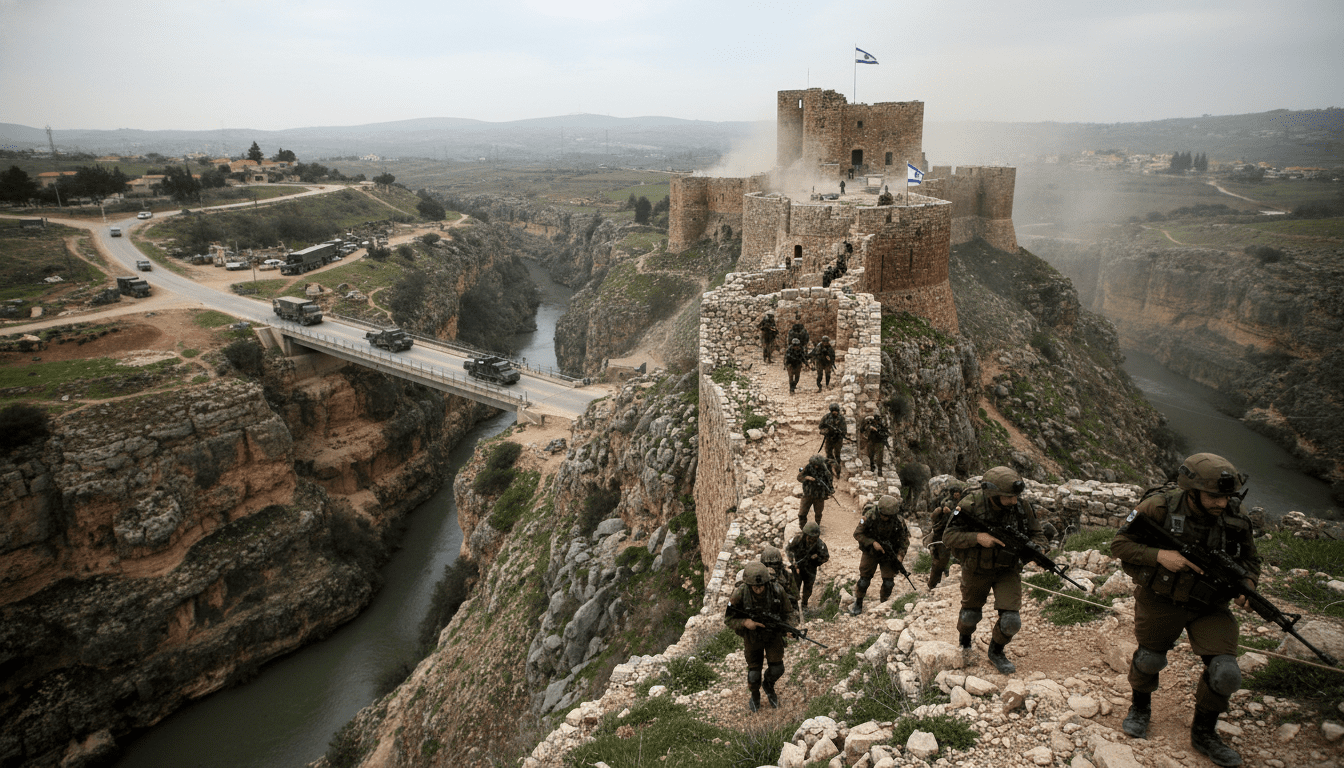
Israeli ground offensive in Lebanon widens as troops cross Litani and seize Beaufort fortress
Israeli ground offensive in Lebanon widens as troops cross the Litani River and capture the Beaufort fortress, prompting evacuations and warnings of dangerous escalation.
Israeli ground offensive expands north of border
Israeli forces announced a broadening of their ground offensive in southern Lebanon, saying operations have moved into additional areas to establish a forward defensive line. The military framed the advance as an effort to remove direct threats to northern Israeli communities and to strengthen operational control of the border region.
Residents south of the Zahrani River were urged to evacuate by Israeli authorities amid warnings of possible attacks, reflecting heightened tensions along the frontier and a widening geographic footprint for the campaign.
Forces cross the Litani River, army says
The Israeli army said its troops have crossed the Litani River, roughly 30 kilometres north of the shared border, marking a significant northward push of the offensive. Prime Minister Benjamin Netanyahu had indicated on Friday that forces had moved across the Litani, while the military said the operation in the Beaufort Ridge and Wadi al-Saluki area began several days ago.
Officials described the movements as part of a plan to extend a “forward defensive line,” a formulation intended to justify deeper penetrations aimed at degrading capabilities that Israeli commanders say threaten towns such as Metula and other northern communities.
Beaufort fortress and strategic ridge captured
Among the gains the Israeli military reported is the capture of the Beaufort fortress and the surrounding hill chain, a site of strategic importance that dates back roughly nine centuries. Control of the ridge gives forces elevated lines of observation and tactical advantage over parts of southern Lebanon, according to military statements.
The seizure is being presented by Israeli authorities as a key operational achievement, described as a significant push against the Iran-backed Hezbollah militia that has carried out strikes across the border during the conflict.
Lebanese prime minister condemns ‘collective punishment’
Lebanese Prime Minister Nawaf Salam publicly denounced the recent operations, accusing Israel of pursuing a strategy of “scorched earth and collective punishment” by destroying towns and forcing civilians to flee. In a televised address he called for intensified political and diplomatic efforts to secure a swift and genuine ceasefire.
Salam nevertheless said Beirut would continue direct negotiations with Israel, which he characterized as the least costly route for the country, with a new round of talks scheduled in Washington on June 2 and 3, 2026.
Ceasefire since April 17 strained; Hezbollah continues attacks
A ceasefire between Israel and Lebanese parties has been in effect since April 17, 2026, but both sides have accused each other of violations and continued hostilities. The Iran-backed Hezbollah militia has rejected both the bilateral ceasefire and government-led talks, maintaining attacks that it says respond to perceived infractions and to support its regional ally Iran.
The current escalation follows a wider regional outbreak of violence after Israeli and U.S. strikes against Iranian targets earlier this year, and a subsequent decision by Hezbollah in early March to join operations in defence of Tehran’s interests.
Humanitarian impact: casualties and mass displacement
Lebanese authorities report that the fighting has exacted a heavy toll on civilians, with 3,371 people killed by Israeli strikes in Lebanon since the outbreak of hostilities and more than one million people displaced from their homes. The numbers illustrate the scale of displacement and the pressure on shelter, medical services and basic supplies in southern communities.
Humanitarian access and civilian protection remain urgent concerns as evacuation orders are issued in areas at risk of attack and as damage to infrastructure impedes relief efforts and local recovery.
Diplomatic efforts to halt the escalation face short-term challenges as both military operations and political posturing continue to shape events on the ground. With Washington set to host talks on June 2–3, 2026, the coming days will test whether diplomacy can keep pace with rapidly shifting battlefield developments and reduce the risk of wider regional confrontation.
