
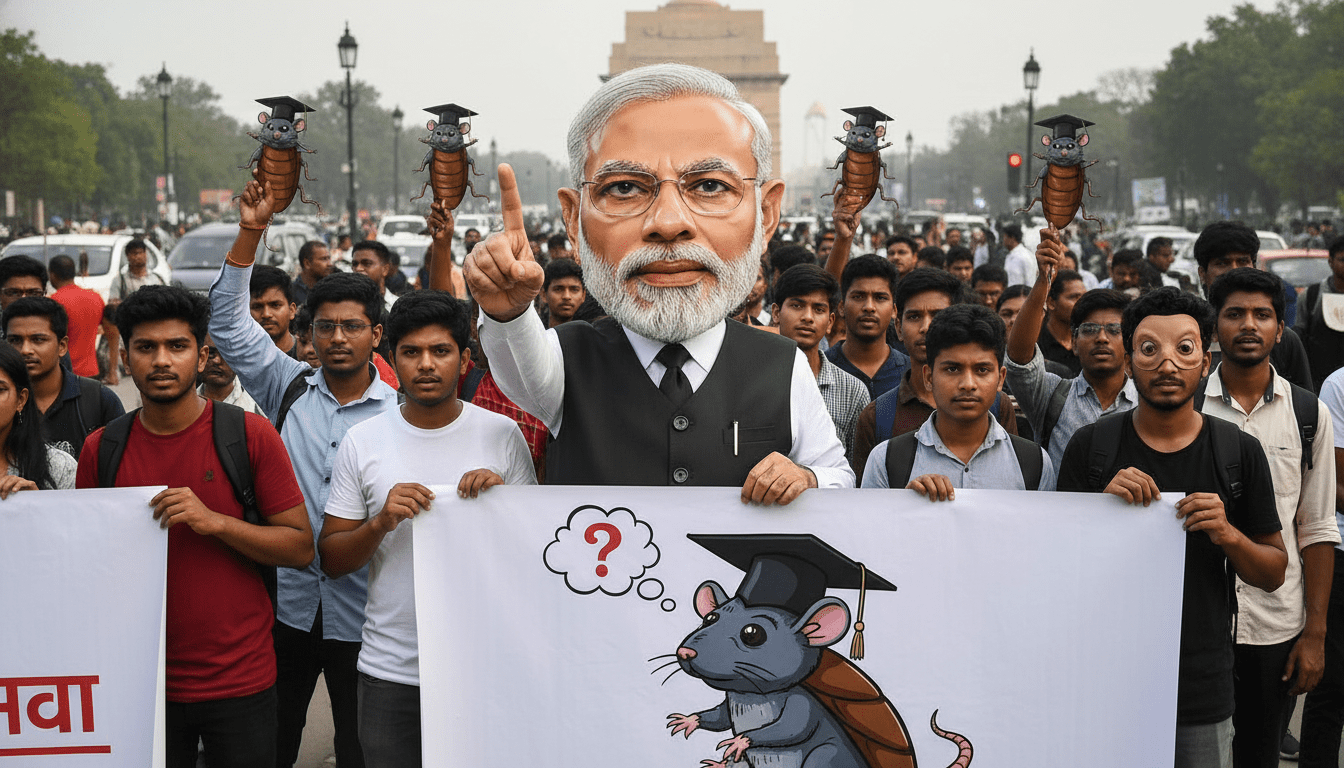
Satirical Protest Movement “Cockroach Janata Party” Surges After India’s Chief Justice Calls Unemployed Graduates ‘Cockroaches’
A satirical protest movement has erupted online after India’s Chief Justice Surya Kant reportedly likened certain unemployed graduates to “cockroaches,” prompting the viral creation of the “Cockroach Janata Party” that is now putting Prime Minister Narendra Modi and his government under mounting political pressure. The satirical protest movement has spread across platforms in a matter of days, reclaiming the slur and turning courtroom outrage into a mass digital backlash. (cbsnews.com)
Chief Justice Surya Kant’s Courtroom Remark and Clarifications
During a Supreme Court hearing on May 15, Chief Justice Surya Kant used language likening some unemployed activists and commentators to “cockroaches” and “parasites,” remarks that many critics say demean a large segment of India’s youth. The judge later attempted to narrow his comments, saying his reference applied to people who secure work through fraudulent degrees rather than to unemployed graduates broadly. (outlookindia.com)
Legal commentators and civil society groups reacted swiftly, arguing that the choice of dehumanising metaphors by the judiciary risked normalising contempt for dissent and vulnerable populations. Observers have pointed to historical precedents in which similar language preceded political repression, heightening the intensity of the public response. (countercurrents.org)
How the Cockroach Janata Party Was Created
The Cockroach Janata Party (CJP) was launched almost immediately after the remark, initially as a satirical social media project created by a university student and amplified by meme culture. The movement framed itself as a parody of the ruling Bharatiya Janata Party, repurposing the slur into a symbol of survival and resilience while publishing a deliberately absurd manifesto and visuals. (onmanorama.com)
Within days the CJP amassed a large following on multiple platforms, with users sharing illustrations, slogans and mock policy proposals that highlighted perceived cronyism, media concentration and the lack of employment opportunities for graduates. The speed of the viral spread made the parody a focal point of national debate about satire, free speech and political accountability. (ranklity.com)
Graduate Unemployment Fuels the Backlash
Underlying the satire is a persistent economic grievance: a recent State of Working India report from Azim Premji University found that graduate unemployment remains stubbornly high, with nearly 40 percent of 15- to 25-year-olds and roughly 20 percent of 25- to 29-year-olds out of work. Those figures have been widely cited by campaigners who argue that frustration over joblessness helps explain why the CJP struck a chord. (azimpremjiuniversity.edu.in)
Analysts say the mismatch between rapidly expanding higher education and lagging formal job creation has produced a large cohort of educated but underemployed citizens who are particularly active online. The CJP’s mockery of elite language tapped into that demographic’s resentment, transforming private anger into a public, performative protest. (azimpremjiuniversity.edu.in)
Government and Judicial Responses Escalate
The viral movement has provoked an official reaction: petitions and public interest litigations asking courts to examine whether the appropriation of courtroom remarks for commercial or political ends violates law, and reports that some CJP accounts were blocked or withheld under legal demands. The Supreme Court has not yet fast-tracked these petitions, saying matters will be considered in due course. (sentinelassam.com)
Senior government and party figures have framed the campaign as a coordinated destabilisation attempt, with calls from some quarters for probes into online funding and foreign influence. Opposition leaders and civil libertarians, however, warn that heavy-handed restrictions on satire risk undermining democratic space and further inflaming youth discontent. (nationalheraldindia.com)
Memes, Markets and the Machinery of Viral Dissent
The CJP’s growth underscores how political satire now leverages platform algorithms, influencer networks and brand-savvy marketing to reach mass audiences almost instantly. Commercial interest followed the viral moment, with commentators noting how memes and merchandise can convert outrage into revenue and cultural currency. (ranklity.com)
At the same time, attempts to suppress accounts and websites have amplified the movement’s visibility, producing a Streisand effect that pushed the parody further into mainstream news cycles and public protests. The interplay between digital culture and real-world mobilization has left both established parties and institutions scrambling to respond. (karvaanindia.com)
Legal Challenges and the Road Ahead
Petitions now before the courts seek a range of remedies, from inquiries into alleged misuse of courtroom language to directions against the commercial exploitation of judicial remarks, while civil liberties groups press for protection of satire as political speech. How the judiciary and executive balance those claims will shape immediate outcomes for the CJP and for broader free-speech norms. (thelawadvice.com)
Political strategists warn that constraining an internet-born satire that channels widespread economic grievance could carry electoral costs, especially among younger voters. Conversely, if the government successfully frames the movement as foreign-funded or unlawful, it may blunt its momentum; both trajectories present risks to stability and democratic trust. (nationalheraldindia.com)
Public anger, economic distress and digital satire have converged in a way that now tests India’s institutions and political narratives. Whatever legal and political steps follow, the episode has already reframed a courtroom aside into a national conversation about dignity, employment and the limits of state response to online dissent.
