
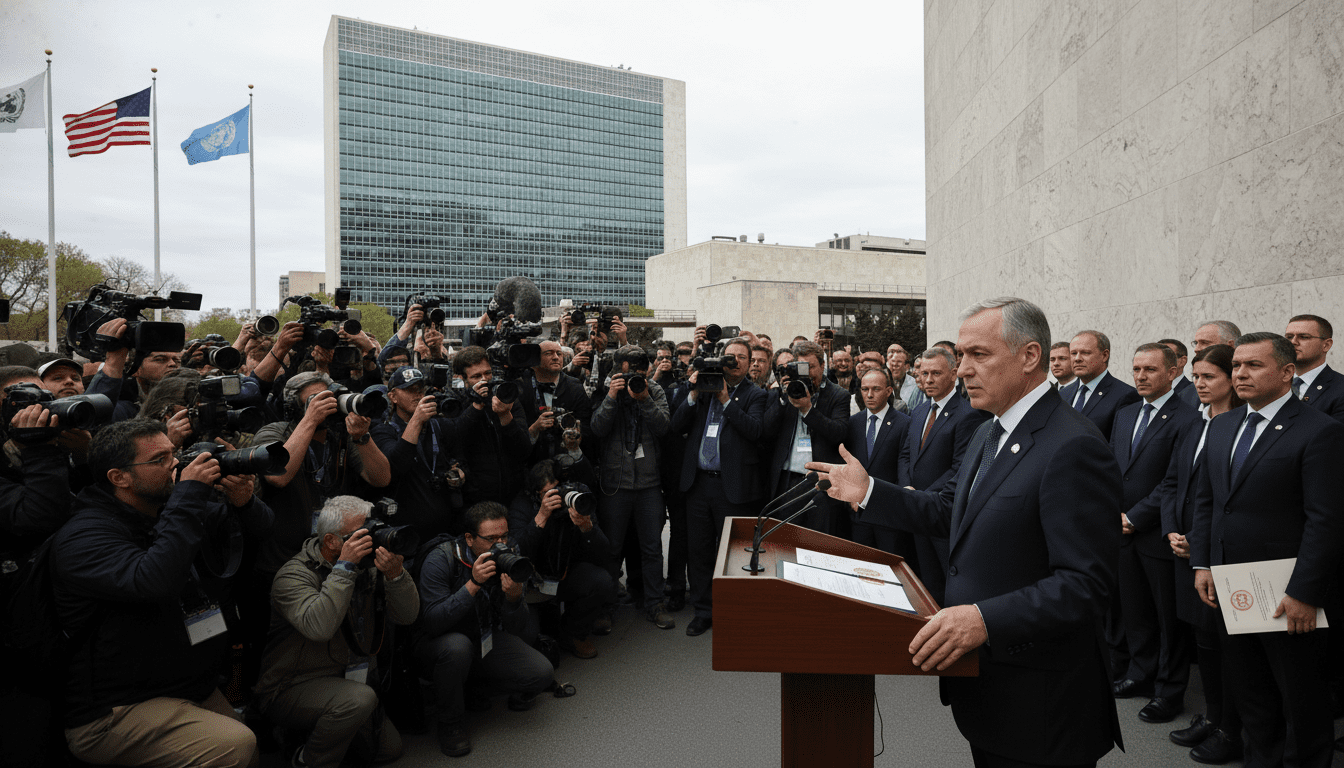
Russia condemns US visa denial for Deputy FM Alimov as breach of 1947 UN Headquarters Agreement
Russia accuses the United States of violating the 1947 UN Headquarters Agreement after a US visa denial prevented Deputy Foreign Minister Alexander Alimov from attending a Security Council meeting in New York.
Russia’s UN ambassador Vassily Nebenzia informed the Security Council on Tuesday that Alexander Alimov, who oversees Moscow’s UN portfolio, was not granted a visa despite repeated requests. Nebenzia characterized the US visa denial as a breach of Washington’s legal obligations under the 1947 agreement that governs access to the UN headquarters. The refusal, he said, also amounted to a diplomatic affront to China, which was presiding over the Security Council in May.
Nebenzia tells Security Council Alimov was barred from entry
Nebenzia told fellow council members that all diplomatic channels had been used to secure Alimov’s travel and that those efforts ultimately failed when the visa was refused. He framed the decision as a direct violation of the covenant that obliges the host country to facilitate arrival of foreign representatives. Nebenzia added that the move undermined the principle that UN functions must be accessible to member states.
The Russian statement placed the focus on procedural guarantees built into the UN’s postwar framework and on the specific role Alimov plays in Moscow’s UN diplomacy. By raising the issue inside the council, Russia sought both to document the incident on the public record and to apply diplomatic pressure on Washington. The allegation comes amid sensitive international talks and high-level meetings involving multiple major powers.
1947 Headquarters Agreement cited as legal basis
The 1947 UN Headquarters Agreement requires the United States to issue visas “without charge and as promptly as possible” to officials attending UN activities in New York. Russia’s delegation invoked that text to argue that the refusal contrasted with established legal obligations. Moscow’s interpretation asserts that exceptions should be rare and narrowly applied, particularly for delegates to Security Council sessions.
Legal experts and diplomats often debate how the agreement’s language applies in practice when national security or sanction regimes intersect with diplomatic travel. Moscow contends the clause is binding regardless of broader bilateral tensions and that denying Alimov’s visa erodes the predictability that the agreement was supposed to secure. The accusation highlights how legal instruments crafted after World War II remain central to contemporary diplomatic disputes.
US Department of State did not immediately comment
Requests for clarification to the US Department of State were not answered immediately, leaving Washington’s rationale unreported at the time of the council debate. US officials frequently cite national security, counterterrorism, or sanctions compliance as reasons for visa restrictions, but no official explanation had been provided in this instance. The absence of an immediate response prolonged the diplomatic uncertainty surrounding the episode.
Analysts say that the optics of silence can be as consequential as the rationale when allegations are aired at the UN. Without an authoritative US statement, member states and observers are left to weigh competing narratives based on statements from capitals and the council chamber. That gap often prompts calls for further bilateral discussions to resolve procedural disputes outside public view.
Incident occurs amid shifting US‑Russia engagement and sustained sanctions
The visa controversy unfolded at a time of tentative rapprochement between Washington and Moscow, driven in part by US President Donald Trump’s stated push to seek an end to the war in Ukraine. Despite recent high-level contacts, including bilateral discussions and parallel diplomatic outreach to Beijing, the United States has maintained sanctions on Russia over the invasion of Ukraine. Those sanctions and broader security concerns complicate routine consular decisions.
Moscow’s complaint highlights the tension between diplomatic outreach and measures meant to penalize or constrain a state. Even as leaders have engaged directly in recent weeks, operational frictions such as travel authorizations demonstrate that rapprochement at the political level does not immediately eliminate bureaucratic or legal obstacles. The dispute also underlines how multilateral forums can become arenas for expressing bilateral grievances.
Iranian delegation complications cited as related example
Russian officials noted that Iran’s top diplomat for the session, Abbas Araghchi, also cancelled participation this week because of visa problems, suggesting a pattern that Moscow argued was unacceptable. The council heard references to prior incidents, including movement restrictions placed on Iran’s delegation during the UN General Assembly in September 2025 and the delayed visa for former Iranian President Hassan Rouhani in 2019. Those cases were cited to illustrate recurring frictions between US visa practices and UN access.
Observers say such examples are used diplomatically to frame a broader narrative about the host country’s responsibilities. Delegations from several states have in the past raised concerns about differential treatment, arguing it impedes the UN’s ability to function as a neutral forum. The comparison to Iran’s experience served Russia’s purpose of highlighting what it described as selective application of entry rules.
Implications for Security Council functioning and future sessions
Russia’s formal protest raises practical questions about how the Security Council will manage representation and debate when member states face entry restrictions. If disputes about access continue, they could complicate scheduling of meetings and the participation of key negotiators. Several diplomats said the council’s credibility depends in part on reliable access for designated representatives.
The immediate outcome could include private démarches between Washington and the affected capitals, requests for legal clarification, or appeals to the UN secretariat to mediate. Longer-term, the episode may prompt renewed scrutiny of how host-state responsibilities are implemented in the context of sanctions and complex geopolitical rivalries.
Russia’s allegation that the United States breached the 1947 UN Headquarters Agreement by denying a visa to Deputy Foreign Minister Alexander Alimov has placed a consular decision at the center of an international dispute, testing the mechanisms that underpin diplomatic access to the world body.
