
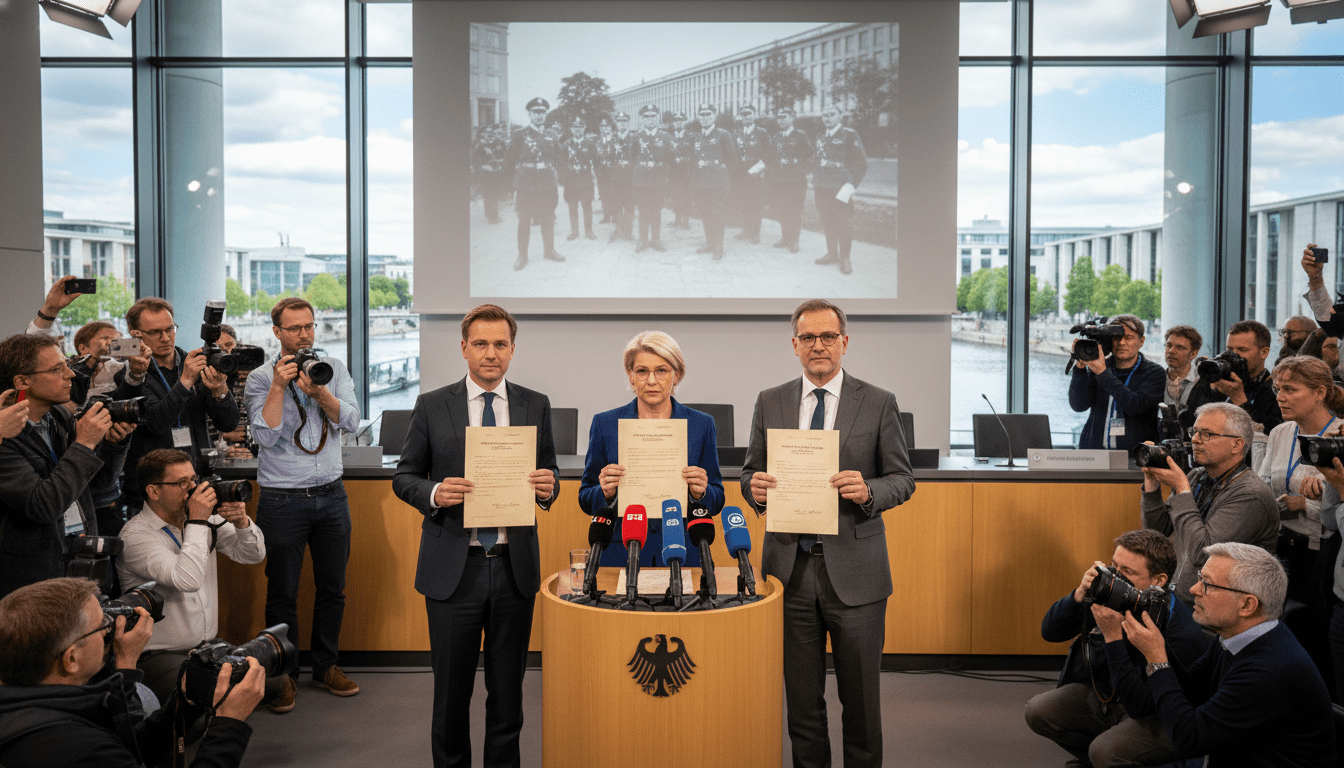
NSDAP membership records stir politicians as Künast, Lauterbach and Ramelow recount family ties
NSDAP membership records have resurfaced in public debate after recent research prompted former ministers Renate Künast and Karl Lauterbach, together with Bundestag Vice President Bodo Ramelow, to speak about unexpected family connections and the emotional impact of the findings.
The renewed scrutiny of NSDAP membership records has led to a wave of personal disclosures from political figures who say the registry contains names linked to their families. Those revelations have reignited familiar questions about historical memory, archival access and the responsibilities of public institutions to document the Nazi past.
New findings in NSDAP membership records
Recent examinations of NSDAP membership records have identified entries that intersect with family histories of serving and former politicians. Researchers locating those names say the discoveries are not uniform in their implications, ranging from distant, incidental connections to more direct associations with local Party structures.
The resurfacing of these records comes amid broader digitization and scholarly efforts to make historical documentation more widely accessible. Archivists warn that name matches in the ledger do not automatically indicate ideological continuity and must be interpreted within wider historical context.
Renate Künast on family revelations
Renate Künast told interviewers she was unsettled by the discovery of a relative’s name in the files and used the moment to reflect on generational responsibility. She emphasized the need to distinguish between individual choices and broader social pressures that shaped lives under National Socialism.
Künast urged that the public conversation remain grounded in rigorous historical inquiry rather than partisan exploitation. She called for better support for families and researchers to understand the precise circumstances behind entries in the NSDAP membership records.
Karl Lauterbach reflects on ancestral ties
Karl Lauterbach framed the findings as a reminder of how the Nazi era continues to surface in contemporary life, even for those in public office. He described the personal unease that arose when a family connection appeared in the registry and said it reinforced his commitment to evidence-based historical work.
Lauterbach also proposed that public institutions should assist citizens in accessing and interpreting archival records. He cautioned against drawing simplistic moral judgments from registry listings without corroborating documents or contextual explanation.
Bodo Ramelow recounts discovery
Bodo Ramelow, serving as a Bundestag Vice President, related that the registry entries prompted careful discussions within his family. He recounted the logistical and emotional effort required to trace how a name in the ledger fit into the wider tapestry of local and regional history.
Ramelow used his experience to press for expanded archival outreach, arguing that families bereft of expert guidance might misunderstand or sensationalize records found in the NSDAP membership files. He called for historians to play a central role in helping the public navigate those discoveries.
Political fallout and calls for transparency
The public responses by Künast, Lauterbach and Ramelow have spurred renewed political debate about access to Nazi-era records and the responsibilities of state archives. Some politicians and civic groups are urging clearer standards for how membership data is released and contextualized for non‑specialist audiences.
Opponents of immediate, broad-based disclosure warn of privacy concerns and the risk of misinterpretation that could fuel polarization. Proponents counter that transparency is essential to reckon honestly with the past and to prevent denial or revisionism.
Historians and archivists weigh in
Academic historians emphasize that NSDAP membership records are a crucial source but not a self-contained verdict on individual behavior. They argue for systematic, annotated releases of the files accompanied by explanatory guides, so researchers and families can distinguish between nominal membership and active participation in crimes.
Archivists stress the technical and ethical challenges of digitizing and publishing large ledger collections. Proper metadata, cross-referencing with other archival holdings and a framework for provenance are cited as necessary steps to avoid misreading entries in the NSDAP membership records.
The debate has also highlighted funding and staffing needs for regional archives, which hold a substantial portion of the relevant material. Experts say investment would improve both public access and the quality of historical interpretation.
Public institutions face a balancing act between transparency, historical accuracy and protection of living descendants’ privacy. The disclosures prompted by the NSDAP membership records have underscored how archival research can reopen family narratives and provoke broader civic discussion.
The reactions from Künast, Lauterbach and Ramelow mirror a larger national conversation about how societies remember and document contentious chapters of history, and they have prompted renewed calls for careful, contextualized access to records that continue to shape public memory.
